If OPEC+ Lifts Voluntary Production Cuts
Oil Prices Could Plunge Over 40% from Current Levels
There is an analysis that if OPEC Plus (+), known as the "oil cartel," lifts its voluntary production cut measures, crude oil prices could plummet to $40 per barrel next year.
On the 12th (local time), according to the US economic media CNBC, Tom Kloza, Global Head of Energy Analysis at oil price information service provider OPIS, recently analyzed, "The fear of downward pressure on oil prices in 2025 is greater than any year since the Arab Spring."
On that day, the front-month December delivery West Texas Intermediate (WTI) crude oil on the New York Mercantile Exchange closed at $68.12 per barrel, up 0.12% from the previous session. WTI has fallen about 6% over the past two trading days due to a strong dollar and concerns over reduced demand from China. The prospect of oil prices dropping to $40 per barrel next year means a plunge of more than 40% from the current WTI price.
The Organization of the Petroleum Exporting Countries (OPEC) and the non-OPEC major oil-producing countries group OPEC+ have been maintaining production cuts since increasing output in August 2022 to support oil prices. The voluntary production cut measure, amounting to an average of 3.66 million barrels per day allocated to all OPEC+ member countries, will continue until next year. Additional voluntary cuts averaging 2.2 million barrels per day by eight OPEC+ countries including Saudi Arabia and Russia will continue until the end of this year.
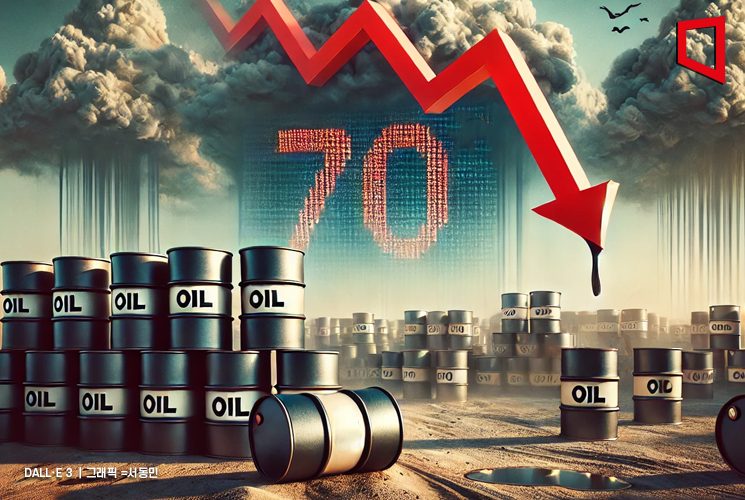
The outlook for crude oil demand next year is not very bright. On this day, OPEC lowered its global oil demand forecast for next year for the fourth consecutive month in its monthly report. OPEC reduced the expected increase in oil demand next year from 1.64 million barrels per day to 1.54 million barrels per day. This is due to growing concerns that domestic demand in China, the largest oil consumer, will not easily recover despite stimulus measures. Meanwhile, oil-producing countries outside OPEC+, such as the United States, Canada, Brazil, and Guyana, are preparing to increase oil supply.
Therefore, if OPEC+ begins to gradually lift production cut restrictions, an oversupply could occur in the market, causing oil prices to crash. Saul Kavonic, Senior Energy Analyst at MST Marquee, predicted, "If OPEC+ lifts cuts regardless of demand, a price war over market share will effectively break out, and oil prices could reach the lowest levels unseen since the COVID-19 global pandemic."
Francesco Martoccia, Energy Strategist at Citibank, said, "The market consensus is that significant oil inventories will accumulate next year."
Even if OPEC+ extends its voluntary production cut measures, the prevailing view is that oil prices will remain weak in the future. Citigroup expects the global benchmark Brent crude oil price to average $60 per barrel next year.
The return of the Trump administration in the US next year is also cited as a factor for weak oil prices. Donald Trump, during his candidacy, pledged to implement "Drill, Baby, Drill" from his first day in office to halve energy prices. Matt Smith, Senior Oil Analyst at energy logistics company Kpler, analyzed, "(For Trump's pledge to be realized,) oil prices would need to fall below $40 per barrel."
© The Asia Business Daily(www.asiae.co.kr). All rights reserved.
!["The Woman Who Threw Herself into the Water Clutching a Stolen Dior Bag"...A Grotesque Success Story That Shakes the Korean Psyche [Slate]](https://cwcontent.asiae.co.kr/asiaresize/183/2026021902243444107_1771435474.jpg)
















