A Total of 9.74 Million Tons in the Last 5 Years... Gyeonggi 4.25 Million Tons · Seoul 3.6 Million Tons
Moon Se-jong, Incheon City Council Member, "Seoul and Gyeonggi Have Become Garbage Dumps"
It has been revealed that 80% of the waste brought into the Sudokwon Landfill Site in Seo-gu, Incheon, originated from Seoul and Gyeonggi Province.
According to data obtained from Incheon City by Moon Se-jong, a member of the Industrial Economy Committee of the Incheon City Council (Democratic Party, Gyeyang 4), the total amount of waste brought into the Sudokwon Landfill Site over five years from 2020 to September this year was 9,745,341 tons.
Of this, 4,257,234 tons, accounting for 43.68%, were sent from 29 cities and counties in Gyeonggi Province, and 3,600,033 tons of waste brought from 25 districts in Seoul accounted for 36.94% of the total. The amount of waste sent from 10 districts and counties in Incheon to the Sudokwon Landfill Site was the smallest at 1,888,072 tons, or 19.37%.
Regarding household waste, which will be banned from direct landfill starting in 2026, the total amount during the same period reached 3,142,163 tons, with Seoul accounting for 1,385,154 tons (44.08%), Gyeonggi 1,363,329 tons (43.39%), and Incheon 393,680 tons (12.53%).
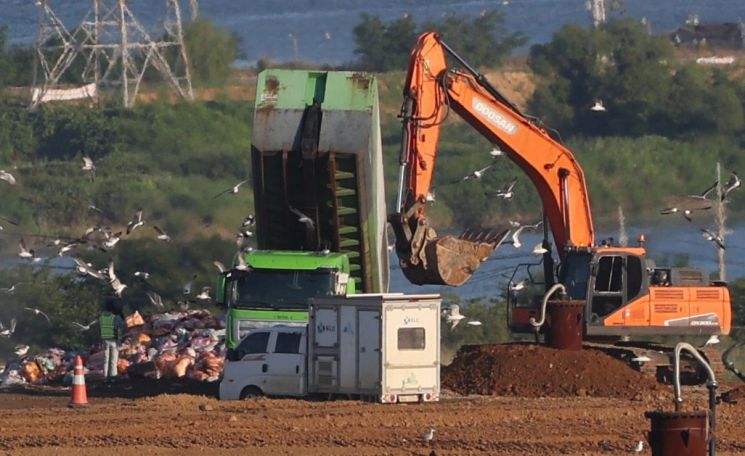 Garbage landfill work is being carried out at the 3-1 landfill site of the Seoul Metropolitan Landfill in Seo-gu, Incheon. Photo by Yonhap News
By region, in Seoul, seven districts sent over 100,000 tons of waste to the Sudokwon Landfill Site: Gangseo-gu (598,506 tons), Seongdong-gu (234,427 tons), Geumcheon-gu (185,229 tons), Songpa-gu (178,694 tons), Eunpyeong-gu (178,694 tons), Gwangjin-gu (153,977 tons), and Gwanak-gu (101,676 tons).
In Gyeonggi Province, Goyang-si had the highest amount at 594,775 tons, followed by Gimpo-si (584,690 tons), Anseong-si (313,010 tons), Bucheon-si (285,723 tons), and Namyangju-si (268,998 tons), with 13 local governments exceeding 100,000 tons. In Incheon, Seo-gu, where the Sudokwon Landfill Site is located, sent the largest amount of 843,708 tons to the landfill, and five districts including Namdong-gu (178,694 tons), Dong-gu (136,010 tons), Michuhol-gu (114,802 tons), and Jung-gu (101,665 tons) exceeded 100,000 tons.
Assemblyman Moon stated, "These figures show that the main users of the Sudokwon Landfill Site in Incheon are citizens of Seoul and Gyeonggi Province," and criticized, "The current Sudokwon Landfill Site has degenerated into a garbage dump for Seoul and Gyeonggi Province, ignoring the 'principle of treatment at the place of generation'." He added, "Incheon, which only looks to the four-party agreement with these local governments, expecting cooperation for the closure of the Sudokwon Landfill Site and the creation of an alternative landfill site, should reflect on itself."
Meanwhile, the Ministry of Environment and the cities of Incheon, Seoul, and Gyeonggi Province have held three rounds of public contests to find alternative landfill sites to replace the current Sudokwon Landfill Site but have failed. Although conditions will be relaxed and benefits enhanced for a re-contest, doubts remain whether any local government will readily step forward.
Mayor Yoo Jeong-bok of Incheon has stated that if the fourth contest also fails, alternative methods to find candidate sites should be pursued rather than holding another contest. Within the Incheon community, voices are emerging that President Yoon Seok-yeol should promptly implement his campaign pledge to establish a dedicated agency for the Sudokwon Landfill Site under the Prime Minister's Office.
The "Sudokwon Landfill Site Problem Resolution Pan-Citizen Movement Headquarters," composed of 23 organizations including the Incheon Federation of Economic Organizations, urged, "President Yoon pledged to entrust the landfill site issue to the Prime Minister's Office to secure an alternative landfill site," and called for "mediation centered on a dedicated agency and the preparation of measures such as expanding incentives."
© The Asia Business Daily(www.asiae.co.kr). All rights reserved.

















