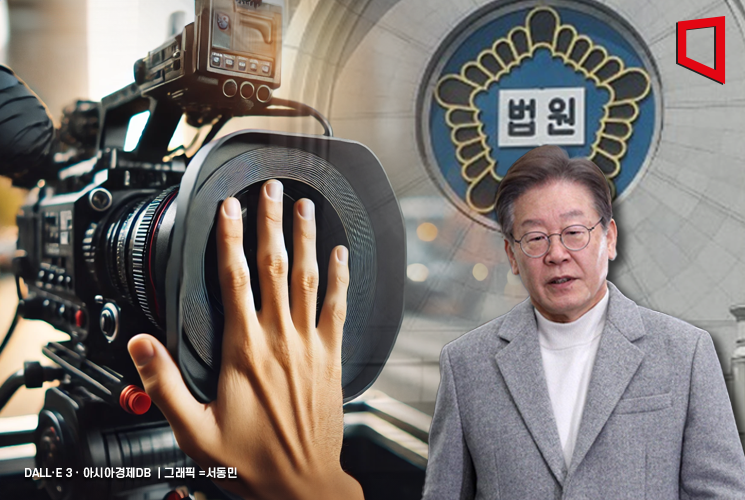
The first trial verdict hearing for Lee Jae-myung, leader of the Democratic Party of Korea, on charges of violating the Public Official Election Act, scheduled to be held at 2:30 PM on the 15th, will not be broadcast live on TV.
The Seoul Central District Court announced on the 13th that the 34th Criminal Division of the Seoul Central District Court (Chief Judge Han Seong-jin), which is handling the trial of Lee Jae-myung’s case, has decided not to conduct filming or live broadcasting of the verdict announcement after comprehensively considering the related legal interests.
This case involves allegations that Lee made false statements to win the 2022 presidential election. It is the earliest of the four trials Lee is facing, having been indicted in September 2022, and the first trial verdict is expected after two years and two months since the indictment.
Specifically, the charges relate to Lee’s statements during a broadcast interview denying acquaintance with Kim Moon-gi, former Head of Development Division 1 at Seongnam Urban Development Corporation, and his remarks at the Gyeonggi Province National Assembly audit suggesting that the land use change for the Baekhyeon-dong development site was approved due to threats from the Ministry of Land, Infrastructure and Transport. These statements are alleged to be false facts made to win the election.
Meanwhile, regarding filming or live broadcasting in court, Article 59 of the Court Organization Act (Prohibition of Recording, etc.) stipulates that "No one shall record, film, or broadcast live inside the courtroom without the permission of the presiding judge," allowing filming or live broadcasting only with the judge’s approval.
Additionally, Article 4, Paragraph 1 of the Supreme Court Rules on Courtroom Attendance and Filming, which details these matters, states that "Anyone seeking permission from the presiding judge under Article 59 of the Court Organization Act must submit an application specifying the purpose, type, subject, time of the filming, and the name of the affiliated institution or individual by the day before the trial date."
Paragraph 2 of the same article provides that "The presiding judge may grant permission for the application only when the defendant (or plaintiff or defendant appearing in court) consents. However, regardless of the defendant’s (or plaintiff’s or defendant’s) consent, permission may be granted if it is deemed reasonably necessary for the public interest." In principle, the presiding judge can permit filming or live broadcasting inside the courtroom only with the consent of the criminal defendant or civil trial parties, but exceptionally, the judge may allow it without their consent if it is for the public interest.
So far, there have been only three instances of live broadcasts of lower court trials, none involving the Supreme Court. These were the April 2018 sentencing of former President Park Geun-hye in the state affairs manipulation case, the July 2018 trial of Park for receiving special activity funds from the National Intelligence Service and interfering in party nominations, and the October 2018 first trial of former President Lee Myung-bak on embezzlement and bribery charges.
Previously, ruling party figures such as People Power Party leader Han Dong-hoon have advocated for the live broadcast of Lee’s verdict hearing. The People Power Party’s Legal Advisory Committee even submitted a petition to the Seoul Central District Court requesting live coverage.
On the other hand, the Democratic Party and others have opposed it, calling it a "public shaming" tactic and a violation of human rights.
© The Asia Business Daily(www.asiae.co.kr). All rights reserved.

















