High-tech Manufacturing Shipment Share in Region 6.1%, Far Below National 24.0%
Foreign Technology Competitiveness Higher in Low-tech Industries than High-tech Industries
R&D Investment and Research Personnel Share Higher in High-tech Industries than Mid- to Low-tech Industries
The technological level of manufacturing industries in the Busan region shows a significantly lower proportion of high-technology sectors, while the proportion of medium- and low-technology sectors is relatively high.
It is analyzed that business restructuring to strengthen technological innovation capabilities must be expedited to increase the added value of regional manufacturing industries.
Busan Chamber of Commerce and Industry (Chairman Yang Jae-saeng) conveyed this on the 13th through the survey report titled ‘Trends and Challenges of Technological Levels in Busan’s Manufacturing Industry.’ This report is based on the classification of manufacturing technology levels by the Korea Institute for Industrial Economics and Trade and includes a field survey of 375 major manufacturing companies in the region.
According to the report, the proportion of shipments from high-technology manufacturing industries in Busan was 6.1%, significantly lower than the national average of 24.0%. In particular, it showed a large gap compared to major cities such as Daejeon (27.2%), Gwangju (26.8%), Incheon (19.2%), Daegu (17.4%), and Seoul (16.3%).
This is because there are almost no high-technology companies with recent growth potential such as semiconductors, secondary batteries, and pharmaceuticals in the region, and the sales scale of Busan’s high-technology sectors like medical and precision instruments and aircraft parts is very small compared to other industries in the region. On the other hand, the proportion of shipments from low-technology manufacturing industries such as food products and textiles was 19.1%, exceeding the national average of 12.7%.
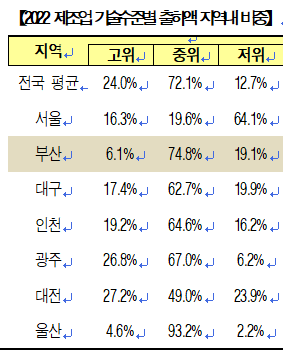 2022 Shipment Amount by Manufacturing Technology Level Regional Share.
The shipment value of machinery parts and materials industries, classified as medium-technology sectors such as steel and machinery, was 74.8%, ranking fifth highest nationwide. This is because the entire southeastern region, including Busan, forms the largest machinery parts and materials cluster in Korea.
Unlike Busan, Gyeonggi and Chungbuk, where new growth manufacturing industries have recently concentrated, show a relatively balanced sales scale between medium- and high-technology sectors. Therefore, it is analyzed that there is a significant need for business restructuring of medium-technology manufacturing companies, which have a high regional proportion in Busan.
The survey results confirmed that for domestic and international technological competitiveness, high-technology sectors have higher domestic competitiveness than overseas, whereas low-technology sectors have comparable competitiveness both domestically and internationally.
In fact, among companies belonging to high-technology sectors, 50% responded that their domestic competitiveness is high, but only 25% said their overseas competitiveness is high.
In contrast, for low-technology sectors, 40% said their domestic competitiveness is high, and 37.5% responded that their overseas competitiveness is also high, indicating that low-technology companies lead in global technological competitiveness.
This is because many regional high-technology companies are latecomers with shorter business histories compared to global advanced companies, while traditional regional industries such as footwear and textiles, which belong to low-technology sectors, have long been recognized overseas for their domestic technological development capabilities through early separation of manufacturing and research functions.
In the R&D field, the gap was also prominent according to technological level. Companies investing more than 5% of their sales in research and development were 35% in high-technology sectors, 4% in medium-technology sectors, and none in low-technology sectors. Regarding R&D personnel, companies employing R&D staff accounting for more than 5% of total employees were 75% in high-technology sectors, but only 6% and 3% in medium- and low-technology sectors, respectively.
A representative of the Busan Chamber of Commerce and Industry’s research team stated, “Since companies with high technological levels have significant effects on employment, sales, and value-added creation, it is necessary to improve the industrial structure by fostering high value-added advanced industries.” He added, “To this end, a control tower that comprehensively supports business restructuring of regional manufacturing industries should actively support individual companies’ business restructuring needs such as entry into new industries, digital transformation, and carbon neutrality.”
© The Asia Business Daily(www.asiae.co.kr). All rights reserved.

















