Dollar Index Hits Highest Level in 6 Months
Global Countries Anticipate Tightening Amid Strong Dollar

Will 'Super Trumpism' stop countries around the world from cutting interest rates?
Due to the strong US dollar following the election of Donald Trump as US president, there is a growing consensus that countries worldwide, which had pivoted their policies earlier this year, will reconsider their stance on interest rate cuts.
According to the British weekly The Economist on the 13th, a strong dollar is an obstacle to central banks around the world lowering interest rates. Generally, a rising dollar is coupled with a weakening outlook for global economic growth.
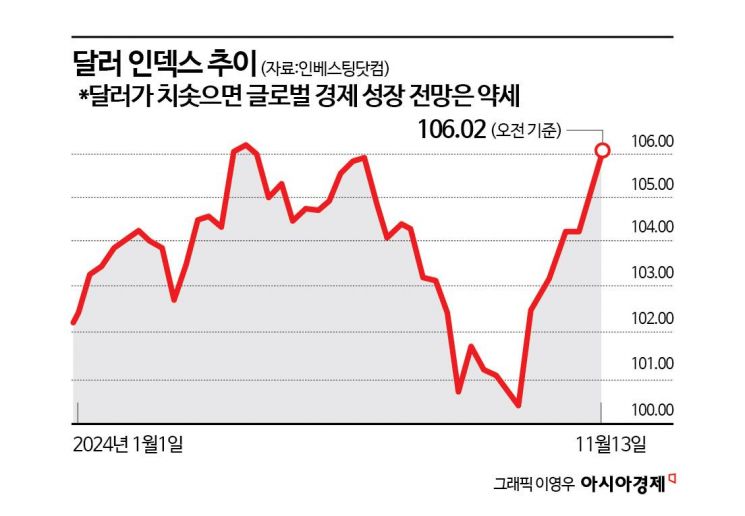
The dollar index, which measures the value of the US dollar against the currencies of six major countries, recorded 106.02 that morning. Surpassing the 106 mark, it reached its highest level in over six months since May. As a result, most major currencies weakened. At the same time, the price of one euro in dollars fell to $1.0617, marking its lowest point since November last year.
The dollar's strength arose amid growing expectations that President-elect Trump will implement policies prioritizing his own country, including imposing high tariffs on countries with trade surpluses with the US. The US economic media CNBC, citing a Goldman Sachs report, stated, "Trump is focused on reducing the US trade deficit, so Asian countries such as South Korea and Taiwan could face tariff threats similar to those imposed on China."
This year can hardly be called anything other than the year of the global pivot, as many countries began cutting interest rates. The Federal Reserve (Fed), the major central bank, implemented a 'big cut' (a 0.50 percentage point rate cut) last September and lowered rates again this month. The European Central Bank (ECB) also cut rates for two consecutive months in October and November following its pivot in June. After Switzerland, the UK, Canada, Sweden, and New Zealand, South Korea also began its pivot last month.
However, The Economist stated, "When countries worldwide are experiencing an overall trade downturn due to a strong dollar, central banks may turn to tightening monetary policy." According to an International Monetary Fund (IMF) report released last year, if the dollar's value rises by 10%, emerging market production decreases by 1.9 percentage points and advanced economies by 0.6 percentage points after one year. When the dollar strengthens, importers face higher costs, reducing demand for foreign goods and thus decreasing overall trade volume. More than 40% of global trade is conducted in dollars. The Economist also reported, "Research shows that a 1% increase in the dollar's value against all currencies results in a 0.6% decrease in trade between countries worldwide." Additionally, the dollar's rise increases borrowing costs for governments and companies, which is another factor delaying interest rate cuts.
The Fed, which prioritizes price stability, is widely expected to slow the pace of interest rate cuts. This is because President-elect Trump's promises of high tariffs, various tax cuts including income and corporate tax reductions, and anti-immigration policies are expected to ultimately stimulate inflation. Global credit rating agency Moody's forecasts that if a 'red sweep' occurs, with the Republican Party controlling both the executive and legislative branches, US inflation will rise from 3% in 2024 to 3.6% next year. Loretta Mester, former president of the Cleveland Federal Reserve Bank, said at the annual UBS Europe Conference held in London the day before, "The number of rate cuts next year will not be as many as expected last September."
Since the dollar plays the role of a 'key currency,' central banks worldwide are also expected to adjust the pace of interest rate cuts accordingly. This is closely related to concerns about attempts by President-elect Trump to interfere with the Fed's independence. Former Governor of the Reserve Bank of India Raghuram Rajan recently criticized, "(Trump's) interference with the Fed is a self-inflicted risk." If political powers, conscious of voter sentiment, intervene in monetary policy, there is a greater incentive to cut rates for short-term economic stimulus, which can eventually lead to high inflation and necessitate tightening. During a press conference in August while he was a candidate, President-elect Trump said, "I think the president should at least have a say there (at the Fed)," openly confronting the Fed, an independent agency of the executive branch.
© The Asia Business Daily(www.asiae.co.kr). All rights reserved.


















