Large-scale Selling by Foreigners and Institutions... Clear Capital Outflow from Stock Market
Sharp Decline in Major Semiconductor Stocks like Samsung Electronics and SK Hynix
All Sectors Except Construction End Lower
The KOSPI closed below the 2500 mark for the first time since the 'Black Monday.' The outflow of funds from the relatively sluggish domestic stock market has accelerated amid the boom in the U.S. stock market and virtual assets, making the 'Korea Run' (investor capital flight from the Korean market) a reality.
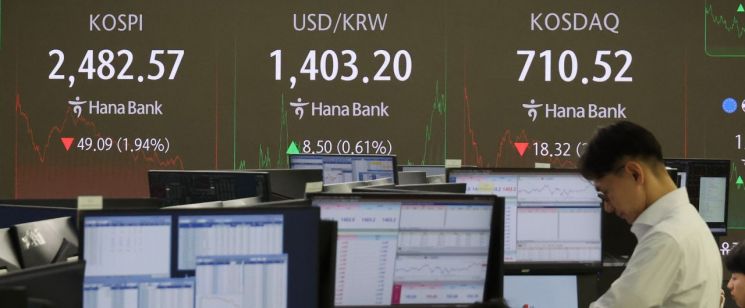
On the 12th, the KOSPI closed at 2482.57, down 49.09 points (1.94%) from the previous session. The KOSPI opened at 2527.94, down 3.72 points from the previous trading day, reached an early high of 2532.44, and then turned downward. After breaking below the 2500 level, selling pressure intensified in the afternoon, pushing it down to the 2480 level. This is the first time in 99 days since August 5, known as 'Black Monday,' that the KOSPI closed below 2500.
By investor type, individual investors alone bought 333.4 billion KRW. In contrast, foreigners sold 234.4 billion KRW, and institutions sold 109.5 billion KRW net.
Among the top 10 market capitalization stocks, all except LG Energy Solution (2.64%) and NAVER (3.07%) declined. LG Energy Solution, classified as a Tesla-related stock that has been blazing in the U.S. stock market, showed an upward trend after news emerged that it would supply auxiliary power and batteries for power supply to SpaceX spacecraft. On the other hand, the 'blue-chip' Samsung Electronics fell 3.64%, continuing its 52-week low rally, and SK Hynix (3.53%) also declined alongside. Additionally, stocks classified as Ukrainian reconstruction stocks?Beomyang Geonyeong, Ilseong Construction, Namgwang Togeon, and TYM?closed at the upper limit. This is due to the influence of the 'Trump Trade.'
By sector, only construction (0.09%) rose, while all others closed lower. In particular, medical precision (-4.01%), pharmaceuticals (-3.23%), electric and gas utilities (-2.56%), electrical and electronics (-2.28%), manufacturing (-2.19%), chemicals (-2.07%), textiles and apparel (-2.04%), and machinery (-1.98%) fell more sharply than the index.
Lee Jaewon, a researcher at Shinhan Investment Corp., said, "U.S. semiconductors showed weakness alongside TSMC's export restrictions to China, and concerns arose that Samsung Electronics would also face export restrictions on foundry processes below 7nm to China." He added, "With the Red Wave (Republican control of the White House and both houses of Congress), the approaching high interest rates, strong dollar fears, and continued foreign capital outflows, selling pressure focused on large-cap stocks persisted." The researcher noted, "This week, attention will be on indicators (CPI, coincident indicators) that will determine the extent of the December Federal Open Market Committee (FOMC) rate cut."
The KOSDAQ index closed at 710.52, down 18.32 points (2.51%) from the previous day.
By investor type, individuals bought 16.5 billion KRW, but foreigners and institutions sold 4.1 billion KRW and 7 billion KRW net, respectively.
185 stocks rose, 1464 stocks fell, and 37 stocks remained unchanged. Among the top 10 market cap stocks, all except EcoPro (0.78%), EcoPro BM (0.13%), and Enchem (0.46%) closed lower. These three stocks share the commonality of being related to secondary batteries and battery sectors. Ligakem Bio (-5.29%), Hugel (-3.56%), Samchundang Pharmaceutical (-3.14%), and Classys (-3.28%) closed with declines exceeding 3%.
© The Asia Business Daily(www.asiae.co.kr). All rights reserved.

















