'Higher Proportion of Men Say "Must Get Married"
Common-Law Marriages and Childbirth Also Increasing
Average Ideal Number of Children is 1.89
Family Relationship Satisfaction Rises Compared to 2 Years Ago
Only 23.3% of Wives Report "Fair Household Chore Sharing"
Wives Lead Household Chores at Over 70%
The proportion of people who think they should get married has increased compared to two years ago. The number of people who believe that having children is necessary after marriage has also risen. At the same time, it is noteworthy that more people believe that even without marriage, they can live together and have children. The most effective measures to address low birth rates were identified as housing support and youth job support.
 A soon-to-be newlywed couple participating in a wedding photo shoot event at Choansan Hydrangea Hill in Nowon-gu, Seoul, last July. This image is unrelated to the article content.
Men think about marriage more than women... Differences in views widen among singles
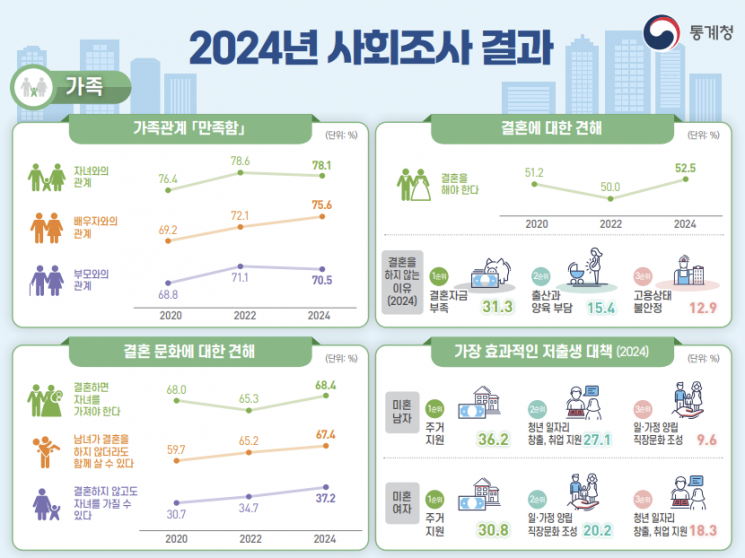
According to the "2024 Social Survey Results" released by Statistics Korea on the 12th, overall satisfaction with family relationships was 63.5%, down 1.0 percentage point compared to two years ago. Satisfaction with relationships with children and parents decreased, while satisfaction with relationships with spouses increased. In particular, satisfaction with relationships with spouses was 80.5% among men, 9.8 percentage points higher than women.
The proportion of people who think household chores should be shared fairly was 68.9%, up 4.2 percentage points from two years ago. The proportion who think wives should lead household chores also fell by 4.3 percentage points to 29.0%. However, the proportion of wives who responded that chores are actually shared fairly was only 23.3%. The proportion who said wives lead household chores remained high at the 70% level.
The proportion of people who think they should get married was 52.5%, up 2.5 percentage points from two years ago. Men were 11.5 percentage points more likely than women to think marriage is necessary, and among single men and women, the difference in views widened to 15.6 percentage points compared to two years ago.
The proportion of people who think having children is necessary after marriage was 68.4%, up 3.1 percentage points from two years ago. Men showed a proportion 8.7 percentage points higher than women. The ideal number of children per family was most frequently answered as 2 (66.9%), followed by 1 (19.2%). On average, it was 1.89 children, decreasing among younger age groups.
The proportion of people who think men and women can live together without marriage was 67.4%, up 2.2 percentage points from two years ago. This proportion has been steadily increasing since 2012 (45.9%). The proportion who think children can be born without marriage also rose by 2.5 percentage points to 37.2%, continuing the upward trend since 2012 (22.4%).
The most common reason for not marrying was lack of marriage funds (31.3%), which increased by 2.6 percentage points compared to two years ago. Other reasons included the burden of childbirth and child-rearing (15.4%) and unstable employment status (12.9%). Among single men and women, men mainly mentioned unstable employment status (12.4%), while women responded that they did not feel the need to marry (19.1%).
The most effective measures to address low birth rates were housing support (33.4%), youth job support (20.8%), and creating a workplace culture that balances work and family life (14.0%). Both single men and women mentioned housing support as the most urgent measure, but while men chose youth job support next, women selected creating a workplace culture that balances work and family life.
Increased burden of children's education expenses... Proportion of responses about social insecurity expands
The proportion of middle and high school students who responded that they are satisfied with their overall school life was 57.3%, up 6.2 percentage points from two years ago. The main reason middle and high school students study was to get a good job (74.9%), followed by admission to their desired university (63.5%), meeting the expectations of people around them (47.4%), and wanting to study better than other friends (38.2%).
The proportion of households responding that children's education expenses are a burden on household finances was 60.9%, up 3.2 percentage points from two years ago. The proportion of people who participated in education or training through information and communication networks such as the internet (mobile) in the past year was 41.7%, up 2.1 percentage points from two years ago.
Overall, the proportion of people who responded that their health status is good was 53.8%, up 0.7 percentage points from two years ago. The proportion practicing regular exercise and regular health checkups increased compared to two years ago, but the proportion having breakfast and getting adequate sleep decreased.
The proportion of people experiencing stress in daily life was 38.4%, down 6.5 percentage points from two years ago. Stress from family life decreased by 0.2 percentage points, but stress from school life increased by 0.1 percentage points.
The proportion of people who feel that society is generally safe was 28.9%, down 4.4 percentage points from two years ago. Compared to five years ago, the proportion who felt society had become safer was 21.9%, down 10.4 percentage points, and the proportion who believe society will be safer in five years was also 22.9%, down 9.7 percentage points.
The biggest social anxiety factor was crime (17.9%). Following that were economic risks (16.5%), national security (16.2%), and environmental pollution (10.0%). The proportion who felt anxious when walking alone at night was 30.5%, with women (44.9%) feeling more anxious than men (15.8%) during nighttime walking.
The proportion of people who felt that the overall living environment in their current area was good was 49.4%, down 0.3 percentage points from two years ago. Among environmental issues, the areas causing anxiety were fine dust (67.4%), climate change (53.2%), radiation (47.5%), and harmful chemicals (41.9%).
Statistics Korea conducted a survey in May targeting about 36,000 household members aged 13 and older residing in approximately 19,000 sample households nationwide and announced the results of this social survey. The social survey is conducted every two years and covers family, welfare, education and training, social participation, health, leisure, and other areas.
© The Asia Business Daily(www.asiae.co.kr). All rights reserved.


















