Recent Study Reveals Details of Changgyeonggung Octagonal Seven-Story Stone Pagoda
Possibility of Relocation to National Palace Museum Annex Gains Attention
"Considering Relocation Due to Its Status as Chinese Cultural Heritage, Not Korean Artwork,
and Its Buddhist Art Character Different from Joseon Palaces"
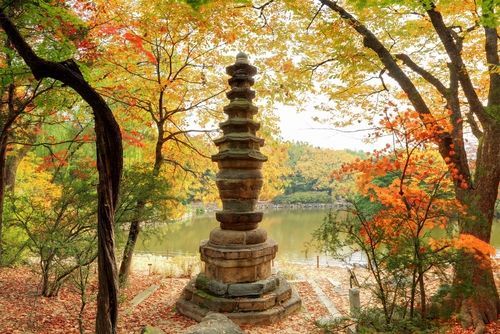 Changgyeonggung Octagonal Seven-story Stone Pagoda. Provided by the Cultural Heritage Administration National Heritage Portal
A research result has emerged suggesting that the treasure stone pagoda located inside Changgyeonggung Palace, a Joseon Dynasty royal palace, was likely relocated during the Japanese colonial period to decorate the palace. Attention is focused on whether plans to relocate the pagoda will be considered, taking into account the historical significance of the Joseon Dynasty.
According to the Cultural Heritage Administration on the 12th, the Industry-Academic Cooperation Group of Dongguk University (lead researcher Kim Min-gyu) recently submitted a report titled 'Historical Verification Study on Stone Structures within Changgyeonggung Palace' to the Royal Palaces and Tombs Division. The research team, led by Kim Min-gyu, a cultural heritage expert specializing in Joseon Dynasty stone art history, investigated the creation background and installation period of major stone structures, including the treasure "Changgyeonggung Octagonal Seven-story Stone Pagoda."
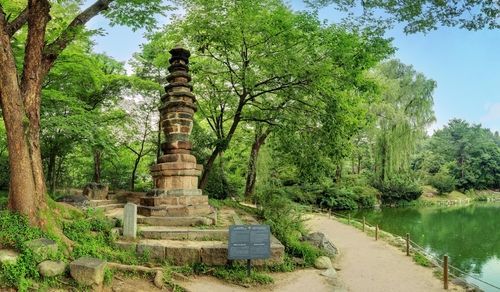 Changgyeonggung Octagonal Seven-story Stone Pagoda. Provided by the Cultural Heritage Administration National Heritage Portal
The Changgyeonggung Octagonal Seven-story Stone Pagoda, erected next to Chundangji Pond in Changgyeonggung, is the only Chinese stone pagoda in Korea. There are theories that it was either brought over from the Ming Dynasty in China or purchased from a merchant from Manchuria when the Yi Royal Family Museum was established inside Changgyeonggung during the early Japanese colonial period.
Based on the inscription carved on the first-story body stone, the research team estimated that it is "a work built during the lifetime of a person named Jeong Ok-am in 1470 in the city of Liaoyang in the Ming Dynasty." They explained, "The individual held the Buddhist official position called 'Dogang' and built it for his longevity," adding, "The pagoda shows the same form and manufacturing method as pagodas in the Liaoyang region." Furthermore, they noted, "It was relocated between 1913 and 1929 for landscaping purposes in Changgyeonggung, and this landscaping method originated in Japan."
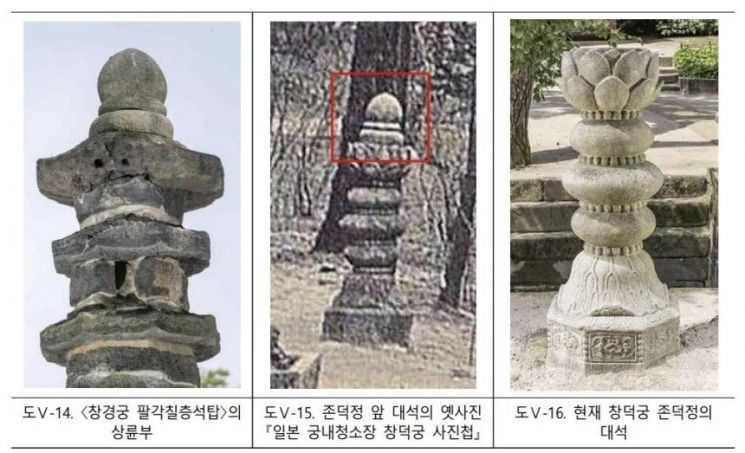 Comparison of the top part and the base stone of the Octagonal Seven-story Stone Pagoda at Changgyeonggung Palace. Provided by the Cultural Heritage Administration
Regarding the finial decoration on top of the pagoda, which appears to have been added later, the team emphasized, "The uppermost component can be considered a Joseon Dynasty work different from the lower pagoda." They argued, based on photo album materials of Changdeokgung Palace held by the Japanese Imperial Household Agency, that "it is presumed to have been placed on a large stone in front of Jondeokjeong Pavilion in Changdeokgung and then put on the pagoda when it was relocated."
The research team also considered the possibility of relocating the Changgyeonggung Octagonal Seven-story Stone Pagoda to another location in the future. They explained, "Since it is a Chinese cultural heritage, not a Korean artwork, and a Buddhist art piece completely different in character from the Joseon royal palace, and because it is currently placed as a feature in a Japanese-style garden, relocation can be considered." Proposed relocation sites include the Changgyeonggung Grand Greenhouse and a branch of the National Palace Museum of Korea scheduled to be established in 2029.
This report is expected to be reflected in the restoration and maintenance plans for Changgyeonggung. A Royal Palaces and Tombs Division official stated regarding the relocation of the Changgyeonggung Octagonal Seven-story Stone Pagoda, "We plan to make a decision after internal review based on the various options presented in the report."
© The Asia Business Daily(www.asiae.co.kr). All rights reserved.



















