The veteran tree has grown and thrived over many years, enduring the wind and rain steadfastly from its position, like a fortress of iron. Now, even if surrounded by three or four grown men, they can barely reach its circumference with their fingertips. It has become a giant towering well above the height of a fourth-floor apartment. No one dared to think of the 'end' of the veteran tree’s grandeur and strength. For decades, people watched over it with the belief that 'it won't be in my generation.' But the time to put a full stop to the veteran tree’s era is drawing near. Six hundred years of time is fading away.
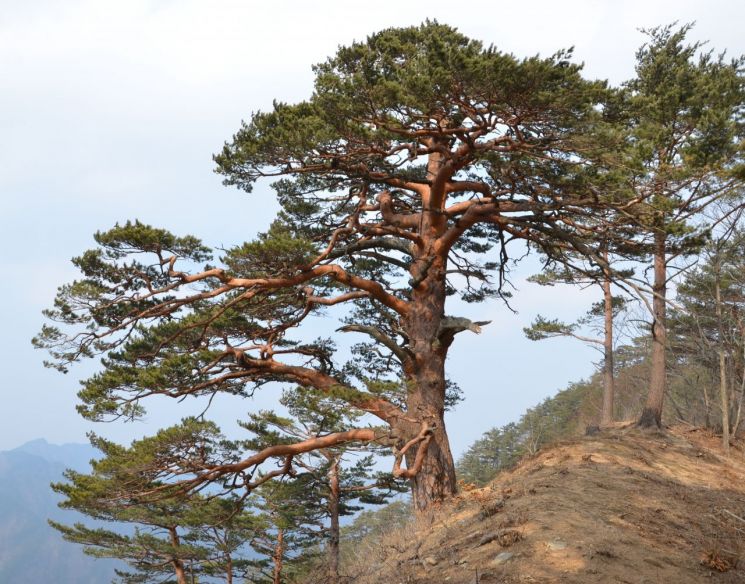 A view of a healthy Daewang Pine before the occurrence of moisture stress and pest damage this summer. Provided by the Korea Forest Service
On the 7th, I encountered the ‘Daewang Pine’ at the summit of Anilwangsan in Uljin. This tree, estimated to be around 600 years old, boasted a magnificent figure with a diameter of 1 meter, a circumference of 5 meters, and a height of 14 meters. Notably, the place where this tree took root is at the edge of a cliff, and the Daewang Pine seemed to be looking down from above at the clustered Geumgang Pines below the cliff. It resembled a monarch (king) overseeing his subjects from a high place. The name ‘Daewang Pine’ is presumed to have been given to capture the tree’s grandeur and this kind of atmosphere.
The summit of Anilwangsan, where the Daewang Pine is rooted, is the apex (turning point) of Section 4 of the Uljin Geumgang Pine Forest Trail. The Uljin Geumgang Pine Forest is designated and managed as a Forest Genetic Resource Protection Area and can only be visited through a reservation-based exploration system. As of last year, a total of about 17,000 people visited the Uljin Geumgang Pine Forest Trail, and among them, about 3,000 visited Section 4, where the Daewang Pine can be seen. This means that one out of every three visitors to the entire trail came to see the Daewang Pine.
However, since around August, access to Section 4 has been restricted, and general public exploration has been controlled. Only a small number of personnel responsible for protecting and managing the Daewang Pine visit this area. The access restriction was implemented to minimize contact with outsiders as the vitality of the Daewang Pine weakened.
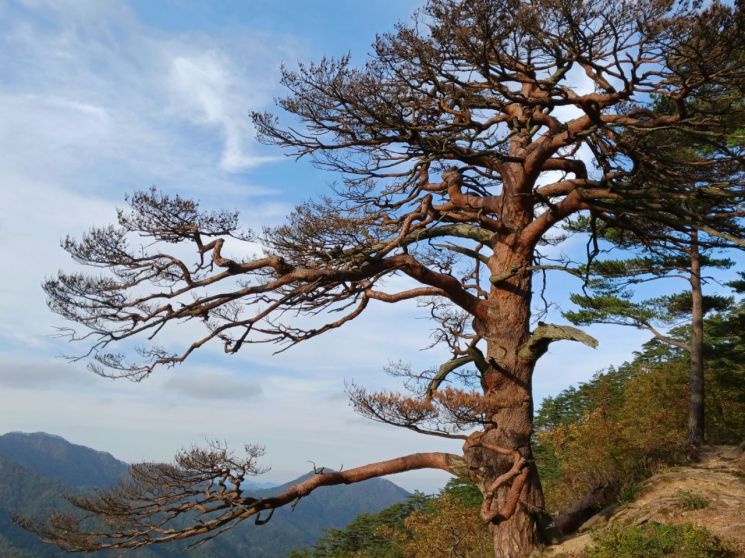 On the 7th, the Daewang Pine tree encountered at the summit of Anilwangsan had only brown leaves that had lost their green color on its bare branches. Experts who visited the site generally concluded that the Daewang Pine had weakened due to the effects of climate change, making it vulnerable to pest and disease damage. Provided by the Korea Forest Service
Around this time, the Daewang Pine’s vitality rapidly declined due to infestation by pests such as pine beetles. The Korea Forest Service restricted access to Section 4 and simultaneously carried out emergency pest control, removal of surrounding dead trees, and nutrient supply to revive the Daewang Pine, but the situation has not improved. Forest experts who visited the site have concluded that it will be difficult to revive the Daewang Pine.
The condition of the Daewang Pine encountered on site was visibly different from other pines at first glance. New needles were not sprouting, and instead of a green hue, the bare branches were covered only with brown-discolored pine needles. Moreover, it was confirmed visually that the discolored needles fell off in clusters when the wind blew. Although its external grandeur remained, it was clear that the tree was lifelessly spending its last moments with all its might.
Several people involved on site unanimously agreed that climate change has had a significant impact on the rapid decline of the Daewang Pine’s vitality. The consensus is that the increased number of hot days in summer and the situation where the tree must endure full sunlight on the cliff created adverse conditions for the Daewang Pine. This year, there was also little rain, causing severe moisture stress. Ultimately, the most convincing explanation is that pests invaded the weakened tree due to climate change, further weakening its vitality.
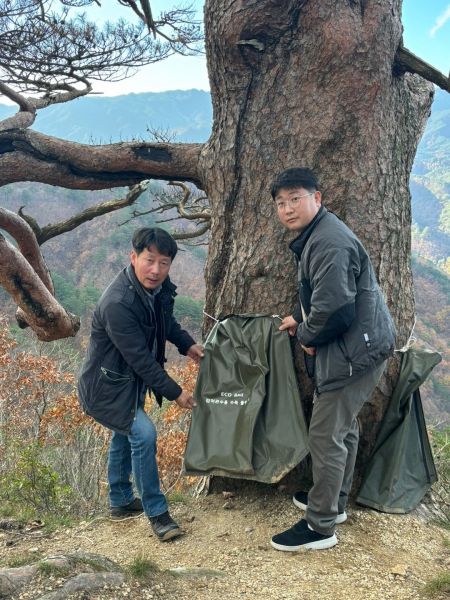 Cheon Dongsu, Officer at the National Sogwangri Forest Ecology Management Center (left), and Park Nojin, Officer at the Korea Forest Service (right), are pointing to the nutrient supply bag installed for administering to the Daewang Pine and explaining the current condition of the Daewang Pine. Photo by Korea Forest Service
Cheon Dongsu (55), an official working at the National Sogwangri Forest Ecology Management Center, said, “Even people who can rest to avoid the heat find it hard to endure, so I can only imagine how much harder it must have been for a tree that cannot escape the blazing sun,” shaking his head. “This summer, when daytime temperatures frequently exceeded 35 degrees Celsius, must have been especially difficult for the Daewang Pine to endure.”
He added, “Many experts who visited the site believe that the Daewang Pine’s vitality deteriorated due to climate change and that it could not overcome pest damage. The continuous scorching heat combined with moisture stress worsened its condition,” conveying the surrounding atmosphere.
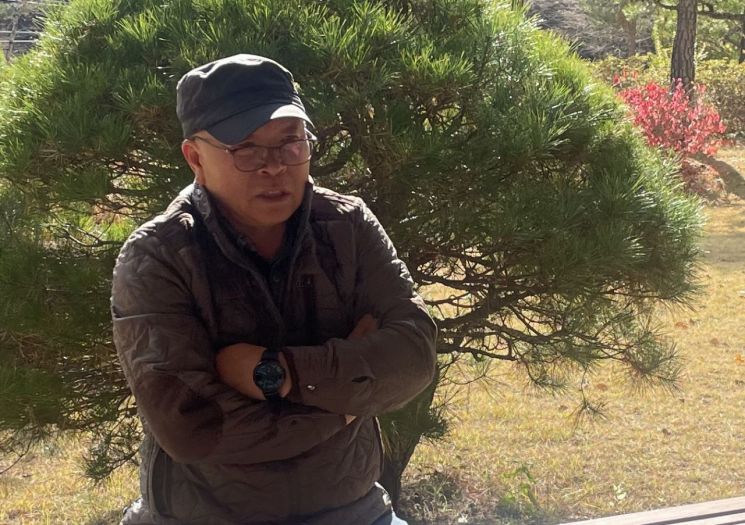 On the 7th, Choi Su-mok, whom we met in Sogwang-ri, Uljin, recalled childhood memories intertwined with the Great Pine Tree and shared old stories. Photo by Korea Forest Service
As news of the Daewang Pine spread quietly, the sense of loss among the residents of Sogwangri, where the Geumgang Pine clusters are located, has only grown. Choi Sumok (65), who was born in Sogwangri and has continuously protected the village to this day, said, “The Daewang Pine, which may be an ordinary tree to some, is a special object of affection for the residents of Sogwangri. Because I grew up seeing it since childhood, memories related to the Daewang Pine still remain, and the recent situation feels awkward and deeply regrettable,” he began.
Mr. Choi recalled the early 1970s when about 100 residents of Sogwangri took turns every year to hold a ritual praying for the village’s peace and prosperity. Although the tree was quite far from the village, the Daewang Pine had been regarded as a spiritual object of the village since then. Although the number of residents sharply decreased after the mid-1980s and the village tradition of holding rituals disappeared for the same reason, the memories remain vivid.
He continued, “The Daewang Pine we visited with the elders when I was young was called the ‘Adult Tree’ in the village. From then until now, I never thought the Daewang Pine would wither in my lifetime. That’s why it pains me every time I see the Daewang Pine dying,” lowering his head.
Sogwangri in Uljin has been designated and protected as ‘Hwangjangbongsan,’ where logging and entry by the general public have been prohibited since the Joseon Dynasty. The Korea Forest Service designated the Daewang Pine as a protected tree in 2014 and has managed it separately for protection.
© The Asia Business Daily(www.asiae.co.kr). All rights reserved.



















