NYT "Trump's Second Term... Heightened Uncertainty on the Korean Peninsula"
"Will Donald Trump, the President-elect of the United States, reignite the 'bromance' with Kim Jong-un, Chairman of the State Affairs Commission of North Korea?"
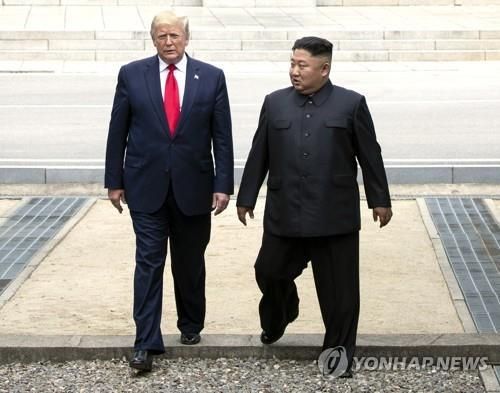 In June 2019 at Panmunjom, then U.S. President Trump met with North Korean Chairman Kim Jong-un. Photo by Yonhap News
With the confirmation of the second Trump administration, uncertainty is rising on the Korean Peninsula, where tensions due to North Korea's nuclear weapons are high, increasing the anxiety among South Koreans, the New York Times (NYT) reported on the 11th (local time).
The NYT stated, "South Koreans are anxiously watching Trump's return to the White House, recalling the 'rollercoaster diplomacy' they had to endure during his first term."
'Rollercoaster diplomacy' refers to the situation during President Trump's first term when he and North Korea's Kim Jong-un exchanged hostile rhetoric, met face-to-face three times, but talks ultimately broke down without significant results, leading to a worsening of the North Korean nuclear issue.
The NYT noted, "Trump's second term brings uncertainty to the Korean Peninsula, where nuclear tensions are high," adding, "The North Korean leader might see an opportunity to improve relations again amid this gap."
With the realization of the second Trump administration, some speculate that President-elect Trump may pressure South Korea by presenting the withdrawal or reduction of U.S. troops stationed in Korea after the government is formed, demanding a significant increase in defense cost-sharing payments, and may also rekindle the 'bromance' with Kim Jong-un.
Regarding this, Professor Lee Byung-chul of Kyungnam University's Institute of Far Eastern Studies told the NYT, "The South Korea-U.S. relationship is heading into a storm," but also explained, "We might see Kim Jong-un and Trump exchanging love letters again." Professor Park Won-gon of Ewha Womans University predicted to the NYT, "This time, Kim Jong-un will likely present strict preconditions to avoid repeating the humiliations of past talks with Trump."
The NYT reported that if North Korea-U.S. talks resume, Chairman Kim is expected to demand sanctions relief and a reduction of U.S. troops in South Korea in exchange for freezing the long-range ballistic missile program and limiting nuclear weapons.
It emphasized, "In particular, what North Korea demands will be limiting, not eliminating, nuclear weapons," noting that "this deviates from the longstanding U.S. and allied policy pursuing 'complete, verifiable, and irreversible' denuclearization."
Another challenge South Korea faces is that President-elect Trump views alliances from a transactional perspective. Since Trump has mentioned that South Korea should pay $10 billion (approximately 14 trillion won) in defense cost-sharing, it is expected that he will demand additional financial burdens from South Korea.
The NYT also speculated that this stance from Trump could ignite the nuclear armament debate within South Korea. The NYT stated, "Trump may cause more South Koreans to question how much more they can rely on the alliance for their own defense and whether they need to possess nuclear weapons for deterrence against North Korea."
© The Asia Business Daily(www.asiae.co.kr). All rights reserved.
![Clutching a Stolen Dior Bag, Saying "I Hate Being Poor but Real"... The Grotesque Con of a "Human Knockoff" [Slate]](https://cwcontent.asiae.co.kr/asiaresize/183/2026021902243444107_1771435474.jpg)
















