Over 3,000 Physical Property, Safety, and Toxicity Tests Conducted Annually
Focus on Eco-Friendly Product Development... Business Agreement with Noroo Paint
"We Will Create Products That Exceed Customer Expectations"
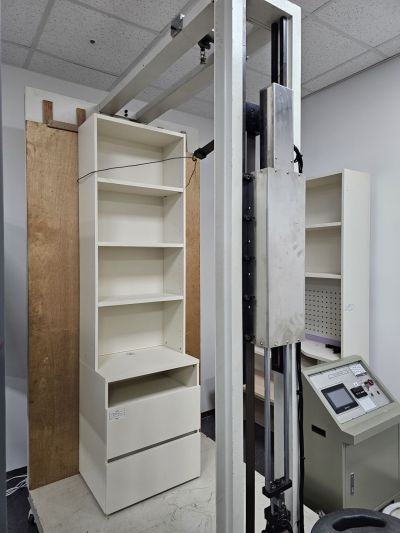
The wardrobe door repeatedly opens and closes. This happens a staggering 50,000 times over the course of a week. On the other side, a drawer is pulled with a force of 25 kg, and the drawer resists to avoid tipping over. Furniture that fails this test does not make it to the market. The ‘Hanssem Research Institute,’ which tests furniture under extreme conditions, resembles a military academy for furniture.
 Go Young-nam, head of the Hanssem Research Institute, is giving an interview to Asia Economy on the 8th. Photo by Hanssem
On the 8th, dozens of types of furniture were undergoing tests at the Hanssem Research Institute located in the Hanssem headquarters in Sangam-dong, Mapo-gu, Seoul. This facility is responsible for quality and safety testing, standard management of specifications, and hazardous substance evaluation for all products released by Hanssem. Using 58 testing devices, the number of tests conducted annually in areas such as physical properties, safety, and toxicity reaches around 3,000.
Go Young-nam, head of the Hanssem Research Institute, explained, “Hanssem conducts rigorous tests not only during product development and manufacturing stages but also after products are released to consumers to ensure there are no physical or chemical issues.” He added, “Products that fail the tests are discarded.”
That day, dozens of types of furniture were being tested at the institute. The motion desk, an electrically height-adjustable desk, repeatedly moved up and down while stacked with dozens of weight plates typically seen in gyms. In a test chamber simulating a boiler, the floor was heated intensely to observe whether the solid wood flooring would deform.
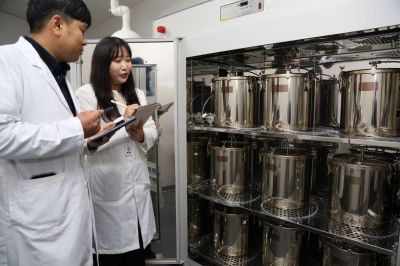
One particularly notable test was to verify that the furniture materials are free from chemical hazards. Hanssem has recently been focusing on producing eco-friendly furniture. To this end, it recently signed an agreement with Noroo Paint to jointly develop Korea’s first ‘eco-friendly water-based paint for furniture.’
In a laboratory designed like a chemical lab, raw material samples were placed into special equipment to capture formaldehyde. This process checks how much formaldehyde is emitted as paint, adhesives, and other substances used in furniture volatilize. Formaldehyde is a carcinogen and one of the causes of atopic dermatitis.
Director Go stated, “Hanssem uses half of the government’s formaldehyde emission standard as its own testing pass criterion.” He explained, “Furniture is used daily in everyday life by everyone, including children and the elderly, so we continuously invest in making products with low toxicity.”
Hanssem plans to focus on developing eco-friendly products going forward. Although the current focus is on the appearance of furniture, consumer interest in the safety of paint components and internal materials is increasing. Director Go emphasized, “Our ultimate goal is not simply to focus on sales but to provide products that exceed customer expectations in terms of environmental friendliness and safety.” He added, “We are striving to make products eco-friendly from start to finish by reducing carbon emissions through methods such as increasing recycling rates.”
© The Asia Business Daily(www.asiae.co.kr). All rights reserved.
![Clutching a Stolen Dior Bag, Saying "I Hate Being Poor but Real"... The Grotesque Con of a "Human Knockoff" [Slate]](https://cwcontent.asiae.co.kr/asiaresize/183/2026021902243444107_1771435474.jpg)













