Growing Momentum for Constitutional Amendment Over Impeachment Within Opposition
Ruling Party Also Focuses on Impact of Constitutional Amendment
Variables Include Lee Jae-myung's Trial and Yoon Seok-youl?Han Dong-hoon Relationship
As allegations of state power abuse involving First Lady Kim Geon-hee and Mr. Myeong Tae-gyun have surfaced, President Yoon Suk-yeol's approval ratings have hit their lowest point since his inauguration, prompting the opposition to launch large-scale outdoor rallies and intensify their offensive. Within the opposition, there is a growing momentum for a constitutional amendment to shorten the presidential term, exemplified by the launch of the 'Presidential Dismissal National Referendum Constitutional Amendment Coalition (Constitutional Amendment Coalition),' rather than pursuing impeachment. But is a constitutional amendment to shorten President Yoon's term truly feasible?
At the 'Second National Action Day to Condemn Kim Geon-hee and Yoon Suk-yeol's State Power Abuse and Demand a Special Prosecutor' event held on the 9th around Seoul's Sungnyemun area, Lee Jae-myung, leader of the Democratic Party of Korea, mentioned the issue of supporting lethal weapons to Ukraine and said, "I could not bring myself to say the two-syllable word, so I spoke like this." The preceding statement was, "Is the chaos because we cannot wage war?" Considering the context, the unspeakable two-syllable word appears to be 'hwanjang (換腸),' a Korean expression meaning 'losing one's mind,' which he refrained from saying outright. The Democratic Party's official explanation aligns with this, but within political circles, interpretations of the 'two syllables' have sparked discussions about impeachment or constitutional amendments.
Even a single euphemistic expression used to avoid harsh language causes a stir, reflecting how sensitive the political sphere is to what kind of 'action plan' the Democratic Party, especially its leader, is devising.
Impeachment, practically difficult
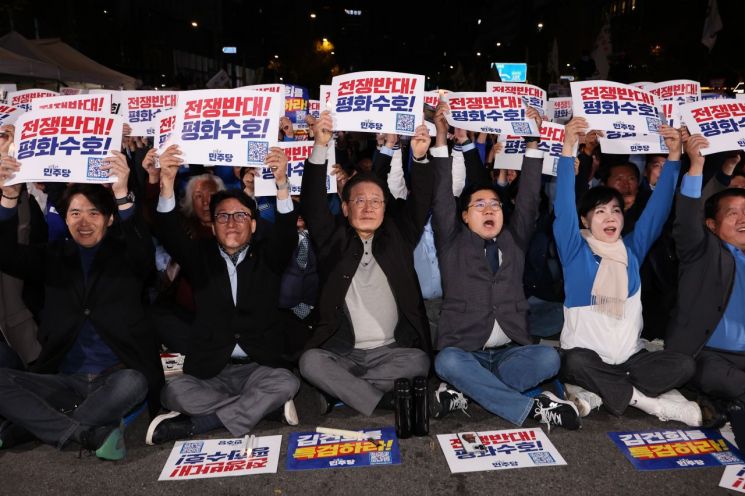 Lee Jae-myung, the party leader, and Park Chan-dae, the floor leader, among others, are holding up placards and shouting slogans at an outdoor rally hosted by the Democratic Party of Korea on the afternoon of the 9th near Sungnyemun in Seoul, titled "The 2nd National Action Day to Condemn Kim Geon-hee and Yoon Seok-youl's State Power Abuse and Demand a Special Prosecutor." Photo by Yonhap News.
Following the impeachment of former President Park Geun-hye, which left a mark on Korean political history, the opposition has repeatedly warned that the Yoon Suk-yeol administration could also become a target of impeachment. Notably, in the last general election, the pan-opposition coalition secured 192 seats, bringing them closer to the two-thirds majority (200 out of 300 seats) required to pass an impeachment motion.
The Justice Innovation Party, which emerged with the slogan "Three years is too long," has already formed an impeachment promotion committee and announced plans to publicly release an impeachment proposal this month, showing particular enthusiasm for impeachment. However, many within the opposition remain skeptical about impeachment. As seen in the case of former President Roh Moo-hyun's impeachment, unless there is a serious constitutional violation, impeachment does not proceed. Currently, aside from suspicions of constitutional or legal violations by President Yoon, no concrete charges have been proven, leading to doubts within the opposition about whether an impeachment motion can pass the National Assembly.
Moreover, there is the burden of entrusting the fate to the Constitutional Court's ruling. Depending on the court's decision, the backlash from impeachment could fully impact the opposition. Above all, the Constitutional Court currently has three vacancies among its nine members appointed by the National Assembly, making it incapable of making major decisions such as impeachment trials.
A bigger problem is that the opposition alone does not have enough seats to impeach. Unless at least eight ruling party lawmakers join the impeachment effort, the motion cannot even be submitted to the Constitutional Court. As confirmed in the re-vote on the special prosecutor law for First Lady Kim Geon-hee, the number of ruling party defectors is at most four. Considering the learning effect from the collapse of conservative forces after former President Park's impeachment, it is unlikely that ruling party lawmakers will readily join impeachment efforts.
Is a constitutional amendment to shorten the term an alternative?
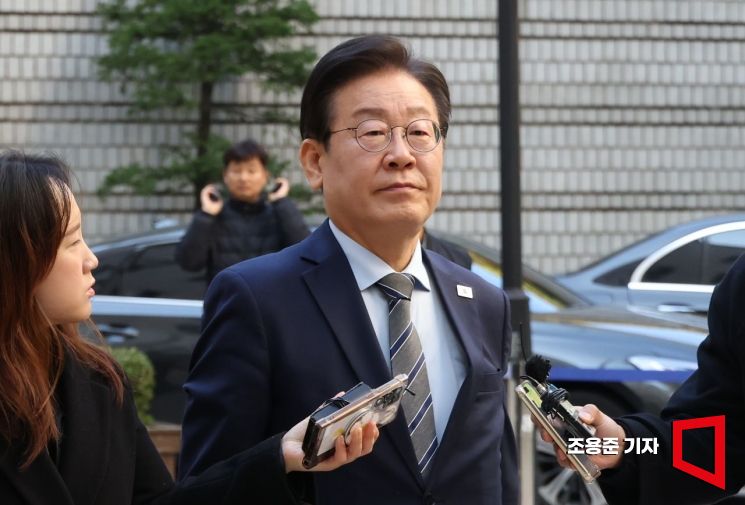 Democratic Party leader Lee Jae-myung is heading to the courtroom on the 8th at the Seoul Central District Court in Seocho-gu, Seoul, to attend the continuation of the first trial related to the 'Daejang-dong breach of trust and Seongnam FC bribery' case. Photo by Jo Yong-jun
The opposition views a constitutional amendment to shorten the presidential term as a politically less challenging alternative to impeachment. On the 11th, Democratic Party lawmaker Jang Kyung-tae appeared on CBS Radio and said, "(A constitutional amendment is) a more rational and feasible option than impeachment," adding, "Impeachment is a disciplinary procedure, whereas a constitutional amendment is a legislative process, so for lawmakers who judge 'this is absolutely impossible,' boarding the constitutional amendment train is preferable to the impeachment train." He further explained, "Impeachment is decided by nine Constitutional Court justices, while a constitutional amendment to shorten the term is decided by a national referendum. If the impeachment verdict changes the presidential election date, a constitutional amendment allows the election date to be determined through broad public consensus and consultation, which is an advantage." Thus, compared to impeachment, a constitutional amendment has a lower political hurdle, higher predictability, and can enhance stability.
Even within the ruling party, although expressed with some concern, attention is being paid to the possibility of a constitutional amendment to shorten the term. Former People Power Party lawmaker Cho Hae-jin pointed out, "The weakest link is a constitutional amendment," and said, "If (Lee Jae-myung) faces crises such as trials, a constitutional amendment to shorten the term may feel much less burdensome. If incentives like a four-year two-term amendment are attached, the justification for support will be strengthened, and it may not be difficult to secure eight votes from the People Power Party."
Even a constitutional amendment to shorten the term faces many hurdles
However, there is much debate about whether a constitutional amendment to shorten the term is even possible. The opposition argues that President Yoon's term can be shortened through revising the supplementary provisions. Constitutional scholars, however, debate the interpretation of Article 128 of the Constitution, which states, "A constitutional amendment to extend the president's term or change the number of terms shall not apply to the president in office at the time of the amendment proposal." While this clause aims to prevent term extensions and thus may not apply to term shortening, it remains a contentious issue. Furthermore, there are concerns that President Yoon might pursue legal actions such as filing a constitutional dispute.
Beyond legal controversies, the opposition also faces the challenge of how to secure the participation of ruling party lawmakers. It remains uncertain whether any ruling party members would readily join a constitutional amendment to shorten the term, which would have effects similar to impeachment.
Within the opposition, there is also debate over how much to shorten the term. Some propose pushing for a constitutional amendment to reduce the term by two years. They describe such an amendment as a 'soft impeachment,' explaining it as "a method for the people to directly judge." However, others argue that to increase effectiveness, a one-year reduction should be chosen. Former lawmaker Kim Du-kwan has advocated via social media that "the term should be shortened by one year, and the next presidential election should be held simultaneously with the local elections on June 3, 2026, through a constitutional amendment." This approach is also seen as a way to offer President Yoon a kind of honorable exit, allowing him to claim a political achievement by sacrificing part of his term to reform the imperial presidency system.
Above all, for constitutional amendment discussions to gain momentum, several political variables must first be resolved. First is the trial issue of Lee Jae-myung. Depending on the verdicts on the 15th and 25th, the opposition could be thrown into turmoil. If the political standing of Lee, the opposition's sole presidential candidate, is shaken, the entire scenario of an early presidential election through a constitutional amendment to shorten the term could collapse.
Another factor is whether the conservative ruling party can unite. Although there have been several conflicts between the party and the government, it is realistically difficult for ruling party lawmakers to join decisions that would end the administration early, given the learning effect from impeachment. The relationship between President Yoon and People Power Party leader Han Dong-hoon is a key variable here. In this regard, Han's recent efforts to mend conflicts with President Yoon and redefine their relationship are noteworthy. This indicates a deepening sense of crisis and suggests that division within the ruling party is unlikely.
© The Asia Business Daily(www.asiae.co.kr). All rights reserved.


















