CJ OnStyle and Shinsegae Live Strong Q3 Performance
Impact of Celebrity-Hosted 'Mobile Live Show'
Strengthening High-Profit Fashion and Beauty Portfolio
The home shopping industry is showing signs of emerging from the tunnel of sluggish business conditions. Mobile live commerce is rebounding the performance that had plummeted due to a decline in TV viewership and the burden of transmission fees. In particular, CJ OnStyle and Shinsegae Live Shopping, which actively pursued a 'de-TV' strategy, recorded double-digit sales growth rates in the third quarter of this year. On the other hand, home shopping companies that focused on defending profitability saw their sales decline.
According to the home shopping industry on the 14th, CJ OnStyle's sales in the third quarter reached 333.8 billion KRW, an increase of 11.2% compared to the same period last year. Operating profit grew by 29.6% to 9.2 billion KRW. Following large IP (intellectual property) programs such as the 'Choi Hwajung Show,' mobile live shows featuring famous celebrities like Han Ye-seul and Soyou performed well, achieving external growth and improving profitability. CJ OnStyle's total handled volume was 881.7 billion KRW, down 3.5%, but mobile live commerce handled volume grew by 88.6%.
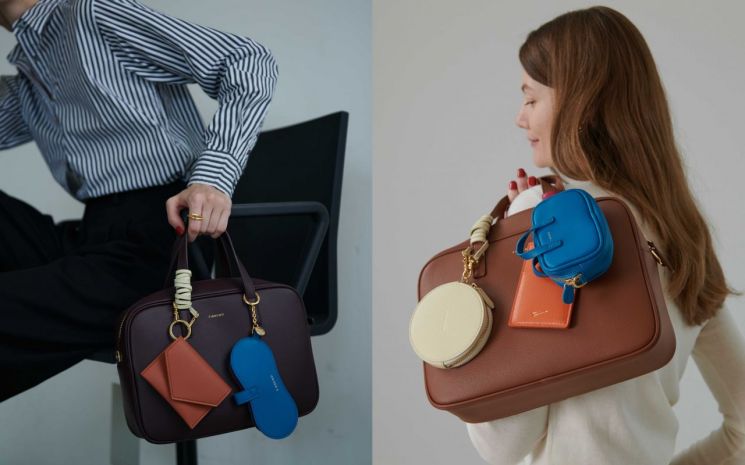 Image of 'Baekku,' matching 'Pibreuno' bags and keyrings launched by CJ OnStyle. Provided by CJ OnStyle
Shinsegae Group's data broadcasting service, Shinsegae Live Shopping, also saw significant improvements in sales and operating profit during this period. Sales increased by 16% to 77 billion KRW, and operating profit grew by 7% to 1.3 billion KRW. The company explained that the strong performance of its own fashion brands such as Edition S, Bluefit, and Edited, along with the synergy effect of affiliated company-linked products, led to external growth.
Lotte Home Shopping's sales declined, but operating profit turned positive to 9.8 billion KRW compared to the previous year, driven by high-margin products such as fashion and beauty. A company official said, "The strategy of improving cost structure efficiency by adjusting the portfolio, reducing the proportion of low-margin products like rentals, and increasing the fashion and beauty programming ratio by 20% was effective."
Data-driven home shopping companies SK Stoa and KT Alpha also saw slight increases in sales to 71.7 billion KRW and 99.4 billion KRW, respectively. In the case of KT Alpha, operating profit also increased by 21.3% year-on-year to 3.3 billion KRW. The company explained that this was due to the expansion of fashion PB (private brand) lineups such as Le Toit and the launch of exclusive fall/winter fashion brands in the second half, including Chouzen, Bruno J, Tabaroni Cashmere, and Fatmus.
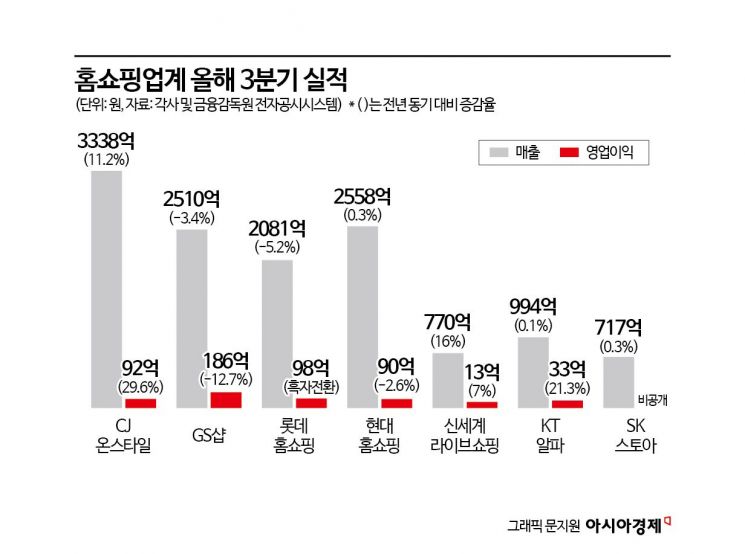
On the other hand, GS Shop and Hyundai Home Shopping have yet to escape the impact of sluggish business conditions. GS Shop recorded sales of 251 billion KRW (-3.4%) and operating profit of 18.6 billion KRW (-12.7%), while Hyundai Home Shopping's sales increased slightly by 0.3% to 255.8 billion KRW, but operating profit decreased by 2.6% to 9 billion KRW. Although these companies also increased the sales proportion of 'de-TV strategy' and high-margin products, it is analyzed that they invested less in differentiated products compared to competitors.
The home shopping industry plans to accelerate the de-TV strategy and strengthen sales of fashion brands in the winter season to recover performance. In the case of GS Shop, it will focus its capabilities on the AI-based revamped application (app) announced in September. Hyundai Home Shopping also plans to diversify its platform portfolio and expand short deals and short commerce specialization based on the renewed Hyundai H Mall app launched in August.
Although some home shopping companies have rebounded, it is expected to take time for the industry to fully recover. In particular, high transmission fees still hamper profitability. Last year, transmission fees accounted for 71% of home shopping sales. If 100 KRW is earned from selling products, 71 KRW goes out as transmission fees. Due to this structure, the total operating profit of the seven domestic TV home shopping companies decreased by 34.9% last year. If the fee burden does not decrease, improving profitability will be difficult. An industry insider said, "Although performance rebounded through strengthening the portfolio centered on high-profit products, it is too early to be relieved due to the decline in TV viewership and the heavy burden of transmission fees," adding, "The trend of focusing capabilities on solid management will continue."
© The Asia Business Daily(www.asiae.co.kr). All rights reserved.
![Clutching a Stolen Dior Bag, Saying "I Hate Being Poor but Real"... The Grotesque Con of a "Human Knockoff" [Slate]](https://cwcontent.asiae.co.kr/asiaresize/183/2026021902243444107_1771435474.jpg)

















