Wando County and National Institute of Maritime Heritage Co-host
Domestic and International Experts Discuss Future and Utilization Plans of Hansun
Wando County announced on the 11th that the "40th Anniversary International Academic Conference on the Marine Silk Road Commemorating the Excavation of the Wando Ship," co-hosted with the National Heritage Agency's National Marine Heritage Research Institute and the Wando County Living Culture Center on the 7th, was successfully concluded.
According to Wando County, the Wando Ship, excavated in 1984 off the coast of Eodu-ri, Yaksan-myeon, Wando County, Jeollanam-do, is Korea's first underwater excavation of a Korean ship (Han-seon) and a symbolic marine heritage site where over 30,000 pieces of Goryeo celadon were recovered together.
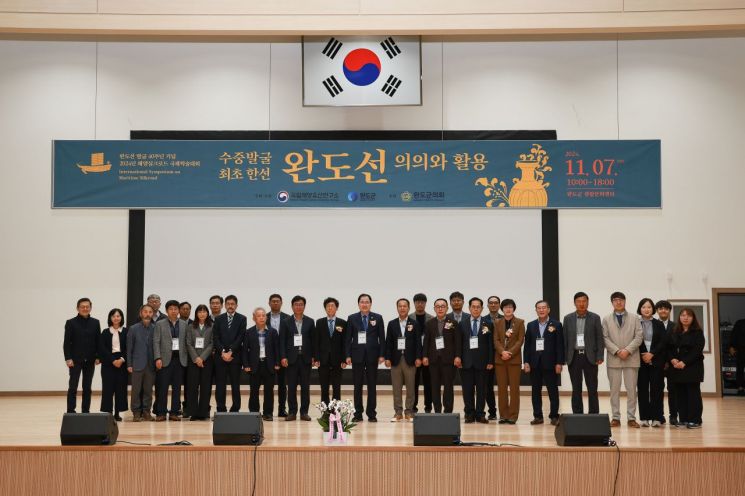 Wando County jointly held the "40th Anniversary International Academic Conference on the Marine Silk Road Commemorating the Excavation of the Wando Ship" with the National Heritage Agency's National Marine Heritage Research Institute. Photo by Wando County
This academic conference was planned to commemorate the 40th anniversary of the Wando Ship excavation, to re-examine the historical significance and future utilization possibilities of the Wando Ship, and to understand the development plans for Han-seon research and underwater cultural heritage.
The conference was attended by Shin Woo-cheol, the mayor of Wando County; council members Ji Min, Park Byung-su, Jo In-ho, Heo Gung-hee, and Jo Young-sik; representatives from the National Marine Heritage Research Institute, the (Foundation) Institute of National Cultural Heritage, Mokpo National University, Wando Cultural Center, Horim Museum, and the (Foundation) Sejong Cultural Heritage Research Institute's Center for Public Archaeology.
Starting with a keynote lecture titled "The Value and Future of the Wando Ship, the First Underwater Excavated Han-seon," the conference featured in-depth presentations and lively discussions. Attendees expressed expectations that with the advancement of the latest technologies, an environment where Han-seon restoration and research can be systematically conducted has been established, raising hopes for Han-seon research and structural restoration possibilities.
In particular, through cases where Goryeo celadon was actively traded from the southwestern coast of Jeollanam-do to the Gyeongsang-do region as part of commercial distribution rather than as tribute, it was re-highlighted that Wando functioned as a central hub in the regional commercial network at the time. Additionally, examples of underwater cultural heritage management in Taiwan and underwater archaeology research and site utilization in Japan provided new perspectives on the preservation and tourism resource potential of the Wando Ship.
Overseas cases suggest the potential of the Wando Ship to contribute to tourism and economic revitalization, and attendees emphasized the need for localized resource utilization strategies. In the comprehensive discussion, directions for marine heritage research were discussed, and specific proposals for tourism resource development using the Wando Ship were exchanged.
A county official stated, "Taking this academic conference as an opportunity, we will actively inherit the marine historical heritage of the Wando region and spare no support to research and develop the brilliant maritime culture of the Jang Bogo era."
© The Asia Business Daily(www.asiae.co.kr). All rights reserved.