Growing Uncertainty in International Politics and Trade... Law Firms' Information Warfare
With former President Donald Trump securing re-election, domestic law firms are rushing to release analyses and forecasts on how changes in the U.S. economic policy direction and Trump's proposed pledges will impact businesses. The reason law firms in Korea have been the quickest to provide such analyses and forecasts is due to their proactive accumulation of local information capabilities as Korean companies expand their presence in the U.S. In Washington DC, near the White House on the road known as ‘K Street,’ lobbying firms and law firms are densely concentrated, and some Korean law firms obtain accurate and vivid information through this channel.
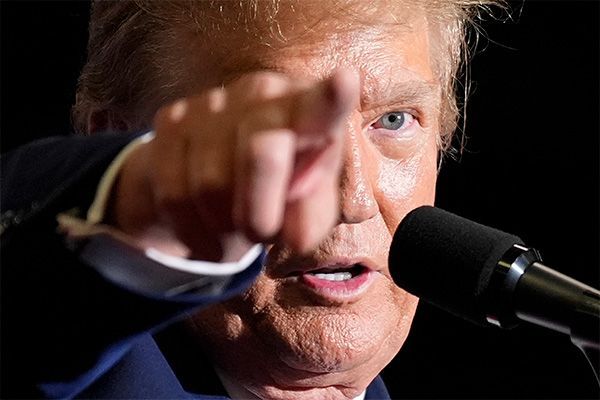 Donald Trump, who will be inaugurated as the 47th President of the United States on January 20 next year, is signaling a major change in the international order as a whole.
 [Image source=AP Yonhap News]
Competition among law firms to strengthen information services and consulting related to the U.S. is also fierce. Law firm Taepyungyang (Representative Attorney Lee Joon-ki) recruited Sung Kim, former U.S. Ambassador to Korea, as the head of its Global Future Strategy Center earlier this year. Other law firms have also been actively hiring former senior officials from the Ministry of Foreign Affairs as advisors to prepare for new markets.
With Trump’s election emphasizing America First and protectionism, Korea, which has a high dependence on foreign trade, faces a test, and law firms are busy trying to turn this into an opportunity.
Sending newsletters and preparing seminars
Major law firms have formed task force (TF) teams to analyze the policies of the second Trump administration to prepare for corporate advisory demands or hold related seminars to provide consulting services on how the U.S. election results might affect companies.
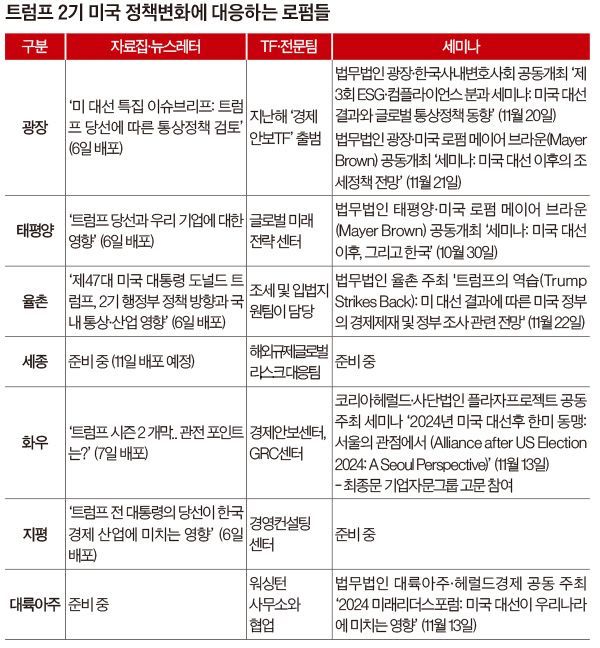
On the evening of the 6th, when Trump’s election was confirmed, Taepyungyang, Yulchon (Representative Attorney Kang Seok-hoon), and Jipyung (Representative Attorney Yang Young-tae) posted newsletters on their websites containing content such as ‘The Impact of Trump’s Election on the Korean Economy and Industry’ and notified their clients via email. The law firms released analyses suggesting that Trump’s election could negatively affect domestic industries such as automobiles, semiconductors, secondary batteries, and steel. They also emphasized the need for strategies to diversify supply chains, as Korea, which exports intermediate goods to China, cannot avoid the impact of U.S. policies aimed at countering China.
A lawyer from one law firm’s international dispute team said, “As soon as Trump’s election was confirmed, we immediately received requests for advice and inquiries to share our information from some clients,” adding, “We are swiftly analyzing related information for our clients and preparing seminars.”
Taepyungyang held a seminar on October 30, a few days before the U.S. election, proactively addressing the potential impact of the election results on Korea. The seminar featured not only Center Director Sung Kim (former U.S. Ambassador to Korea) but also former U.S. Deputy Secretary of State John Sullivan, who engaged in a dialogue, distinguishing the event from those of other law firms. After launching the Global Future Strategy Center earlier this year, Taepyungyang plans to discuss key issues with experts from various fields through the center and propose countermeasures to clients. On the 13th, they will hold a seminar related to Ukraine reconstruction projects. Trump stated in a broadcast last May that he would meet with Putin to resolve the Ukraine conflict and promised to end the war within 24 hours if elected president.
Therefore, as the nature of the war between Russia and Ukraine is expected to change after Trump’s inauguration, they plan to examine the direction of Korean companies’ entry into reconstruction projects.
Gwangjang (Representative Attorney Kim Sang-gon) launched an ‘Economic Security TF’ within its International Trade Group in the second half of last year. The TF has been monitoring the U.S. election situation and potential policy changes by the candidates, and on the 6th, distributed a newsletter titled ‘Special Issue Brief on the U.S. Election.’ Gwangjang is scheduled to hold the ‘3rd ESG & Compliance Subcommittee Seminar: U.S. Election Results and Global Trade Policy Trends’ jointly with the Korean In-house Counsel Association on the 20th. On the 21st, they are preparing a webinar (via ZOOM) with U.S. law firm Mayer Brown on the topic ‘Tax Policy Outlook After the U.S. Election.’
Daeryuk Asia (Representative Attorney Lee Kyu-chul) plans to distribute newsletters in collaboration with its Global Compliance Team after completing trend analysis through its Washington office. Daeryuk Asia will invite Kim Geon, a member of the National Assembly’s Foreign Affairs and Unification Committee from the People Power Party, to the Future Leaders Forum on the 13th. The topic will be ‘The Impact of the U.S. Election on Korea.’
HwaWoo (Representative Attorney Lee Myung-soo) announced that Choi Jong-moon, advisor of the Corporate Advisory Group, will attend the seminar ‘Alliance after US Election 2024: A Seoul Perspective’ held at the National Assembly Museum in Yeouido on the 13th. Advisor Choi will chair the first session, ‘The Korean Peninsula and the ROK-U.S. Alliance After the U.S. Election,’ leading discussions on the impact of the U.S. election results on security and foreign policy and Korea’s strategic response. Advisor Choi previously served as Director-General of the South Asia-Pacific Bureau at the Ministry of Foreign Affairs, Ambassador to Sri Lanka, Ambassador to France, and Second Vice Minister of Foreign Affairs.
Yulchon, having responded to various corporate advisory demands related to the U.S. election through its Legislative Support Team and Tax Division, plans to address changes in the U.S. government following Trump’s election. Sejong (Representative Attorney Oh Jong-han) is also preparing newsletters and seminars.
Protectionist policy stance expected to continue
Experts predict that the protectionist stance centered on America First, which was the economic policy of Trump’s first administration, will continue, leading to increased import restrictions and the application of universal tariffs, significantly impacting Korean companies.
In August last year, Trump announced plans to impose a universal basic tariff of 10% on imports. He also mentioned imposing a uniform 60% tariff on Chinese imports. Additionally, under the Reciprocal Tariff Act, there is a possibility of imposing tariffs on imports from trade partners at the same rate as tariffs those partners impose on U.S. products. This would inevitably affect the prices of Korean companies’ export products.
Park Ji-woong (43, Judicial Research and Training Institute Class 37), a lawyer at Yulchon and former Presidential Secretariat official, explained, “Tariff increases will inevitably have a significant industrial impact on East Asia, including Korea,” adding, “Since the structure where Korea exports primary goods to China and China exports finished products to the U.S. no longer works, efforts to reduce high trade dependence on China have become necessary.” He further noted, “Reflexively, the competitiveness of Korean finished products may improve, but many Korean companies have factories in China, so they need to consider relocating factories, which could lead to increased costs.”
There is also a forecast that sectors such as petrochemicals and refining may experience positive effects, so it is necessary to assess and prepare for industry-specific impacts.
Jung Dong-won (56, Class 31), a lawyer at HwaWoo and former investigator at the Ministry of Trade, Industry and Energy’s Trade Commission, said, “If prices of oil and coal decrease and production increases, cost burdens will ease, benefiting related Korean companies.”
Park Hyo-min (42, Class 41), a lawyer at Sejong and former advisor to the Ministry of Foreign Affairs’ Economic Security Diplomacy Advisory Committee, explained, “If higher tariffs are imposed on Chinese products, Korean products competing similarly to Chinese ones may gain an advantage,” adding, “Depending on supply chains and industries, there could be both positive and negative factors, so thorough pre-monitoring considering international situations is essential.”
It was also pointed out that changes in U.S. trade policy could damage the global trade order. Trump views existing trade agreements as unfavorable to the U.S. economy and is expected to attempt to revise bilateral trade agreements, which could limit the role of the World Trade Organization (WTO) and cause significant problems for trade norms established through agreements like the Korea-U.S. FTA.
Jung Ki-chang, a foreign attorney at Gwangjang, said, “Multilateralism has declined with Trump’s election,” adding, “The U.S. is breaking agreements first, and with the return of the era of industrial policy, a strategic approach rather than reliance on rules is necessary.”
A senior advisor at a major law firm who worked for the Ministry of Foreign Affairs for many years said, “Since Trump’s first term, the U.S. has not followed WTO rules at all and has violated various agreements,” adding, “Korea is not a country that creates rules but one that follows international norms, but currently, it is difficult to establish common international norms, and fragmentation will persist for a long time.” He added, “This could lead to difficulties for Korean companies, but the only option is to analyze the situation carefully and respond accordingly.”
However, representatives of foreign law firms operating in Korea said it is necessary to observe what trade policies Trump will pursue in the future. Although it is difficult to make forecasts as policies have not yet been implemented, they foresee that crises and opportunities may come simultaneously.
Jinyoung Lee, Suhyun Han, Suyeon Park, Legal Times Reporters
※This article is based on content supplied by Law Times.
© The Asia Business Daily(www.asiae.co.kr). All rights reserved.


















