Disagreement Over Inclusion of Statements Related to Kim Moon-gi's 'Actions'
High Likelihood of Guilty Verdict in Baekhyeon-dong Case
Verdict on Perjury Coaching Case on 25th... CEO Lee Claims Innocence via Facebook Daily
The first trial verdict for Lee Jae-myung, leader of the Democratic Party of Korea, on charges of violating the Public Official Election Act is expected this week. As the court's guilty or not guilty judgment on the earliest of the four trials Lee is facing, it can be seen as the first test to determine the authenticity of Lee's judicial risk.
Compared to the Daejang-dong development corruption case, the facts are relatively simple, and there is already considerable evidence revealed, so the prosecution has been confident in proving the charges. Especially since this election crime case is likely to have a final Supreme Court ruling before the next presidential election scheduled for March 2027, it has attracted attention from both the political and legal communities.
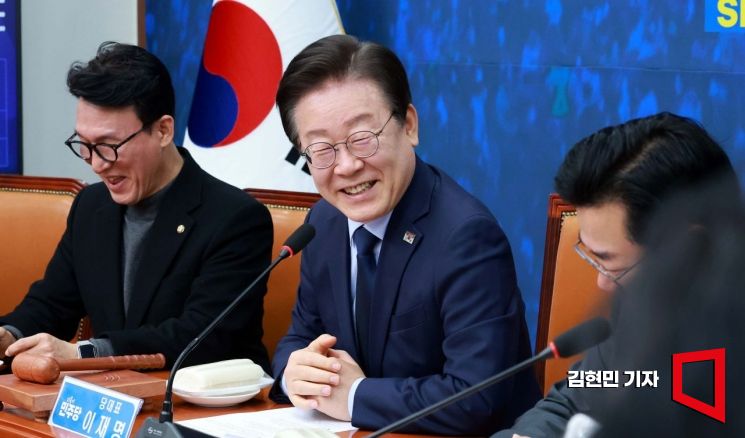 Lee Jae-myung, leader of the Democratic Party of Korea, is speaking at the Supreme Council meeting held at the National Assembly on the 11th. Photo by Kim Hyun-min
According to the legal community on the 11th, the Seoul Central District Court Criminal Division 34 (Chief Judge Han Seong-jin) will hold the sentencing trial for Lee's violation of the Public Official Election Act on the afternoon of the 15th.
Lee is accused of publicly spreading false information during the last presidential election, claiming that he did not know the late Kim Moon-gi, former head of Development Division 1 at Seongnam Urban Development Corporation, during his time as mayor of Seongnam, and that the Ministry of Land, Infrastructure and Transport pressured him to change the land use of Baekhyeon-dong site.
Lee's position is that he did not remember Kim, a lower-ranking official, because he had so many staff at the time. However, it was revealed that Lee went on an overseas trip and played golf with Kim and former Seongnam Urban Development Corporation Planning Director Yoo Dong-gyu during his tenure as mayor, and there were circumstances indicating that Kim reported directly to him several times. The prosecution believes that Lee denied his relationship with Kim in a broadcast interview the day after Kim, who was in charge of the practical work and involved in the Daejang-dong corruption, took an extreme step to hide Lee's involvement.
Regarding the background of the Baekhyeon-dong land use change, Lee, who had even made a campaign pledge that residential development was not allowed, suddenly changed his stance and upgraded the site, which was a natural green area, vertically by four levels to quasi-residential use. The prosecution's view is that this change was due to a request from Kim In-seop, a broker and former head of Lee's campaign headquarters, and that Lee used the non-existent pressure from the Ministry of Land, Infrastructure and Transport as an excuse.
In September last year, then Minister of Justice Han Dong-hoon explained the reason for requesting Lee's arrest consent at the National Assembly, stating, "Lee claims that the unprecedented four-level land use change was due to 'pressure from the Ministry of Land, Infrastructure and Transport,' but the Ministry's December 2014 reply stating 'land use changes are at the discretion of local governments,' testimony from the Seongnam city official who directly reported the reply to Mayor Lee, and statements from related personnel at Seongnam city, the Ministry, and the Food Research Institute all indicate that Lee's claim is completely different from the facts."
In general crimes, the right to run for office is lost only if a prison sentence or higher is confirmed, but in the case of violating the Public Official Election Act, even a confirmed fine of 1 million won or more restricts the right to run for office for five years. If a fine of 1 million won or more is confirmed in this case, Lee will not only be unable to run in the next presidential election, but the Democratic Party will also have to return the 43.4 billion won in election expenses reimbursed from the last election.
Although the allegations related to Kim Moon-gi have been mainly highlighted in the media, the legal community views the possibility of guilt related to the Baekhyeon-dong land use change as higher. This is because, as Lee emphasizes, the issue of whether he remembers Kim is a subjective matter of Lee's internal perception, whereas whether the Ministry's pressure actually existed can be determined through objective evidence or testimony. Especially, since Lee first made the statement at the Gyeonggi Province audit and has repeatedly made similar statements in various settings, actively explaining himself, it is analyzed that this reduced the prosecution's burden of proving 'intent.'
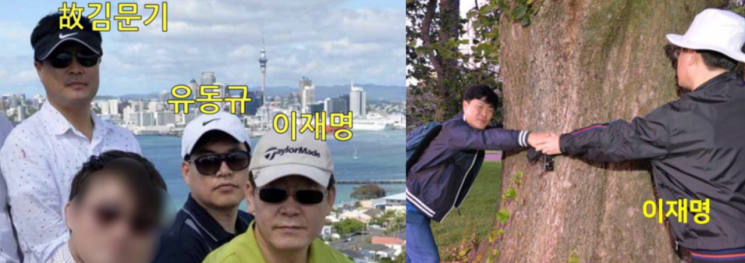 A photo taken in January 2015 during an overseas business trip to New Zealand, showing Lee Jae-myung, then mayor of Seongnam and current leader of the Democratic Party of Korea, together with Yoo Dong-gyu, former Planning Director of Seongnam Urban Development Corporation, and the late Kim Moon-gi, former Head of Development Division 1 at Seongnam Urban Development Corporation (left), and a photo of Lee and Kim holding hands. Provided by the People Power Party.
A prosecutor with extensive experience in election crime investigations said, "The Baekhyeon-dong related case seems likely to result in a guilty verdict, while the case related to Kim Moon-gi is honestly a 50-50 chance," adding, "Article 250 of the Public Official Election Act, which stipulates the crime of spreading false information, enumerates the objects of false information such as candidates' occupation, career, property, actions, and support status. The prosecution and Lee's side differ on whether the statement 'I don't know Kim Moon-gi' falls under 'actions.'
In other words, Lee's side argues that it is purely a matter of Lee's perception and not an external action, while the prosecution believes that since the perception in the mind is expressed outwardly, it should be considered an 'action.' However, the prosecutor added, "Ultimately, it depends on the judge's formation of belief, but if the focus is on 'why Lee said he did not know Kim Moon-gi at the time,' it seems to have been somewhat proven."
Regarding the burden of proof for the crime of spreading false information under the Public Official Election Act, the Supreme Court holds the position that "for the crime under Article 250, Paragraph 2 of the Public Official Election Act to be established, the prosecutor must actively prove that the published fact is false, and the crime cannot be established merely because there is no proof that the published fact is true." The Supreme Court also stated, "In deciding the burden of proof, the prosecutor, as the active party, must bear the obligation to prove beyond reasonable doubt not only the existence of certain facts but also the non-existence of certain facts, such as the non-existence of a specific act at a specific time and place."
If the court rules not guilty for Lee on the 15th, the opposition's persistent claims of 'targeted investigation' will gain strength, and calls for the introduction of a special prosecutor for Kim Geon-hee, who has been repeatedly cleared by the prosecution, are expected to grow louder.
On the other hand, if the court recognizes guilt and sentences Lee to a fine of 1 million won or more, the Democratic Party's attacks on the prosecution and judiciary will intensify, but internal confusion and division due to the realization of Lee's judicial risk seem inevitable.
Meanwhile, Article 270 of the same law (Mandatory Provisions on the Trial Period for Election Crimes) stipulates that the sentencing for election crimes must be made within six months from the date the indictment is filed, and the second and third trials must be made within three months from the date of the previous trial's sentencing. Although the Supreme Court interprets this provision as a 'guidance provision' despite the article's title, the trial period is inevitably shorter compared to other crimes. Therefore, this case is likely to have a final Supreme Court judgment before the next presidential election.
On the 25th, the first trial sentencing for Lee's perjury coaching charge is scheduled. Besides the testimony of Kim Jin-sung, who was coached by Lee to commit perjury and actually committed perjury in court, there is also an audio recording of Lee's voice asking for favorable testimony. Last September, Chief Judge Yoo Chang-hoon dismissed the arrest warrant for Lee but stated that "the charges seem to be substantiated."
Seemingly aware of this, Lee posted on his Facebook on the 6th, "How can it be perjury coaching when the coaching failed?" and on the morning of the same day shared an edited video of the phone call related to the perjury coaching case on his Facebook, writing, "The truth may be temporarily hidden, but it does not disappear and will eventually be revealed," showing his full effort to claim innocence ahead of the sentencing.
Earlier, the prosecution requested a two-year prison sentence for Lee's violation of the Public Official Election Act and a three-year prison sentence for the perjury coaching charge.
© The Asia Business Daily(www.asiae.co.kr). All rights reserved.
![Clutching a Stolen Dior Bag, Saying "I Hate Being Poor but Real"... The Grotesque Con of a "Human Knockoff" [Slate]](https://cwcontent.asiae.co.kr/asiaresize/183/2026021902243444107_1771435474.jpg)

















