KAIST has secured a foundational technology for a new molecular switch material that can be turned on and off with light by utilizing the principles of natural product synthesis.
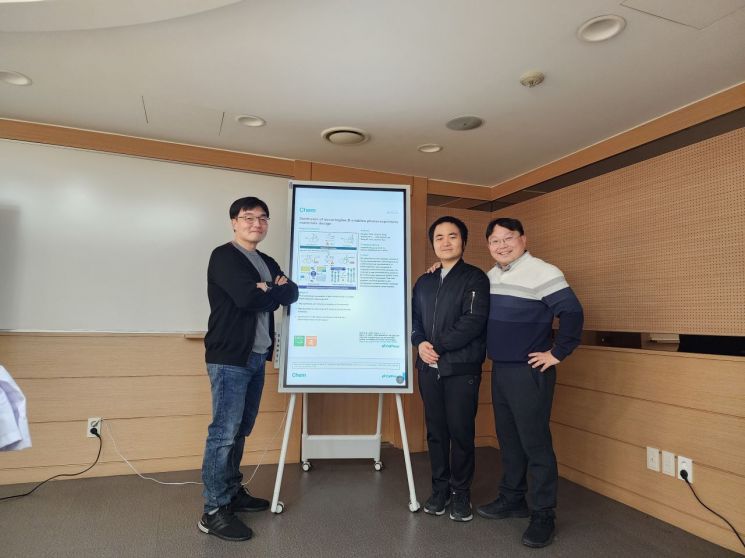 (From left) Professor Donggi Yoon, Department of Chemistry, KAIST; Sangbin Park, Integrated MS-PhD Program; Professor Sungkyu Han. Courtesy of KAIST
On the 11th, KAIST announced that a joint research team led by Professors Hansoon Kyu and Yoon Donggi from the Department of Chemistry has, for the first time in the world, elucidated the synthesis method of securingine B, a member of the securinega alkaloid natural product group, and developed a new type of molecular photo-switch based on the chemical reactivity discovered during this process.
The securinega alkaloid natural product group has attracted continuous academic interest due to its anticancer and neurodegenerative disease treatment effects.
The joint research team devised a molecular photo-switch that reversibly changes its form and properties through light of different wavelengths, based on the principle of molecular rearrangement beyond the natural product synthesis of this substance.
Subsequently, the joint research team developed a photoresponsive chiral dopant to apply the newly developed photo-switch material to the field of optical materials.
Additionally, to apply this to the display field, they observed that when blue light was irradiated onto a liquid crystal material, the twist pitch of the chiral liquid crystal changed while still maintaining the properties of the photo-switch.
Chirality is a fundamental concept in chemistry and one of the key factors determining the optical properties of materials, characterized by pairs like left and right hands that cannot be superimposed on each other.
The photo-switch developed by the joint research team operates on the principle of bond formation and migration within the molecule, changing its molecular structure. It enables not only color changes depending on the wavelength but also on/off switching of fluorescence, allowing applications as a fluorescent probe in the biological field.
Professor Han said, “This research is a case where principles discovered during the basic science research process of natural product synthesis were connected to the development of a new applicable molecular photo-switch,” adding, “It reaffirmed the importance of basic science research exploring the operating principles of natural phenomena for the development of new technologies.”
Meanwhile, the study, with KAIST Department of Chemistry integrated MS-PhD student Park Sangbin as the first author, was published on the 31st of last month in the international journal Chem, published by Cell Press.
This research was conducted with support from the National Research Foundation of Korea’s Individual Basic Research Program, KAIST’s Leap Research (UP) Project, KC30 Project, and the Next-Generation Collaborative Research Laboratory Project.
© The Asia Business Daily(www.asiae.co.kr). All rights reserved.
![Clutching a Stolen Dior Bag, Saying "I Hate Being Poor but Real"... The Grotesque Con of a "Human Knockoff" [Slate]](https://cwcontent.asiae.co.kr/asiaresize/183/2026021902243444107_1771435474.jpg)
















