Political Pressure Draws the Line on "Central Bank Governor Independence"
"Additional Rate Cut Possible in December... Need to Watch Data"
US CPI, PPI, Retail Sales Indicators Scheduled for Release This Week
Neel Kashkari, president of the Minneapolis Federal Reserve Bank and a prominent hawkish (monetary tightening) figure within the U.S. Federal Reserve (Fed), warned on the 10th (local time) that if President-elect Donald Trump's tariff policies lead to retaliatory tariffs from other countries, the impact on inflation would be inevitable. Regarding concerns that Trump's presidency would increase political influence over the Fed, he dismissed them by stating, "The central bank president is independent."
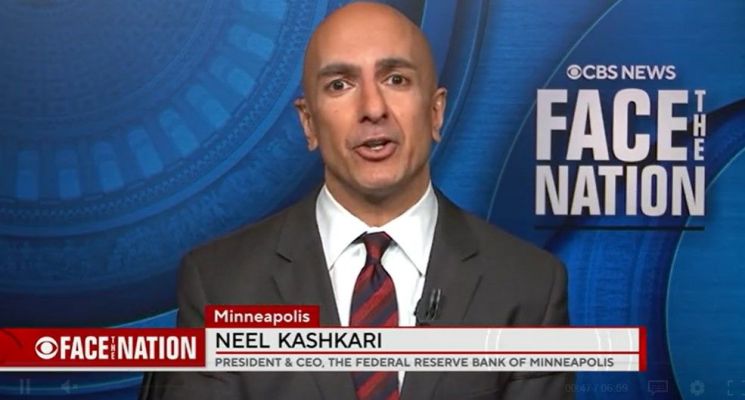 Neel Kashkari, President of the Minneapolis Federal Reserve Bank, is answering questions on the CBS program 'Face the Nation' on the 10th (local time). Photo by CBS
On the same day, Kashkari appeared on CBS's "Face the Nation" and said, "From an inflation perspective, one-time tariffs are quite easy to model and will not affect inflation in the long term," adding, "The problem is tit for tat." He warned, "If one country imposes tariffs and another country responds, escalating the situation, it becomes much more worrisome and uncertain." He further added, "We will have to see what actual measures are implemented after Trump takes office and how other countries respond."
President-elect Trump, who won the November 5th election, has so far announced large-scale tariff policies, including a universal tariff of up to 20% and a high tariff of 60% targeting Chinese products. There are growing expectations that a retaliatory tariff war with major trading partners such as China and the European Union (EU) could be reenacted with greater intensity, similar to the first Trump administration. According to Goldman Sachs, if tariff rates increase, corporate earnings per share are estimated to decline by 1-2% due to reduced consumer spending, retaliatory tariffs, and increased uncertainty.
Additionally, Kashkari assessed Trump's announced tough immigration policies, including large-scale deportations, saying, "There is a possibility of some confusion during companies' response processes." However, he noted that the specific impact on inflation is highly uncertain, depending on actual policies, congressional situations, and corporate adaptations. He said, "The Fed will wait," and added, "We need to observe the government's decisions before analyzing their impact on economic forecasts."
Regarding concerns that the fiscal deficit problem will worsen after Trump's inauguration, he said, "According to the Congressional Budget Office's forecast, it will grow as large as the moon. At some point, it must be addressed," but drew a line by stating it is the domain of Congress and the executive branch. He emphasized, "Whatever Congress and the executive branch decide to do, we have goals of 2% price stability and maximum employment," adding, "We will adjust monetary policy to achieve these goals." He also stated, "It is clear that the fiscal deficit must be resolved in the long term," and insisted, "This is an area for Congress and the executive branch to handle."
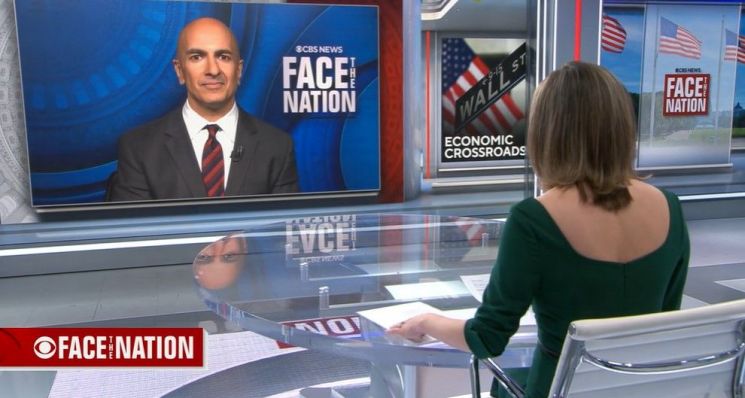 Neil Kashkari, President of the Minneapolis Federal Reserve Bank, is answering questions on the CBS program "Face the Nation" on the 10th (local time). Photo by CBS
On the same day, Kashkari reiterated the Fed's political independence in handling monetary policy. With President-elect Trump, who is set to take office in January next year, openly stating that the Fed should be under presidential control, Kashkari was asked if he was concerned about such political pressure. He firmly replied, "No." He continued, "My Fed colleagues and I are fully committed to the dual mandate of 2% price stability and maximum employment given to us by Congress," emphasizing, "There are structural elements designed by Congress to provide continuity. The central bank president is independent."
Regarding the possibility of additional interest rate cuts within the year, he said, "We really need to see what the data looks like before drawing conclusions. The meeting is in six weeks," but added, "I definitely think additional rate cuts are possible." The Fed had lowered the benchmark interest rate by 0.25 percentage points at the November Federal Open Market Committee (FOMC) meeting held last week. He said, "We have made significant progress in lowering inflation, and the economy has remained surprisingly strong," but added, "I don't want to declare victory yet. We need to finish the job. But we are on a good path now."
This week, inflation indicators including the Consumer Price Index (CPI) and retail sales data are scheduled to be released. Wall Street expects the October CPI, to be announced on the 13th, to show a 2.6% year-over-year increase, slightly exceeding the previous month's 2.4% rise. The core CPI, excluding food and energy prices, is expected to maintain the previous month's level at 3.3% year-over-year. The Wells Fargo economist team led by Jay Bryson stated in a weekly investor memo that "the October CPI report is likely to support the notion that the 'last mile' of inflation returning to the 2% target is the most challenging." On the following day, the October Producer Price Index (PPI), a wholesale price indicator, will be released on the 14th, and retail sales data will be published on the 15th. Major corporate earnings reports from Home Depot, Walt Disney, and Cisco are also scheduled.
© The Asia Business Daily(www.asiae.co.kr). All rights reserved.


















