GPS Tracked but Unretrieved Due to Battery Drain
Annual Deficit of 10 Billion Won in Ttareungi Operations
Seoul's public bicycle system, Ddareungi, continues to experience losses and thefts despite being equipped with a Global Positioning System (GPS) device.
On the 8th, Lee Kyung-sook, a member of the People Power Party in the Seoul Metropolitan Council (Dobong 1), analyzed data received from the Seoul Facilities Corporation and found that from 2020 to September of this year, a total of 2,652 Ddareungi bicycles were lost or stolen. While 2,480 bicycles were recovered, 172 remain missing.
The corporation stated that in 2020, all devices attached to Ddareungi bicycles were replaced with GPS-based tracking units, but bicycles that were not recovered could not be found due to battery depletion. Lost or stolen Ddareungi bicycles are retrieved directly by delivery personnel. There are 234 delivery workers responsible for collecting and redistributing Ddareungi bicycles, which is relatively insufficient compared to the number of rentals, resulting in a heavy workload.
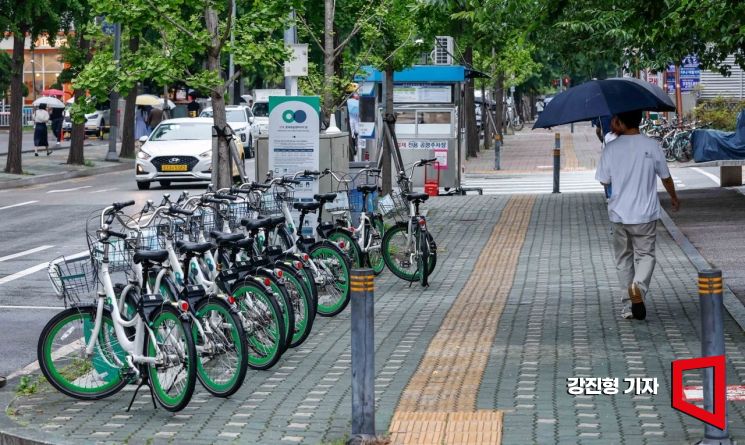 Recently, the cumulative usage of the public bicycle service "Ddareungi" is approaching 200 million rides, with losses and damages continuing unabated. Ddareungi bicycles are stocked at a storage facility near Yeouido Station in Seoul. Photo by Jinhyung Kang aymsdream@
Councilor Lee said, "Ddareungi is a public bicycle system operated with citizens' taxes," and added, "Strong measures are necessary against unauthorized users."
The operation of Ddareungi runs at an annual deficit exceeding 10.1 billion KRW. Last year, operating revenue was 16.467 billion KRW, while operating expenses reached 27.416 billion KRW, resulting in a deficit of 10.949 billion KRW. The daily one-hour usage fee for Ddareungi has remained at 1,000 KRW for 15 years.
Additionally, one out of two Seoul citizens expressed that they would stop using Ddareungi if the fees were increased. According to the interim report of the "Public Bicycle Fare Realignment Plan Academic Study," submitted to the Seoul Metropolitan Council by Kim Ji-hyang of the People Power Party on the 7th, a survey was conducted among 18,877 Ddareungi users. Nearly half, 46%, responded that they would stop using the service if fees were raised. Satisfaction with the current fees was relatively high at 78%.
The Ddareungi fare is 1,000 KRW for one hour and 2,000 KRW for two hours on a daily pass. Subscription passes (one hour) include a 7-day pass for 3,000 KRW, a 30-day pass for 5,000 KRW, a 180-day pass for 15,000 KRW, and a one-year pass for 30,000 KRW. This fare structure has remained unchanged since the pilot operation began in November 2010, spanning 15 years.
The number of Ddareungi bicycles in operation has increased significantly from 400 units in 2010 to 45,000 units as of September this year, with annual usage approaching 40 million rides. However, the Ddareungi project has recorded deficits close to 10 billion KRW annually: 9.46 billion KRW in 2022, 10.949 billion KRW last year, and 9.511 billion KRW as of September this year.
To address chronic deficits, the city attempted to recruit advertising operators in 2022 but failed twice due to lack of bidders. Since then, there has been no progress in diversifying revenue streams to resolve Ddareungi's deficits. Seoul has also considered raising fees and introducing new fare plans but has yet to present a viable solution.
© The Asia Business Daily(www.asiae.co.kr). All rights reserved.

















