9% Annual Increase Over 4 Years... Transition to Single Household Rate Plan
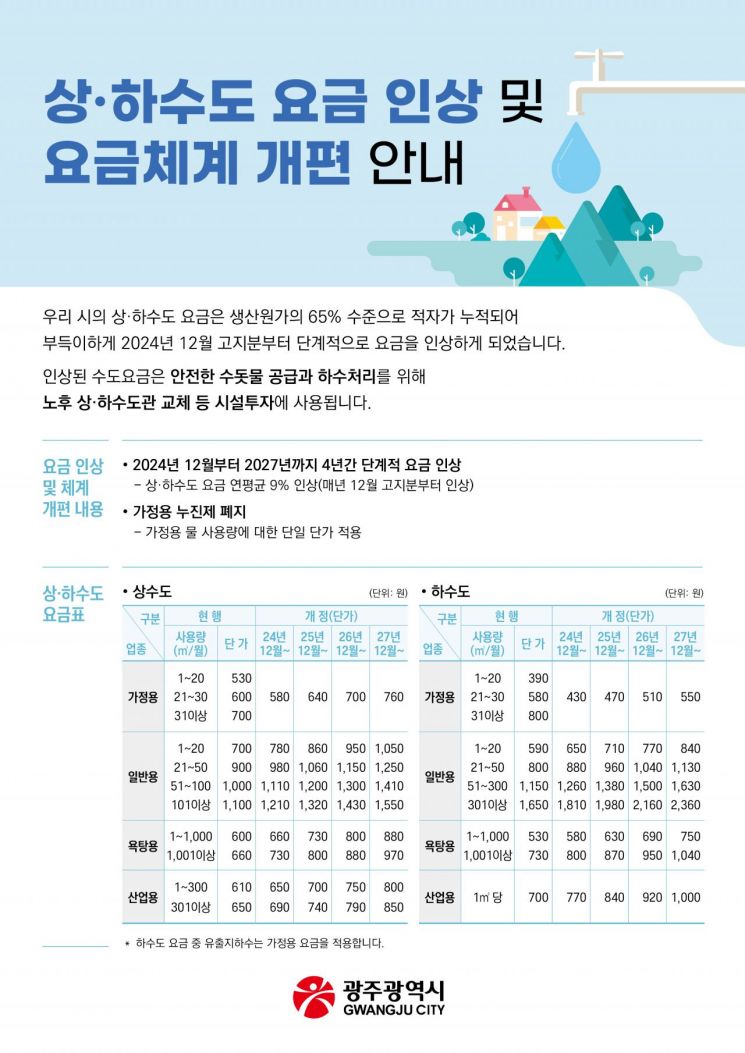
Gwangju City announced on the 8th that it will increase water and sewage fees by 9% annually for four years starting from the December billing this year (an average monthly increase of 800 KRW for water and 560 KRW for sewage). The residential fees, which previously applied a tiered rate based on usage, will be converted to a single-rate system.
This decision follows the resolution made by the ‘Gwangju City Price Countermeasure Committee’ on August 20 to raise water and sewage fees. To stabilize prices and reduce the burden on citizens, the committee froze five local public utility fees, including city bus, city gas, urban railway, taxi fares, and garbage bag fees. Additionally, the increase in public parking fees decided in 2020 was also postponed.
However, due to the growing accumulated deficit, water and sewage fees will be raised gradually. Since the last increase in 2017, Gwangju’s water fees have been frozen for seven years, remaining at about 65% of production costs. Sewage fees are also at approximately 65% of treatment costs, resulting in accumulated deficits, making the increase unavoidable, according to Gwangju City.
The city plans to invest the increased revenue by allocating 16.7 billion KRW next year to replace aging water pipes and 13.6 billion KRW to expand water reservoirs. Additionally, 1 billion KRW will be invested in an emergency water pipeline project to prepare for disasters such as droughts.
For sewage facilities, 6.3 billion KRW will be invested in 2025 to upgrade sewage treatment plants necessary for improving water quality in rivers such as the Yeongsan River and Gwangju Stream. Other investments include 41.9 billion KRW for separating rainwater and sewage pipes, 15.3 billion KRW for repairing aging sewage pipelines to prevent sinkholes, 5.5 billion KRW for repairing old sewage pipes in autonomous districts, and 8.6 billion KRW for urban flood prevention projects.
With this fee increase, based on an average monthly residential usage of 14㎥ (tons), water fees will increase by an average of 800 KRW per month, and sewage fees by 560 KRW per month. Furthermore, the tiered rate system for residential fees, which had three stages based on usage, will be abolished and replaced with a single-rate system.
Kim Il-gon, Director of Gwangju City Water Management Policy Division, explained, “The fee increase is unavoidable to secure safe tap water supply to citizens, prevent ground subsidence through the maintenance of aging pipes, and secure funds for sewage treatment facility investments. To reduce the burden on citizens as much as possible, the fees will be raised gradually over four years instead of a one-time increase.”
© The Asia Business Daily(www.asiae.co.kr). All rights reserved.
![Clutching a Stolen Dior Bag, Saying "I Hate Being Poor but Real"... The Grotesque Con of a "Human Knockoff" [Slate]](https://cwcontent.asiae.co.kr/asiaresize/183/2026021902243444107_1771435474.jpg)
















