As the e-commerce market enters a period of low growth, e-commerce companies are shifting their strategies to focus on profitability and maintaining corporate value, moving away from deficit structures. Samjong KPMG announced this in a report titled "The Current Status and Challenges of the E-commerce Market Entering Maturity," published on the 8th.
The report diagnosed that the annual online shopping transaction amount last year was 228.8607 trillion KRW, growing 8.4% compared to the previous year, and that the annual growth rate, which had maintained double digits since 2018, recorded a single digit, indicating a slowdown in the growth of e-commerce companies.
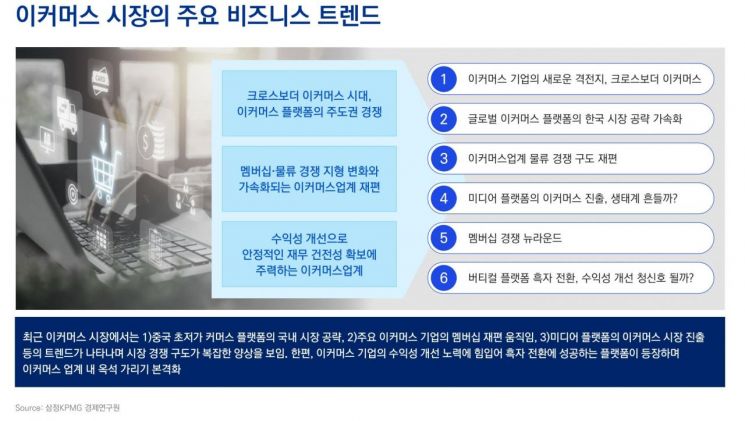
Accordingly, a major business trend is the rise of 'cross-border e-commerce,' which sells products to customers worldwide. According to market research firm Statista, the global cross-border e-commerce market size is expected to grow about tenfold from $785 billion in 2021 to $7.938 trillion in 2030. Through this strategy, e-commerce companies can expand their markets and increase competitiveness by broadening their product sourcing globally. Previously, global e-commerce platforms such as China's AliExpress and Japan's Rakuten have actively entered the domestic market, strengthening their influence.
The logistics strategies in the industry are also changing. To provide fast delivery services, domestic e-commerce companies that had previously chosen logistics internalization are adjusting their strategies to reduce their own logistics scale and strengthen collaboration with logistics companies for efficiency. Logistics companies are enhancing fulfillment services and increasing delivery speed to support e-commerce companies in maintaining competitiveness such as same-day or next-day delivery.
Meanwhile, in the e-commerce market, 'content commerce,' which combines content and products to induce purchases, is rapidly growing. E-commerce companies utilize content commerce in various ways by acquiring consumer data to refine product recommendation algorithms and increasing consumers' platform dwell time to boost purchase conversion rates. TikTok operates 'TikTok Shop' in eight countries including Southeast Asia, the United States, and the United Kingdom, expanding its e-commerce business. Last year, it also filed a trademark for 'TikTok Shop' in Korea.
Changes are also observed in the competitive landscape surrounding paid memberships. When Coupang raised its membership price and shifted its strategy to enhance consumer benefits, other e-commerce platforms also competed to attract consumers by adding various membership benefits or adjusting prices.
Park Hong-min, a partner at Samjong KPMG, stated, “By combining platforms and business solutions, companies can create added value and provide differentiated solutions using big data. Expansion into global areas such as the overseas direct purchase market is necessary, and companies with strengths in product sourcing can seek new opportunities by expanding the presence of Korean products.”
© The Asia Business Daily(www.asiae.co.kr). All rights reserved.
![Clutching a Stolen Dior Bag, Saying "I Hate Being Poor but Real"... The Grotesque Con of a "Human Knockoff" [Slate]](https://cwcontent.asiae.co.kr/asiaresize/183/2026021902243444107_1771435474.jpg)
















