Fed Cuts Benchmark Interest Rate by 0.25 Percentage Points
South Korea May Lower Rates in 'January Next Year'
Concerns Over Weak Domestic Demand but High Exchange Rate Pressure
The U.S. Federal Reserve (Fed) cut the benchmark interest rate by 0.25 percentage points as expected by the market, while the Bank of Korea is expected to keep rates unchanged this month and consider a rate cut in January next year. This is due to the dollar's strength continuing after former President Trump's election, pushing the exchange rate past 1,400 won, as well as ongoing concerns about financial stability such as household debt that have not yet been fully resolved.
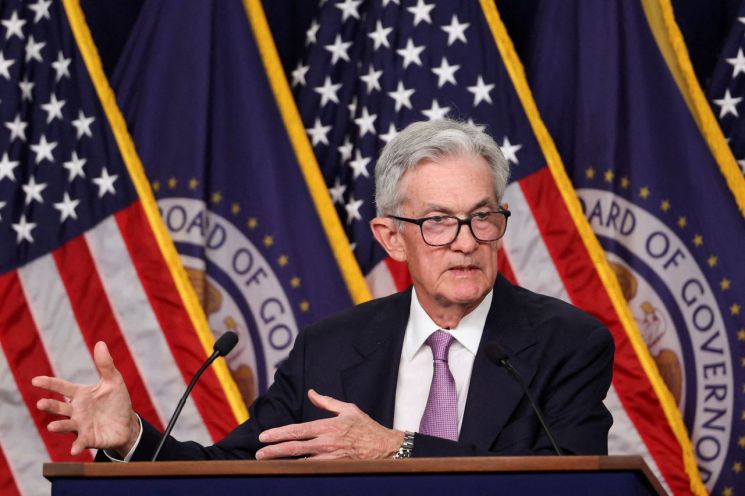
In its policy statement, the Fed assessed that "risks related to achieving employment and inflation goals are roughly balanced." Regarding inflation, it removed the phrase calling for "greater confidence in the slowdown" and stated that inflation is "still somewhat elevated but progress is being made toward the Committee's 2% target."
At a press conference that day, Fed Chair Jerome Powell said, "Despite today's rate cut, current monetary policy remains restrictive," and added, "We will move monetary policy toward a more neutral stance." This indicated that the current accommodative monetary policy would continue.
Korea Likely to Keep Rates Steady This Month... Possible Cut as Early as January Next Year
While the U.S. implemented a 'small cut' (0.25 percentage points) as expected by the market, Korea is likely to keep the benchmark interest rate unchanged this month. Although the recently released third-quarter real GDP grew by only 0.1% quarter-on-quarter and weak domestic demand indicators such as goods consumption and construction investment are factors pushing for a rate cut, the exchange rate near the 1,400 won level and the still concerning household debt situation are causing the Bank of Korea to deliberate carefully on its rate decision.
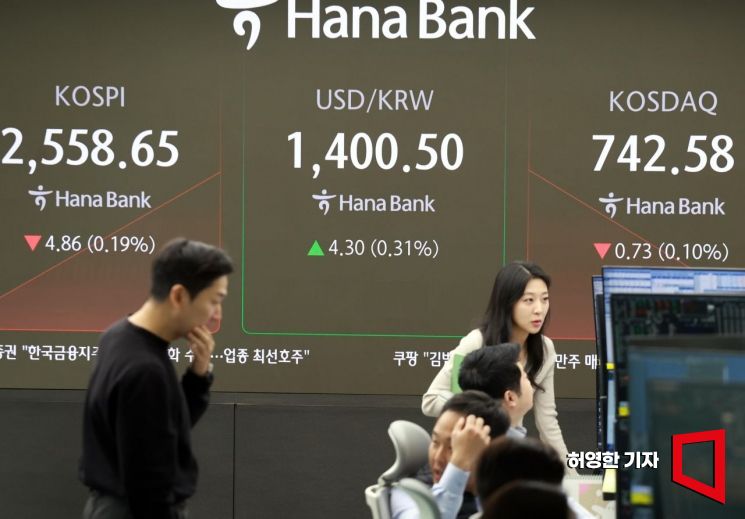 Due to the impact of Donald Trump's election as U.S. President, the won-dollar exchange rate, which surpassed 1,400 won the previous day, fluctuated around the 1,400 won mark on the 7th as well. The KOSPI and KOSDAQ opened slightly lower. Employees are working in the dealing room at Hana Bank in Euljiro, Seoul. Photo by Heo Young-han
On the 6th, the won-dollar exchange rate in the Seoul foreign exchange market surpassed 1,400 won intraday for the first time in about seven months since April. This followed the confirmation of Donald Trump's victory in the U.S. presidential election. Trump's campaign pledges emphasizing U.S. first policies and protectionism, including tariff increases, led to a stronger dollar. The won-dollar exchange rate opened at 1,386 won on the morning of the 8th, down 10.6 won from the previous trading day’s closing price (3:30 p.m.), returning to the 1,380 won range but still maintaining a high level.
At the comprehensive national audit on the 29th of last month, Lee Chang-yong, Governor of the Bank of Korea, said regarding this month's rate decision, "We will make a comprehensive decision after observing how the dollar's strength will evolve following the U.S. presidential election and the impact of the macroprudential policies started last month on real estate and household debt." At the end of last month in Washington D.C., he mentioned, "The exchange rate is currently much higher than we want and rising rapidly," adding, "The exchange rate, which was not a consideration in the previous meeting, has now become a factor to consider again."
Lee Jae-hyung, a researcher at Yuanta Securities, said, "Since the U.S. interest rate level is still higher than Korea's, the Bank of Korea has considerable leeway," adding, "Household debt issues are still emphasized, so unless there is a clear domestic issue, there is no special reason to cut rates in the November decision."
Kim Myung-sil, a researcher at iM Securities, said, "Governor Lee Chang-yong recently mentioned real estate stabilization, so an additional rate cut in November seems difficult," and added, "Considering that next year the Bank of Korea's economic growth forecast of 2.1% is likely to be missed, a rate cut as early as January next year is expected."
Kim Ji-man, a researcher at Samsung Securities, explained, "If the U.S. continues its rate-cutting stance until the end of the year, we will have no choice but to cut rates as long as our financial stability situation does not worsen," adding, "Since inflation is already close to the target, rather than delaying the timing of the cut too much, the Bank of Korea will cut rates in January next year considering the economy."
Government: "24-Hour Joint Monitoring System for Financial and Foreign Exchange Markets in Operation"
Meanwhile, on the morning of the 8th, Choi Sang-mok, Deputy Prime Minister and Minister of Economy and Finance, held a macroeconomic and financial meeting with Lee Chang-yong, Governor of the Bank of Korea, Kim Byung-hwan, Chairman of the Financial Services Commission, and Lee Bok-hyun, Governor of the Financial Supervisory Service, stating, "Recently, our financial and foreign exchange markets have seen increased volatility such as exchange rate rises due to the U.S. presidential election impact, but stock prices, bond yields, and short-term rates such as CP (commercial paper) and CD (certificates of deposit) have remained relatively stable."
He continued, "However, since external uncertainties may persist for some time, we will expand and reorganize the existing 24-hour joint monitoring system, which has been mainly operated focusing on the Middle East situation, to include financial and foreign exchange markets, and will respond promptly according to contingency plans if market volatility expands excessively."
Yoo Sang-dae, Deputy Governor of the Bank of Korea, held a market situation briefing that morning and said, "Immediately after the U.S. presidential election, the domestic financial and foreign exchange markets saw the exchange rate rise and then largely reverse, and the volatility of other price variables such as interest rates and stock prices was relatively limited." He added, "However, with increased uncertainty surrounding global growth, inflation trends, and major countries' monetary policy paths, it is difficult to rule out the possibility of increased volatility in foreign exchange and financial markets depending on the policy details of the second Trump administration," expressing concern.
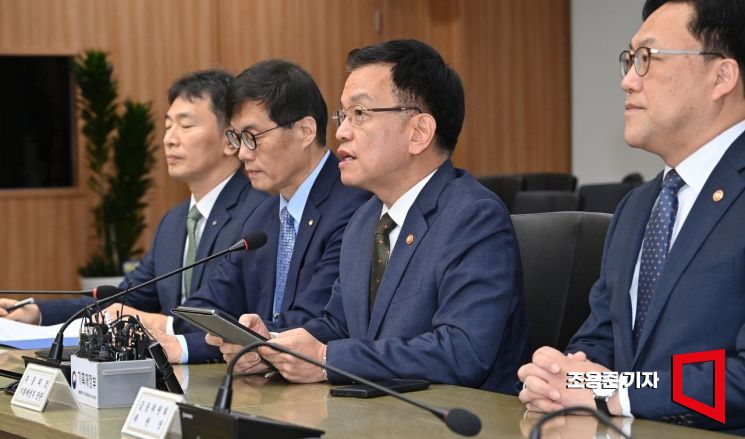 Choi Sang-mok, Deputy Prime Minister for Economy and Minister of Strategy and Finance, is speaking on the US presidential election, FOMC results, and international financial market trends at the Macroeconomic Financial Meeting held at the Export-Import Bank in Yeouido, Seoul on the 8th. From left: Lee Bok-hyun, Governor of the Financial Supervisory Service; Lee Chang-yong, Governor of the Bank of Korea; Deputy Prime Minister Choi; Kim Byung-hwan, Chairman of the Financial Services Commission. Photo by Jo Yong-jun
© The Asia Business Daily(www.asiae.co.kr). All rights reserved.



















