KAIST-Hosted National Assembly Strategic Game Era Korea Strategy Forum
Participants Mention Need for Strategy Shift Focused on AI Regulation
With Donald Trump, the President-elect of the United States, expected to significantly ease regulations on artificial intelligence (AI) if he begins his term, there is a growing outlook that our government should actively support companies to promote technological independence.
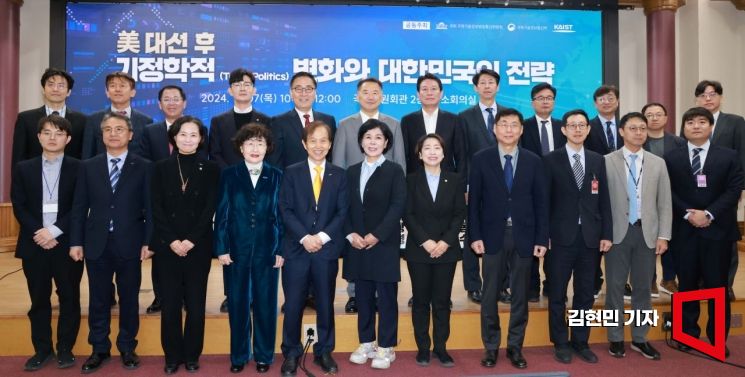 Chairperson Choi Min-hee and members of the National Assembly Science, ICT, Broadcasting and Communications Committee, along with KAIST President Lee Kwang-hyung and other attendees, are taking a commemorative photo at the discussion on Tech-Politics changes after the U.S. presidential election and South Korea's strategy, held on the 7th at the National Assembly Members' Office Building. Photo by Kim Hyun-min
At a discussion held on the 7th at the National Assembly by the Korea Advanced Institute of Science and Technology (KAIST) titled "Geopolitical and Policy Changes after the US Presidential Election and South Korea's Strategy," the consensus was that the US stance on AI will change dramatically. A prime example is the rapid rise of Elon Musk, CEO of Tesla. Musk is accelerating AI development while operating XAI alongside Tesla and SpaceX. He was also an early investor in OpenAI, the developer of ChatGPT.
Yoon Jung-hyun, a researcher at the Institute for National Security Strategy, mentioned, "Musk attended the AI summit held in the UK last year and questioned why governments should regulate AI."
He added, "While Biden focused on AI safety, Trump criticized the Biden administration's AI policies as hindering innovation. Trump is likely to support private sector self-regulation of AI."
If the AI regulations promoted by the Biden administration are significantly relaxed under Trump's administration, it could become even more difficult to catch up with the US. Especially since the US virtually monopolizes GPUs essential for AI development, the current trend where AI development is led by the US and regulation by the European Union (EU) is expected to change substantially.
Researcher Yoon advised, "Our AI Basic Act could also be greatly affected," and suggested approaching the issue from a long-term perspective rather than focusing on short-term achievements.
Lee Dong-soo, Director at Naver who develops AI using semiconductors in the corporate field, expressed concern, saying, "Recently, in the AI field, technologies are not even disclosed through papers due to fears of technology leakage." This comment anticipates a further strengthening of the US-centered AI dominance system. Lee cited the recent fourfold increase in usage fees by the US AI company Anthropic as an example and proposed, "AI and semiconductor stakeholders should unite and adopt a self-reliant technology strategy."
Director Lee also pointed out issues regarding regulation. He said, "Although it is said that regulations will be greatly eased, there are actually considerable regulations," and emphasized, "It is also important for us to widely provide AI services and increase semiconductor demand."
Professor Baek Seo-in of Hanyang University emphasized the role of the state, saying, "I think we have spent time in complacency. We need to wake up." He evaluated, "The state should play a role in areas where the private sector cannot. We have indeed provided insufficient support to companies. The problem is too little support rather than technological independence."
Professor Baek continued, "Research on mid- to long-term geopolitical strategies is necessary, and clear directional action plans must be concretely established. Without this, our momentum could be lost or easily taken by other countries," expressing concern and suggesting the need for international cooperation to accurately grasp information.
Professor Seo Yong-seok of KAIST said, "In the era of technological hegemony competition, the key is securing talent. Even if we invest budgets to train talent, they are being poached," citing that the number of KAIST PhD graduates employed overseas has quadrupled over the past eight years. He added, "While treatment is important, we need to create a country where scientists look admirable."
Semiconductor expert Professor Yoo Hoi-jun of KAIST evaluated, "Trump focuses on the economy, so compared to the Biden administration, which emphasized alliance-level responses in diplomatic matters, it might be easier." He said, "If money earned in China is invested in the US, Trump might like it."
Professor Yoo also analyzed that it is necessary to diversify semiconductor supply chains by expanding into various regions and to implement more sophisticated semiconductor policies. He pointed out the current problem in the Korean semiconductor industry where the ecosystem is disappearing and only Samsung and SK Hynix are visible. Professor Yoo said that Korea can lead the world sufficiently with neuromorphic technology and AI applied to home appliances and factories as AIX.
The discussion was attended by National Assembly Science, ICT, Broadcasting and Communications Committee Chairperson Choi Min-hee, Whips Choi Hyung-doo and Kim Hyun, along with other lawmakers and expert groups, who agreed on the need for efforts at the National Assembly level.
President Lee Kwang-hyung stated, "Depending on the US presidential election results, technological competition between the US and China is likely to intensify, but it simultaneously presents new challenges and opportunities for our country," and proposed, "The direction South Korea should take is to develop essential technologies such as artificial intelligence and semiconductors to the world's highest level to secure scientific and technological sovereignty, and to nurture the necessary scientific and technological talent for this purpose."
© The Asia Business Daily(www.asiae.co.kr). All rights reserved.
![User Who Sold Erroneously Deposited Bitcoins to Repay Debt and Fund Entertainment... What Did the Supreme Court Decide in 2021? [Legal Issue Check]](https://cwcontent.asiae.co.kr/asiaresize/183/2026020910431234020_1770601391.png)















