Professor Kim Jeonghu of London City University Lectures on 'Sustainable Glocal Cities'
Introducing European Cases... "Balanced Urban Regeneration in Economy, Society, and Environment"
■ Gwangju City-Gwangju Policy Research Association '9th Policy Forum'
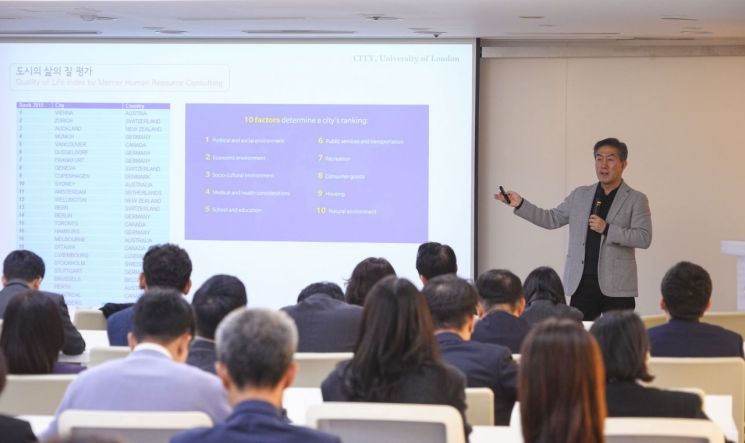 Kim Jeong-hu, Director of the Urban Architecture Policy Research Institute at London City University, is giving a lecture on "Sustainable Glocal Cities in 21st Century Europe" at the 9th Policy Forum held on the morning of the 7th in the City Hall medium conference room. Photo by Gwangju City
Gwangju City and the Gwangju Policy Research Association held the 9th Policy Forum on the 7th at the City Hall's medium conference room under the theme of "Sustainable Glocal Cities in 21st Century Europe." The forum aimed to examine cases of sustainable urban regeneration in 21st century Europe and discuss the direction of urban development in Gwangju.
About 100 people attended the forum, including Mayor Kang Ki-jung, Choi Chi-guk, Director of the Gwangju Research Institute, Gwangju city officials, and executives from public institutions.
Professor Kim Jeong-hoo from London City University gave a lecture on urban regeneration cases and the resulting urban changes in 21st century European cities such as London, Paris, Amsterdam, and Stockholm.
Professor Kim stated, "Since 2007, the global urban population has surpassed the rural population, and new urban problems such as inequality, car-centric infrastructure, poor housing, and environmental issues have intensified, making it impossible to solve these issues through traditional quantitative growth alone. In the 21st century, qualitative growth has also become important, and sustainable urban regeneration that balances the economy, society, and environment must be achieved."
He introduced cases where private sector participation in urban regeneration created startup hubs by utilizing abandoned buildings and solved various urban problems, such as the Google Campus in London, Station F in France, and Norrken House in Stockholm. Amsterdam’s "Westergasfabriek" was presented as a case where a disused gas factory was transformed through urban regeneration into a park, performance hall, and an eco-friendly hotel called the "Conscious Hotel," fostering environmental awareness and coexistence with residents.
In response to questions about benchmarking effects and private sector participation from attendees, Professor Kim emphasized, "There is a reason why advanced countries are removing airports and reducing roads to create cities centered on public transportation, bicycles, and walking," adding, "Creative benchmarking tailored to the local context is necessary." He also noted, "Urban regeneration projects that started with government and local government budget support eventually stopped once the funding ended," and answered, "Although it is challenging, an environment must be created where companies and citizens participate as main agents of urban regeneration to ensure sustainability."
Mayor Kang Ki-jung of Gwangju said, "Through the lecture, I gained many ideas about urban regeneration, including cases from France," and added, "Gwangju will also transform into a sustainable glocal city through urban regeneration and revitalization of startups."
Meanwhile, the "Policy Forum" is a policy discussion platform co-hosted by Gwangju City and the Gwangju Policy Research Association. It has held forums on various topics such as local decentralization, data, distributed energy, shrinking society, and climate/environment, with this being the 9th session. The 10th Policy Forum is scheduled to be held in January next year.
© The Asia Business Daily(www.asiae.co.kr). All rights reserved.
![Clutching a Stolen Dior Bag, Saying "I Hate Being Poor but Real"... The Grotesque Con of a "Human Knockoff" [Slate]](https://cwcontent.asiae.co.kr/asiaresize/183/2026021902243444107_1771435474.jpg)
















