Overview of Seoripul District
More than Half of Long-term Jeonse 2 Supply, SH Corporation's Role Increasing
Possibility of LH and SH Corporations Dividing Zones for Development
Estimated 4,000 Integrated Public Rental Units out of 20,000 Households
Private Developers May Participate in Station Area Development, Some Units for Sale
The outline of the Seoripul District land development project, which will supply 20,000 households in Seocho-gu, Seoul, is gradually emerging. Although it is a land development project, the government is considering a plan for Seoul Housing and Communities Corporation (SH Corporation) to jointly implement half of the project. Since the proportion of long-term lease housing exceeds half, there is also a proposal to develop it separately from the sale housing. While reviewing the addition of new stations on the Shinbundang Line, the government is also considering involving private developers in some parts of the station-area complex development, and private sale units are also expected to be released.
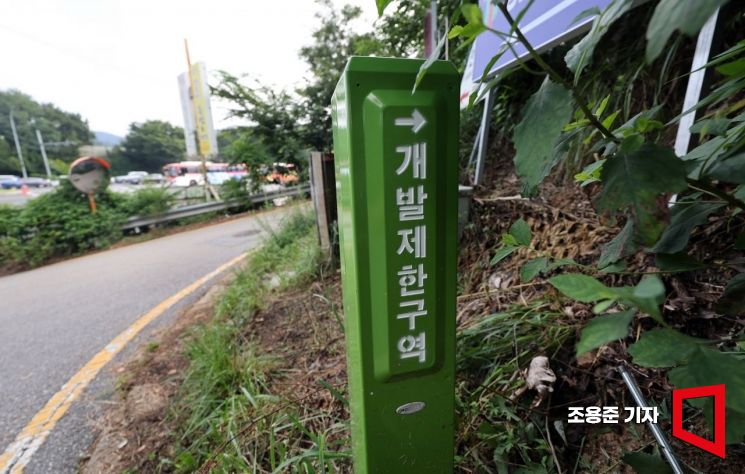 The government announced the release of the Greenbelt (development-restricted areas) within the metropolitan area, discovering new housing sites totaling 80,000 units, with 50,000 units this year and 30,000 units next year. The photo shows the development-restricted area around Naegok-dong, Seocho-gu, Seoul, which is strongly considered for Greenbelt release as of the 9th. Photo by Yongjun Cho jun21@
Seoripul District to be Developed 5:5 by LH and SH Corporation
According to Seoul City and others on the 7th, Seoul City and the Ministry of Land, Infrastructure and Transport (MOLIT) are discussing a plan for LH Corporation and SH Corporation to each implement the Seoripul District development at a 5:5 ratio. A Seoul city official said, "MOLIT suggested designating the implementers quickly, and we conveyed the opinion that joint implementation with a half share each is necessary."
Seoul City’s position is that 55% (11,000 households) of the housing supplied in Seoripul District will be newlywed couples’ long-term lease housing 2 (Miri-nae House), and that SH Corporation’s increased share is necessary for future rental housing management. A Seoul city official explained, "A significant number of long-term lease houses will be built in Seoripul District, and LH has no experience supplying long-term lease housing. Since this is land located in Seoul, SH Corporation has more know-how regarding long-term lease housing."
MOLIT also agrees with joint implementation and plans to meet with LH and SH Corporation soon to discuss the details of joint implementation. Jin Hyun-hwan, MOLIT’s first vice minister, recently appeared on MBC radio and said, "We plan to implement the project jointly with LH and SH Corporation," adding, "Rather than selling the land to the private sector, most of it will be public housing directly built by public corporations."
MOLIT intends to discuss various plans regarding the implementation ratio and each party’s role. There is also a possibility of dividing the district into zones for sale housing and long-term lease housing for separate development. A MOLIT official said, "Since many long-term lease houses will be built, SH Corporation will have to play a large role. LH will proceed with what it can first, and an agreement will be made. We will discuss various plans, including development by zones (blocks)."
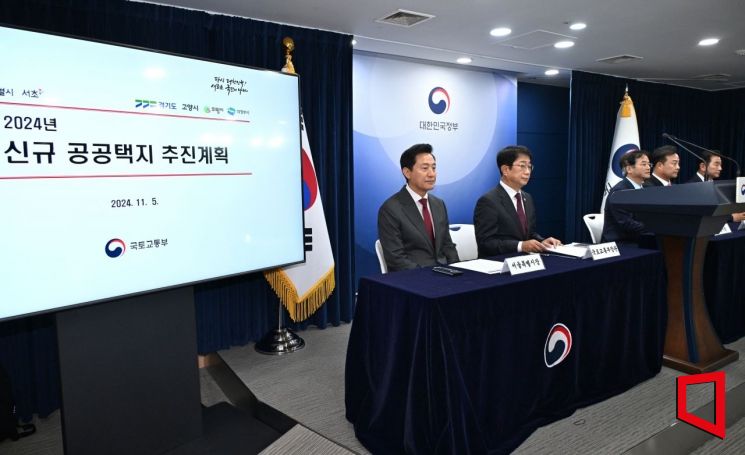 The Ministry of Land, Infrastructure and Transport announced on the 5th at the Seoul Government Complex a plan to supply 50,000 housing units by announcing new public land candidates as a follow-up measure to the August 8th policy. (Photo by Seoul City)
SH Corporation Shows Strong Willingness to Participate Amid Lack of Projects
SH Corporation, which lacks development projects, is showing a strong willingness to participate actively. Land development projects are the main source of revenue for public corporations. The structure involves purchasing land, compensating owners, and selling it for profit. In Seoul, due to a shortage of developable land, SH Corporation has not been able to proceed with new large-scale land development projects since the Magok District. Local housing public corporations such as GH have criticized that it is excessive for LH to take full charge of regional land development projects. In the case of the 3rd New Town project, LH and GH jointly implemented the project at an 80% and 20% ratio, respectively.
Park Seung-jin, a Seoul city council member, requested during the Seoul city administrative audit, "It has become important who will take charge of future land development and housing construction," and asked, "Please closely coordinate with MOLIT so that SH Corporation can lead the project at least on Seoul city-owned land." In the past, LH conducted large-scale land development in Yangwon District, Jungnang-gu, but local residents’ and tenants’ demands were not reflected after the development. Councilor Park pointed out, "For LH, it was just one of many project sites, and they left after only seeking profit." Until now, government-led land development projects have often been led by LH or had LH’s participation ratio overwhelmingly high. In the Wirye New Town development project, which was jointly implemented by LH and SH Corporation, LH developed 75% and SH Corporation 25%.
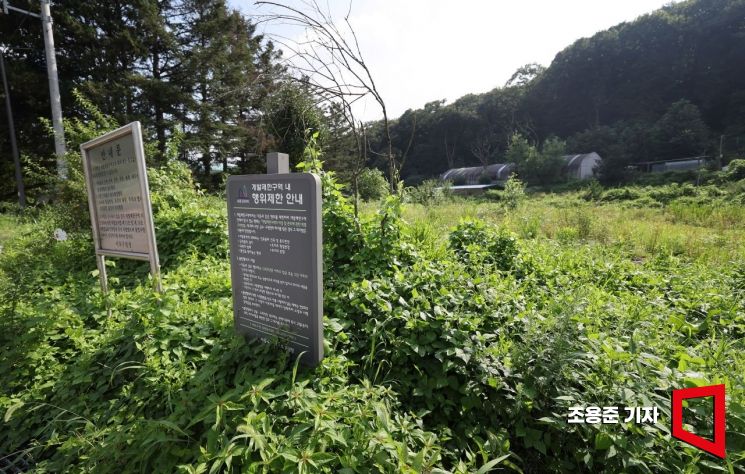 The government announced the release of the Greenbelt (development-restricted areas) within the metropolitan area to discover new housing sites totaling 80,000 units, with 50,000 units this year and 30,000 units next year. The photo shows the development-restricted area around Naegok-dong, Seocho-gu, Seoul, which is strongly considered for Greenbelt release as of the 9th. Photo by Yongjun Cho jun21@
Station-Area Development to Include Private Sale Units
Private sale housing units are also expected to be released within Seoripul District. However, the supply is expected to be small-scale near station areas. Vice Minister Jin said, "Unlike the past public rental housing, pure private sales will be limited to station-area housing." A Seoul city official also explained, "Since the greenbelt is being lifted to supply housing, public interest must be secured, so we plan to review a method to minimize supply by developing only some areas where private participation is necessary, such as station areas."
Excluding the 11,000 long-term lease houses from the 20,000 households supplied in Seoripul District, and assuming up to 20% (up to 4,000 households) of integrated public rental housing, the total sale volume is estimated to be 5,000 households or less, which is below 25%.
The government emphasized ‘public interest’ several times when announcing the new land site candidates. Since the greenbelt, which had been restricted for development for future generations, is being lifted, securing ‘public interest’ is seen as an important task. In the case of the so-called ‘half-price apartments’ public rental housing, individuals who purchased at prices lower than market value monopolized the price difference.
Furthermore, MOLIT expects that most of Seoripul District can be supplied as original land, enabling rapid project promotion. However, the speed of project promotion is directly linked to compensation, so smooth compensation as well as original land supply is necessary to accelerate the project. Vice Minister Jin explained, "Seoripul District will be supplied as original land," adding, "Original land preserves the terrain, allowing the project to proceed more quickly."
© The Asia Business Daily(www.asiae.co.kr). All rights reserved.
![Clutching a Stolen Dior Bag, Saying "I Hate Being Poor but Real"... The Grotesque Con of a "Human Knockoff" [Slate]](https://cwcontent.asiae.co.kr/asiaresize/183/2026021902243444107_1771435474.jpg)


















