Conflict Continues Within Coalition Over Budget and Economic Policies
New Confidence Vote Scheduled for January Next Year... Early General Election Expected in March
German Chancellor Olaf Scholz abruptly dismissed the Finance Minister, who had opposed his economic policies, causing the so-called 'traffic light' coalition government (Social Democratic Party, Free Democratic Party, Green Party) to collapse. Amid rapidly spreading political turmoil in Germany, Chancellor Scholz announced that he plans to initiate a vote of confidence in himself in January next year.
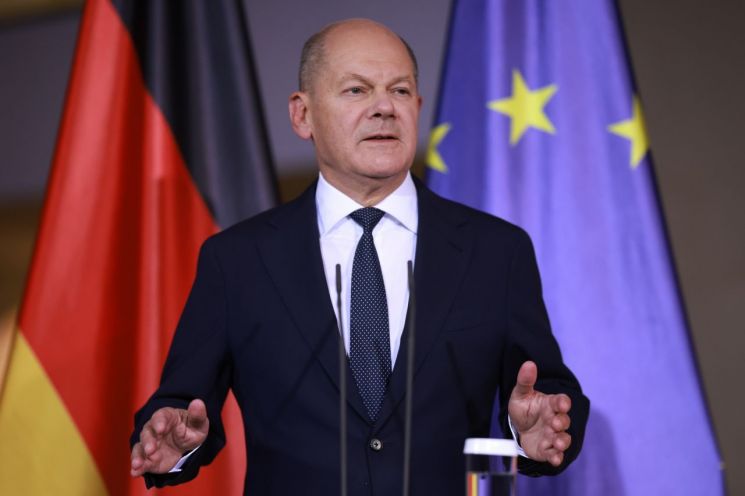
According to Deutsche Welle and others, on the evening of the 6th (local time), Scholz held a live-streamed press conference where he announced that he had requested President Frank-Walter Steinmeier to dismiss Finance Minister Christian Lindner, leader of the Free Democratic Party (FDP). He explained the dismissal by saying that although he presented a comprehensive plan and a new compromise regarding the 2025 budget, Minister Lindner rejected it, stating, "The Finance Minister has no intention of implementing the proposal for the benefit of our country. We had to ensure that our country would not suffer damage."
The dismissal of federal government ministers in Germany officially requires the Chancellor to request and obtain approval from the President. Deutsche Welle described it as a "bombshell announcement," reporting that "Scholz's patience, previously regarded as tedious and technocratic, has run out." The dismissal of Minister Lindner immediately led to the resignation of other FDP ministers, including Transport Minister Volker Wissing.
The next year's budget has long been cited as one of the causes of division among the three parties in the coalition government. Lindner, who has opposed the coalition's economic policies with a pro-business stance, argued that the 2025 budget must be fundamentally reorganized. Last week, he released an 18-page list of demands including cuts to social welfare budgets, reductions in climate protection measures, tax cuts for businesses, and tax relief for high-income earners. This was interpreted as a de facto "final ultimatum." In response, Chancellor Scholz proposed a new compromise, stating that Lindner's demands did not align with the policy direction agreed upon in the traffic light coalition, but ultimately the gap was not bridged. Scholz also emphasized that the current coalition budget includes measures to reduce corporate energy costs, preserve jobs in the automotive industry, and increase tax incentives for companies making investments.
At the press conference, Scholz harshly criticized Minister Lindner, saying he was "acting irresponsibly," "only concerned with his supporters and the survival of his party," and displaying "an incomprehensible level of selfishness." Deutsche Welle noted that "Scholz's voice trembled slightly," adding that "the speech was so detailed that it was hard to imagine the Chancellor had only just synthesized all this information today." The Guardian also reported that "the discord and resentment in Berlin showed no signs of abating," and that "the unpopular three-party coalition government has ended."
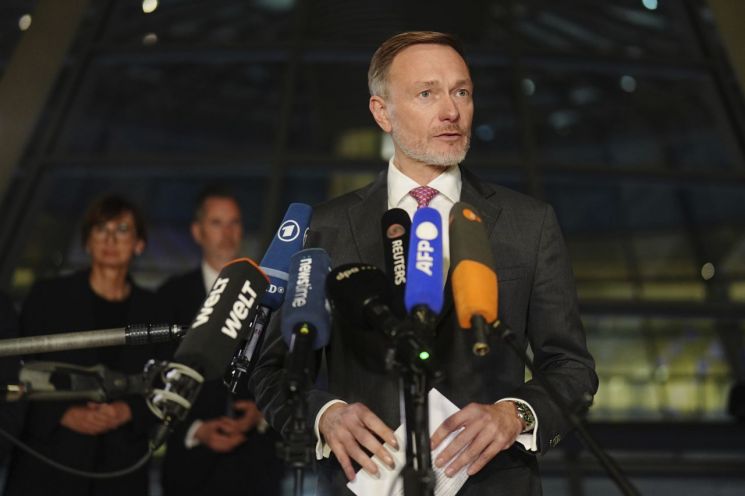 Christian Lindner, Germany's Finance Minister from the Free Democratic Party, is expressing his position on the 6th (local time) in Berlin immediately after Chancellor Olaf Scholz announced his dismissal. · Photo by AP Yonhap News
Accordingly, Scholz will lead a minority government centered on the remaining Social Democratic Party and Green Party members of the traffic light coalition for several weeks. He plans to submit a vote of confidence in himself to the Bundestag on January 15 next year. Local media have reported that the likelihood of Scholz being voted out of office in the confidence vote is high, which could lead to the early dissolution of parliament and a snap election in March. The originally scheduled election date is September next year.
Scholz also called on the opposition parties to cooperate. He said he would immediately seek dialogue with Friedrich Merz, leader of the main opposition party, the Christian Democratic Union (CDU), to build cooperation on two urgent issues: strengthening defense capabilities and boosting the economy. He added, "Our economy cannot wait until the next general election is held."
Referring to the U.S. presidential election concluded with the election of former President Donald Trump, Scholz said, "Anyone who has observed the United States in recent weeks would have confirmed that the country is deeply divided," and emphasized that such a situation must not happen in Germany. Immediately afterward, Scholz left without taking any questions. Deutsche Welle described this as "no questions were taken after the most impressive speech," and assessed that "it is clear how deeply frustrated Scholz has been in recent weeks." The outlet also added that it is uncertain whether the remaining coalition members or the opposition will support his plans.
Clemens Fuest, an economist at the Ifo Institute, told The Guardian that the situation is "economically difficult," and that "there is no doubt that a new government capable of acting as soon as possible is needed."
Minister Lindner, immediately after Scholz's press conference, criticized the Chancellor, saying, "(Scholz) has long failed to recognize the need for a new economic awakening in our country," and accused him of "disregarding the economic concerns of the people." He stated, "We are ready to take responsibility for this country," and "We will fight to do the same under a different government next year."
Leading fiscal policy, Minister Lindner had previously clashed openly with Chancellor Scholz, holding a separate business meeting on the same day Scholz convened business leaders to discuss economic stimulus. He also had repeated conflicts with Robert Habeck, the Minister for Economic Affairs and Climate Protection (Green Party), over issues such as green subsidies.
© The Asia Business Daily(www.asiae.co.kr). All rights reserved.
![Clutching a Stolen Dior Bag, Saying "I Hate Being Poor but Real"... The Grotesque Con of a "Human Knockoff" [Slate]](https://cwcontent.asiae.co.kr/asiaresize/183/2026021902243444107_1771435474.jpg)

















