Strengthening Protectionism and US First Policy
Former President Donald Trump has returned after four years. In his second term, the Trump administration is expected to drive "America First" and protectionism more quickly and forcefully, based on the experience of his first term. Trump has already announced multiple times his plans to impose high tariffs and repeal various policies of the Biden administration. With the Republican Party also dominating Congress, he has secured strong momentum. Significant changes are expected not only within the United States but also in the foreign policy stance, which has deeply involved itself in international affairs as the "world's police."
Blueprint Prepared Early... Strengthening 'America First'
According to The Washington Post (WP), former President Trump has announced 41 executive orders to be implemented on his first day back in the White House. He has also prepared a governance blueprint early on through initiatives like "Project 2025" and the "America First Policy Institute (AFPI)."
The U.S. political media outlet Politico reported that Trump’s associates expect him to move faster than during his first term to achieve his goals. They also analyzed that he intends not only to overturn Biden administration policies but to fundamentally restructure policies and federal agencies.
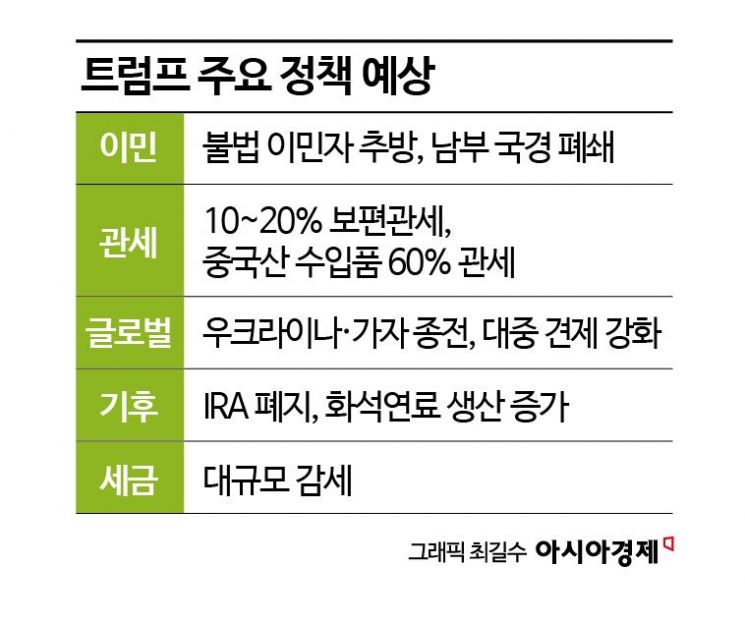
The second Trump administration is expected to significantly strengthen protectionism by prioritizing tariffs and trade. Trump, who has stated that his favorite word is "tariff," has announced plans to impose comprehensive tariffs to reduce the massive trade deficit. He plans to impose a universal tariff of 10-20% on $3 trillion worth of imports and a 60% tariff on all Chinese imports. This expands the tariffs on Chinese steel imposed during his first term to all imports. He is also expected to take an aggressive stance at trade tables with allies, including the 2026 U.S.-Mexico-Canada Agreement (USMCA) negotiations.
Immigration is a key issue in this U.S. presidential election and is considered a driving force behind Trump’s election. According to WP, Trump has pledged 74 times to implement strong immigration policies on his first day in office. His plan includes detaining illegal immigrants in large-scale immigrant detention centers and conducting the largest deportation operation in history. There is also talk of reintroducing the policy of separating illegal immigrant families at the border.
Ending Two Wars... Strengthening Checks on China
The two major global diplomatic issues?the Ukraine war and the Gaza war, known as the "two wars"?are likely to be concluded soon. Trump, who advocates "America First," criticized these two wars throughout the election campaign as failures of the Biden administration. Regarding the Ukraine war, he pledged to initiate peace negotiations within 24 hours of taking office and emphasized that extensive material support harms U.S. national interests. The war between Ukraine and Russia, which has lasted two years and nine months, is expected to come to an end soon. Although he has not clearly stated his position on the Gaza war, according to Israeli media reports, Trump told Israeli Prime Minister Benjamin Netanyahu that he hopes the war will end before his inauguration in January next year. The Biden administration’s advanced technology sanctions and other measures to check China are expected to be further strengthened.
IRA Repeal and Large-Scale Tax Cuts Likely Difficult
Significant changes are also anticipated in climate policy. Trump has repeatedly emphasized that he will repeal the Inflation Reduction Act (IRA), which includes electric vehicle subsidies, and reclaim the budget immediately upon taking office. He also stated that he would pursue a fossil fuel-centered policy. However, U.S. media consensus is that a full repeal of the IRA is impossible due to legal and procedural issues and opposition within the Republican Party. Moreover, since oil companies have invested significantly in low-carbon energy projects, it is believed that rather than a full repeal, stricter conditions on subsidies and tax credits will be imposed through executive orders.
Large-scale tax cuts have also been promised. The $460 billion tax cut policy implemented during Trump’s first term is set to expire in 2025, and Trump has promised to make it permanent. He has also proposed new tax cuts, including the elimination of the tip tax. However, with the U.S. government’s fiscal deficit reaching $2 trillion, passing these measures through Congress is expected to face significant challenges. Trump plans to fund the tax cut initiatives by raising tariffs and repealing IRA tax breaks, but Politico predicts this will be difficult.
© The Asia Business Daily(www.asiae.co.kr). All rights reserved.


















