‘Suseo Taekji Development District’ Residential Environment Improvement
Complex Development to Strengthen Suseo Station’s Core Functions
Final Decision Planned for First Half of Next Year
Seoul City will ease height regulations to promote reconstruction in the Suseo and Irwon-dong areas of Gangnam-gu. The city will also actively pursue complex development to strengthen the central function of Suseo Station.
On the 7th, the city announced that it has prepared a redevelopment plan for the ‘Suseo Housing Development District’ unit planning zone and will open it for public inspection and collect residents' opinions from today until the 21st.
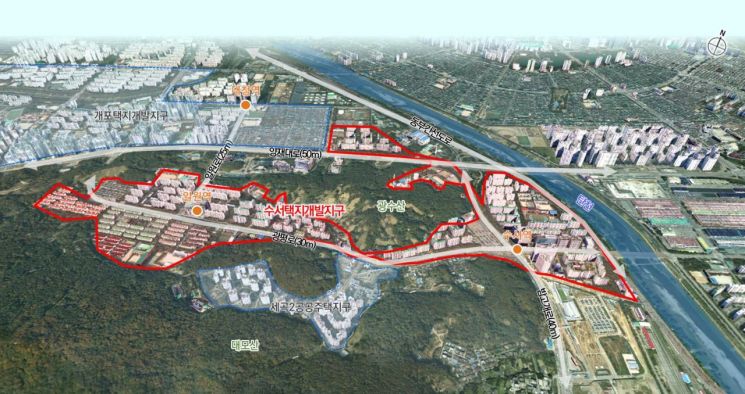 Location map of 'Suseo Residential Development District' in Gangnam-gu, Seoul. Provided by Seoul City
The Suseo Housing Development District was established in the early 1990s to alleviate the housing shortage in Seoul. Most of the 16 complexes developed at that time have been completed for over 30 years, making redevelopment necessary. The need to strengthen the central function of Suseo Station has also been consistently raised.
Accordingly, the city launched a basic plan and unit planning redevelopment project for the Suseo Housing Development District in September last year, holding 13 expert (MP) advisory meetings and consultations with related departments. This redevelopment plan is the first in 12 years since 2012. The city explained, “The plan includes spatial conditions of the Suseo Housing Development District (1,335,246㎡) and measures to respond to future changes in residential culture.”
First, housing complexes that have reached the redevelopment period will be designated as special planning zones to proactively support reconstruction. Height regulations applied to the general commercial areas around Suseo Station will be eased differentially to 120m along Bamgogae-ro, 100m in other areas, and 70m elsewhere. Previously, height limits were 100m along Bamgogae-ro, 80m along Gwangpyeong-ro, and 25?30m or less in side areas.
Complex development around Suseo Station will also be promoted, considering its status as a central area. Industrial and residential support functions will be introduced to support the creation of office, retail, and cultural spaces, and an underground pedestrian network linked to the Suseo Station area will be established to enhance accessibility and connectivity.
Additionally, reflecting the pleasant residential characteristics around Irwon Station, a pedestrian green space connecting east-west between Suseo Station along Gwangpyeong-ro will be created, and a natural-friendly specialized district harmonizing with Daemosan will be induced in the low-rise residential complexes on the south side of Gwangpyeong-ro, along with improvements to residential conditions.
After completing the public inspection and review of residents’ opinions on the redevelopment plan for the Suseo Housing Development District unit plan, the city plans to finalize (or revise) the unit plan in the first half of next year following a traffic impact assessment and review by the Seoul City Urban and Architectural Joint Committee.
Jo Nam-jun, head of Seoul City’s Urban Space Headquarters, said, “We will do our best to strengthen the regional central functions reflecting the changed local conditions of the Suseo Housing Development District and to improve the residential environment of housing complexes that have reached the redevelopment period.”
© The Asia Business Daily(www.asiae.co.kr). All rights reserved.

















