Gwangju City Councilor Kang Su-hoon Holds Policy Debate Meeting
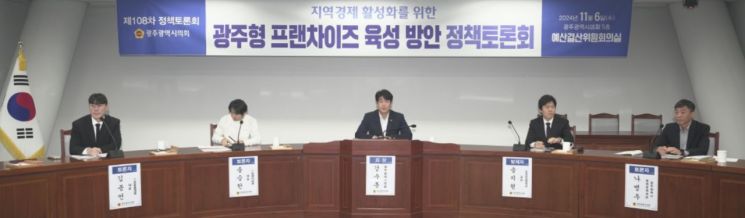 Councilor Kang Su-hoon of Gwangju City Council held a policy forum on the 6th in the 5th-floor Budget and Accounts Special Committee meeting room of the City Council, focusing on "Plans to Foster Gwangju-type Franchises" to revitalize the local economy.
 [Photo by Gwangju City Council]
Kang Su-hoon, a member of the Gwangju Metropolitan Council (Democratic Party, Seo-gu 1), held a policy forum on the morning of the 6th in the 5th-floor Budget and Accounts Special Committee meeting room of the City Council, with the theme of "Plans to Foster Gwangju-type Franchises" to revitalize the local economy. The forum was organized to explore ways to strengthen the competitiveness of small business owners and self-employed workers in the Gwangju area.
The forum was chaired by Councilor Kang Su-hoon, and the discussion proceeded in the order of a presentation by Professor Song Ji-hyun of Chosun College of Science and Technology, followed by discussions from Song Seung-han, CEO of Brave Queen Co., Ltd., Kim Jong-eon, CEO of Moram Platform Co., Ltd., and Na Byung-woo, Director of the Gwangju City Economic Policy Division.
Professor Song Ji-hyun stated, "The Gwangju-type franchise is an expansion concept of the Gwangju-type job project, focusing on creating high value-added items by utilizing local agricultural and livestock products, regional cultural resources, and processed goods. Local governments, affiliated organizations, regional financial institutions, franchise-specialized universities, research institutes, and local dining organizations and small business owners must collaborate to help Gwangju grow into a new innovation model and a competitive small and medium-sized enterprise."
CEO Song Seung-han, who participated in the discussion, said, "Last year, the closure rate of self-employed businesses in Gwangju was 11.8%, the highest nationwide, and the vacancy rate was also the highest in the country." He raised his voice emphasizing the urgency of enacting the "Gwangju-type Franchise Support Ordinance" through this policy forum.
CEO Kim Jong-eon argued, "Franchise startup education is an essential infrastructure not only for simple support but also for revitalizing the local economy and creating jobs. For this system, cooperation among local governments, financial institutions, and the private sector, as well as strengthening education and support networks, must be prioritized."
Na Byung-woo, Director of the Gwangju City Economic Policy Division, said, "The number of franchise headquarters and brands in the Gwangju area is on the rise. Going forward, we plan to strengthen education and consulting support projects so that prospective franchise entrepreneurs and operators can acquire relevant expertise." He added, "We will also consider ways to foster healthy franchises that coexist with local commercial districts."
Councilor Kang said, "Now is not a competition between countries, but a competition between cities. When many companies start with one directly managed store in Gwangju, establish headquarters, and expand throughout South Korea and globally, Gwangju's status will rise. This is why fostering Gwangju-type franchises is important." He emphasized, "Gwangju, which has strengths in food culture, needs to devise various plans to nurture food-related companies and promptly establish a system to activate the franchise industry that will expand domestically and internationally."
© The Asia Business Daily(www.asiae.co.kr). All rights reserved.
![Clutching a Stolen Dior Bag, Saying "I Hate Being Poor but Real"... The Grotesque Con of a "Human Knockoff" [Slate]](https://cwcontent.asiae.co.kr/asiaresize/183/2026021902243444107_1771435474.jpg)
















