Export Opportunities for Our Power Equipment, Infrastructure, and Bio Sectors
Economic Distancing Policy from China Expected to Accelerate
As former President Donald Trump re-enters the White House, KOTRA has analyzed that the United States' economic and trade policies will actively return to protectionism.
On the 6th, KOTRA released a report analyzing the impact of changes in the Trump administration's economic and trade policies on the global trade order, including South Korea. The report includes policy forecasts for the Trump administration as well as interviews with local industry stakeholders conducted through overseas trade offices.
In the report, KOTRA predicted that as the U.S. focuses on high tariffs, supply chain restructuring, and strengthening domestic industries, new opportunities and challenges will arise simultaneously for Korean companies.
KOTRA observed that the Trump administration is expected to reorganize supply chains within the U.S. and strengthen a domestic-centered economic structure through the revival of manufacturing. To this end, it plans to promote economic growth through large-scale tax cuts and deregulation. Policies prioritizing the use of American-made products are expected to be reinforced through energy self-sufficiency and the development of traditional energy industries. The development of advanced technologies and revitalization of manufacturing within the U.S. are also expected to accelerate.
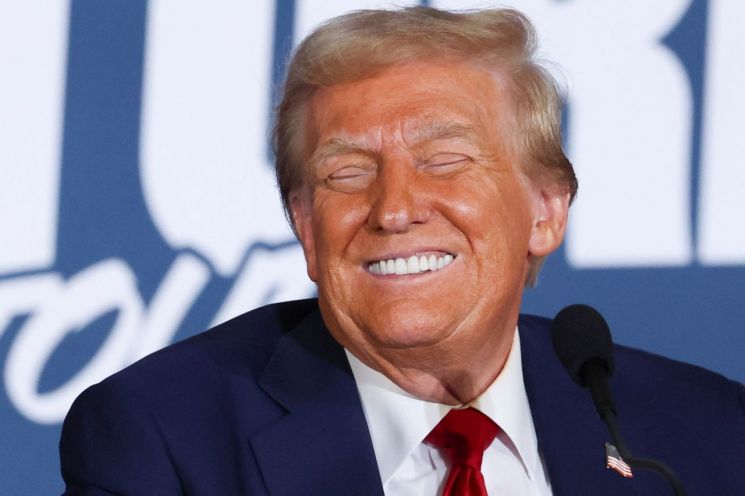 On the 29th of last month (local time), Trump smiling brightly at a campaign rally. Photo by Yonhap News.
Trade policy will focus on imposing high tariffs and decoupling from China. KOTRA stated, "The Trump administration is highly likely to strengthen comprehensive high tariffs and protectionist measures to resolve trade imbalances and protect domestic industries."
Existing trade agreements will also be reviewed with U.S. interests prioritized. Policies to accelerate economic distancing from China and reduce dependence on China in global supply chains are expected to continue.
Korean companies are expected to face both opportunities and risks simultaneously.
KOTRA forecasted that export opportunities will expand in sectors such as power equipment, advanced industrial components, and biotechnology in line with U.S. manufacturing promotion and infrastructure expansion policies. With the expansion of data centers causing a surge in demand for power infrastructure, Korean companies are likely to gain a favorable position in related exports. In the automotive and biotech sectors, Korean products are expected to seize opportunities to replace Chinese products in the U.S. market.
However, there is also a warning that entry barriers may be strengthened. KOTRA pointed out that Trump's high tariff policies could weaken the price competitiveness of Korean consumer goods industries and cause damage. Therefore, it advised strengthening presence in the U.S. market through premium product development and strategic marketing.
Technological innovation is essential in advanced industries such as artificial intelligence (AI) and biotechnology. Since the Trump administration plans large-scale investments in these fields, Korean companies may fall behind if they do not secure technological competitiveness.
Lee Ji-hyung, Head of KOTRA's Economic and Trade Cooperation Headquarters, said, "The U.S. presidential election changes the order and landscape of the global market, so its results and impacts must be closely examined," adding, "We will systematically support our companies' exports and local market entry under the new U.S. government system."
© The Asia Business Daily(www.asiae.co.kr). All rights reserved.
![Clutching a Stolen Dior Bag, Saying "I Hate Being Poor but Real"... The Grotesque Con of a "Human Knockoff" [Slate]](https://cwcontent.asiae.co.kr/asiaresize/183/2026021902243444107_1771435474.jpg)
















