Most Perpetrators Are Teenagers... Focus on Preventive Education
Training for Teachers Conducted, Parent Manuals Distributed
As the government intensifies efforts to punish and support the removal of deepfake false videos, the Ministry of Education has stepped up preventive education and school measures, considering that incidents mainly involve teenagers. They plan to assess students' awareness of deepfakes and conduct tailored prevention and publicity campaigns.
On the 6th, related ministries including the Ministry of Education, the Office for Government Policy Coordination, the Ministry of Gender Equality and Family, and the Ministry of Science and ICT announced the "Strengthened Measures to Respond to Deepfake Sexual Crimes," which includes these details. At a briefing held at the Government Seoul Office that afternoon, Kim Jong-moon, the First Vice Minister of the Office for Government Policy Coordination, stated, "Most perpetrators and victims of deepfake sexual crimes are teenagers. While victims suffer unspeakable pain and damage, perpetrators often do not even recognize the severity of their crimes. Considering this, we will conduct customized preventive education by target group and intensify nationwide public awareness campaigns to raise vigilance against deepfake crimes." According to the police, 506 suspects of deepfake sexual crimes were arrested from January to October this year, of whom 81.2% were teenagers. There were also 78 'criminally irresponsible juveniles' under the age of 14.
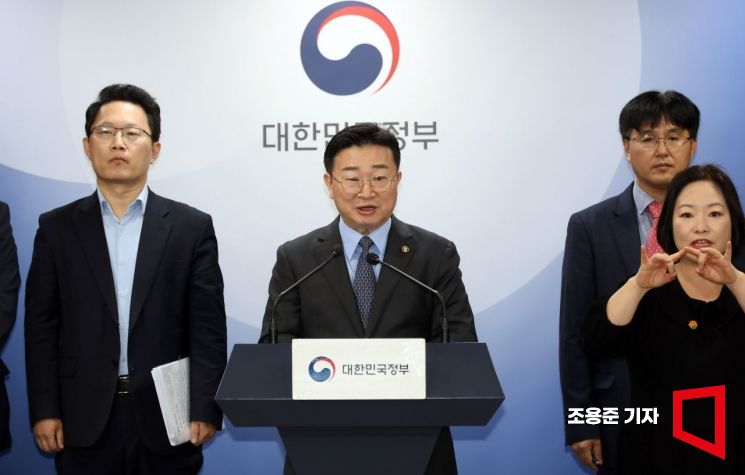 Kim Jong-moon, Chair of the Government-wide Task Force on Deepfake Response (First Deputy Minister of the Office for Government Policy Coordination), is announcing measures to strengthen the joint response to deepfake sex crimes by related ministries at the Government Seoul Office in Jongno, Seoul, on the 6th. Photo by Jo Yong-jun
Earlier, since August, the Ministry of Education has been providing rapid removal support and counseling services linked with the Ministry of Gender Equality and Family’s Digital Sexual Crime Victim Support Center when students or staff report victimization. In cases involving perpetrator students, strict deliberations are conducted during the school violence handling process, and measures such as mandatory special education are implemented.
The Ministry of Education emphasized strengthening preventive education in this new policy. First, a "Deepfake Awareness Survey for Students" will be conducted next year targeting elementary, middle, and high school students to prepare follow-up measures. Digital sexual violence prevention education, which was previously conducted for at least one session per year, will be expanded to "up to 15 sessions." Additionally, five types of manuals for responding to digital sexual crimes will be distributed within this month.
The environment will also be improved to enable teachers and parents to participate in preventive education. Educational materials for prevention will be rapidly developed, and training for teachers will be promoted. When conducting on-site training at schools, "Digital Citizenship Education" will be included as a mandatory course. Education offices will distribute response manuals and prevention content to parents.
Universities will operate awareness improvement programs, including experience booths for prevention programs. Sexual violence officers will undergo three training sessions and simulated case handling drills to strengthen their response capabilities.
Regarding measures for 'criminally irresponsible juvenile' perpetrators, a Ministry of Education official explained, "Although discussions on lowering the age of criminal responsibility for these juveniles have begun, there was significant opposition and caution within schools, so this was not reflected in the current measures."
However, restrictions on smartphone use within schools are under consideration. A Ministry of Education official said, "Recently, the Human Rights Commission also judged that smartphone regulation itself is not a human rights violation, and there is a bill proposed in the National Assembly. We will actively cooperate to develop regulatory measures."
© The Asia Business Daily(www.asiae.co.kr). All rights reserved.
![Clutching a Stolen Dior Bag, Saying "I Hate Being Poor but Real"... The Grotesque Con of a "Human Knockoff" [Slate]](https://cwcontent.asiae.co.kr/asiaresize/183/2026021902243444107_1771435474.jpg)
















