"Knowing the Differences Between Korea and the US Reveals the Answer"
Trinity and Han & Park Publish in LA
Q. I am a U.S. citizen, but I want to spend my senior years in Korea. While looking into nursing hospitals in Korea, I want to live with my relatives. If I leave my U.S. assets to my children living in the U.S., will it be subject to taxation by the Korean government?
A. Korea imposes inheritance tax based on the residence of the decedent. If a U.S. citizen lives in Korea for more than 183 days, it is highly likely that the decedent's worldwide assets will be subject to taxation. In this case, the U.S. may also impose inheritance and gift taxes.
Q. While studying in the U.S., I received $100,000 (about 138 million KRW) annually for 10 years as study funds until I settled down. My parents and younger sibling lived together in Korea. If the $1 million study funds given by my parents are considered an advance gift, can my sibling claim a statutory reserved portion?
A. Korean courts do not recognize amounts spent by parents on their children's education as special profit gifts. Since education is considered a parental obligation, even if the child is an adult, costs for university or graduate school education are generally not regarded as advance gifts.
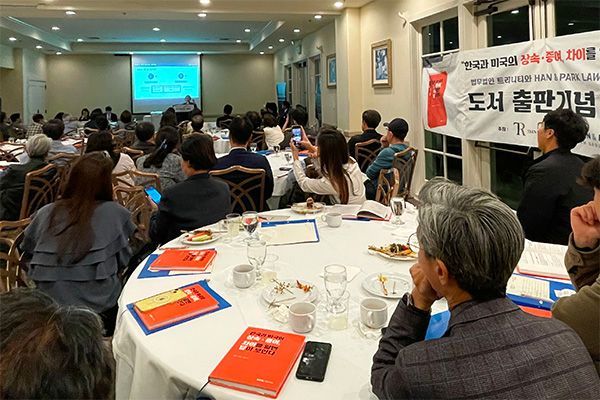
The Korean population residing in the U.S. has surpassed 2 million. Among them are senior generations considering "reverse immigration" to spend their later years in Korea, "Gireogi dads" who hold U.S. permanent residency and live in Korea, and "international students" supported by their parents in Korea. Amid high interest in cross-border inheritance and gift tax issues they face, Korean and U.S. law firms have jointly released related guidelines.
Law firm Trinity and the U.S. law firm HAN&PARK LAW GROUP jointly published Inheritance and Gifts in Korea and the U.S.: Understanding the Differences Reveals the Answers, which addresses the differences in inheritance and gift systems between the two countries for immigrants. They held a two-day publication seminar on the 3rd and 5th in Los Angeles (local time).
The seminar was organized to address inheritance, gift, and trust-related issues faced by immigrants and their families who live between Korea and the U.S. Attendees asked specific questions about whether they are subject to taxation in both countries and which country should be the focus for inheritance and gift planning.
The presentations were given by co-authors, Trinity's lead attorney Sanghoon Kim and U.S. attorneys Yujin Park and Hayan Park from HAN&PARK, explaining the practical differences and application methods of Korean and U.S. inheritance laws and trust systems.
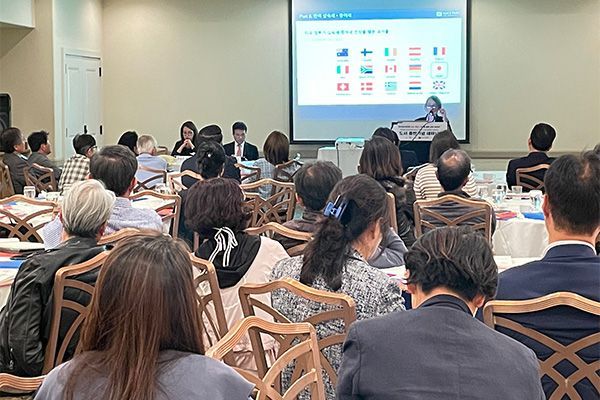
Attorney Sanghoon Kim cited the presence or absence of the statutory reserved portion system as the biggest difference between Korean and U.S. inheritance laws. He said, "If a parent who is a Korean national dies, Korean law applies and a child who is a U.S. citizen can claim the statutory reserved portion. However, if the decedent parent specifies in their will that inheritance will be handled according to California state law, the claim for the statutory reserved portion is exceptionally not possible." He added, "In the case of study funds, Korean courts do not consider them special profit gifts and regard them as support for the child's education, so they are likely excluded from the statutory reserved portion. On the other hand, support for purchasing a house or key money deposit at the time of marriage can be subject to statutory reserved portion return."
Foreign attorney Yujin Park emphasized using the "trust system" to simplify inheritance procedures and effectively protect family assets. Attorney Park said, "In the U.S., there are no public documents to prove family relationships, so verifying family ties or marriage history requires complicated procedures." She stressed, "In such cases, probate procedures typically take 3 to 4 years, and if litigation ensues, it can take much longer." She added, "When a non-resident parent in the U.S. safely transfers assets to their children, trusts are useful tools to protect assets from the children's personal situations such as divorce, bankruptcy, or creditors."
Foreign attorney Hayan Park said, "For 'Gireogi dads' who hold permanent residency and engage in economic activities in Korea, it is essential to consider that they may be regarded as non-residents in the U.S., which can reduce tax exemptions." Regarding reverse immigration, she said, "For those considering senior life in Korea who are U.S. citizens and residents of Korea, not only Korean assets but also assets in the U.S. can be subject to Korean government taxation." She added, "The U.S. also taxes citizens on worldwide assets, so the possibility of double taxation is high."
A representative from a U.S. asset management firm said, "I participated in this seminar because cooperation with legal experts from Korea and the U.S. has increased." He added, "Recently, due to issues with the U.S. medical system, worsening public safety, and deepening polarization, the senior generation considering reverse immigration to Korea is growing."
Reporter Hyunkyung Lim, Legal Times
※This article is based on content supplied by Law Times.
© The Asia Business Daily(www.asiae.co.kr). All rights reserved.
![From Bar Hostess to Organ Seller to High Society... The Grotesque Con of a "Human Counterfeit" [Slate]](https://cwcontent.asiae.co.kr/asiaresize/183/2026021902243444107_1771435474.jpg)

















