Hyundai Motor Starts 'Hyper Casting' Process Test
Order and Installation Completed for One 9000t Press Machine
Full-Scale Operation of Hyper Casting Plant in 2026
Reducing Electric Vehicle Weight to Lower Costs and Improve Energy Efficiency
Hyundai Motor Company has completed the installation of a 9000-ton class ultra-large press machine and is preparing to fully enter the "era of stamping electric vehicles." The goal is to increase the production speed of electric vehicles through the introduction of a new manufacturing process while also contributing to cost reduction.
On the 5th (local time), Italian casting equipment manufacturer IDRA announced that it had completed the installation of a 9000-ton class giga press at Hyundai Motor's Ulsan plant and started the production process. IDRA emphasized that it took only 10 months from equipment delivery to installation and initial production stabilization. The project involved IDRA, Hyundai Motor, and SH Solution, a domestic automotive parts solution company.
Hyundai Motor is promoting the introduction of an ultra-large die casting production method called "Hyper Casting." They are also establishing a dedicated Hyper Casting factory in Ulsan with an investment of 1 trillion KRW. The newly installed equipment is for testing prior to mass production, and full-scale mass production using the new method is expected to begin in 2026 with the operation of the dedicated factory.
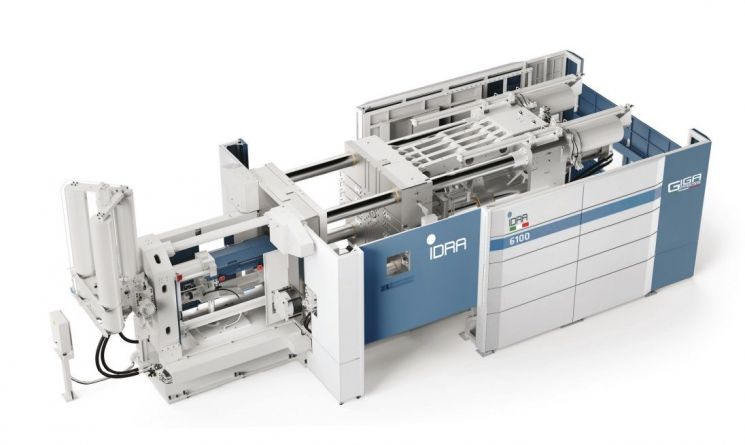 Italy-based foundry equipment company Idra's ultra-large die casting facility "Giga Press" (photo shows the 6000-ton class machine). Idra website
This method involves pouring aluminum alloy castings into a large mold and stamping the body or parts at once under high pressure. The industry notes that Tesla was the first to introduce this method in 2020 under the name "Giga Casting." Along with Hyundai Motor, Toyota, Volkswagen, Volvo, and Chinese companies are actively pursuing its adoption.
The reason automakers are focusing on this method is that it can reduce production costs. In Tesla's case, the rear body parts, which were previously divided into about 70 pieces, were stamped as one, reducing the cost of electric vehicles by 40% and weight by 30%. With the conveyor belt eliminated, the factory production area was also reduced by 20%. Especially for electric vehicles, which are heavier than internal combustion engine vehicles due to battery installation, reducing weight can improve energy efficiency and driving range.
The core of this technology lies in the alloy composition of the casting and the ultra-large press equipment capable of applying extremely high pressure instantaneously. IDRA has been the sole supplier of equipment from the early stages of Tesla's giga press process. They produce ultra-large press machines ranging from 5500 tons to 9000 tons. IDRA is the only company in the world that manufactures 9000-ton class ultra-large press machines. It is known that Tesla ordered IDRA’s 9000-ton press machine for Cybertruck production, and Volvo also ordered two units last year.
A Hyundai Motor official said, "We also ordered one 9000-ton class machine to test the new manufacturing process," adding, "It will still take some time before it is applied to full-scale mass production."
© The Asia Business Daily(www.asiae.co.kr). All rights reserved.

















