Observation of the Sun's Mysteries for Two Years After Installation Work
Near midnight on the 5th, researchers at the Korea Astronomy and Space Science Institute (KASI) control room watching the live broadcast of the solar observation telescope, the Solar Coronagraph, developed in collaboration with NASA, successfully arriving at the International Space Station (ISS), shouted in excitement. This moment marked the successful culmination of the cooperation with NASA that began in 2016.
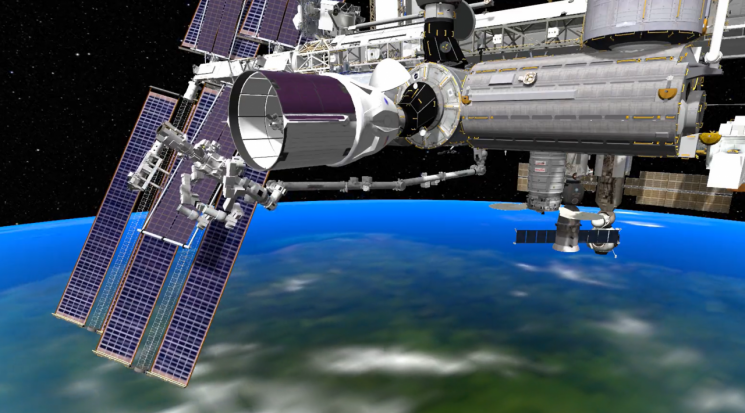 A simulated image of CODEX being installed on the International Space Station. Photo by Space Agency
According to the Space Agency on the 6th, the Solar Coronagraph (hereafter CODEX, COronal Diagnostic EXperiment), launched aboard SpaceX's Dragon cargo spacecraft from Kennedy Space Center in Florida at 11:29 a.m. on the 5th (local time 9:29 p.m. on the 4th), successfully docked with the ISS at 11:52 p.m. (local time 9:52 a.m. on the 5th) about 12 hours later.
From the 9th to the 11th, CODEX will be installed at the designated location (ELC3-3) on the ISS using NASA's robotic arm over three days, undergo about one month of commissioning, and then perform solar observation missions for 6 months up to a maximum of 2 years. During the ISS’s 90-minute orbital period, it will observe the sun for up to 55 minutes each orbit. CODEX not only captures the shape of the solar corona but also simultaneously observes the temperature and velocity of the corona?previously only limitedly observable?within a single instrument, rendering these as two-dimensional images for the first time in the world.
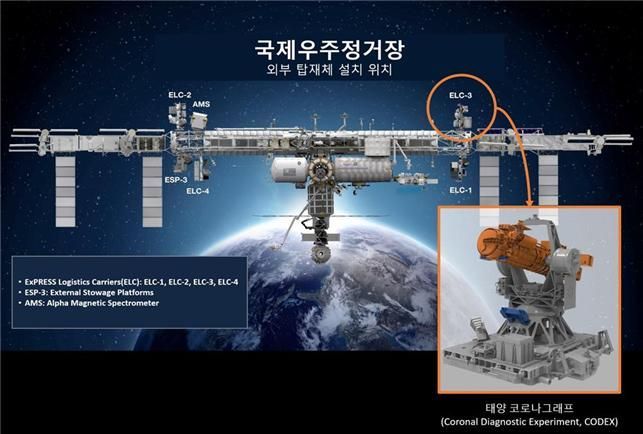
The coronagraph is a special telescope that can observe the corona, the outermost region of the solar atmosphere, which is over a million times dimmer than the solar surface. Because the solar surface, the photosphere, is extremely bright, observing the corona from the ground is difficult except during total solar eclipses. CODEX, jointly developed by Korean and American researchers, is the world’s first coronagraph designed to simultaneously observe the shape, temperature, and velocity of the solar corona within a single instrument and represent these as two-dimensional images. It is equipment aimed at unraveling the mysteries of the sun.
Dr. Kim Yeonhan of KASI, the Korean lead researcher, and Dr. Choi Seonghwan, who oversees the Korean technical development team, said, “We are very pleased and still nervous that the joint cooperation and development with NASA in the field of heliophysics, which began in 2016, has matured to the point of successful launch and docking.”
Kang Hyunwoo, Program Manager for Space Science Exploration Mission Design at the Space Agency, emphasized, “The successful launch of the next-generation coronagraph CODEX represents a significant advancement in space weather forecasting and related research caused by solar activity,” adding, “This launch demonstrates Korea’s elevated status in the field of space science.”
© The Asia Business Daily(www.asiae.co.kr). All rights reserved.
![Clutching a Stolen Dior Bag, Saying "I Hate Being Poor but Real"... The Grotesque Con of a "Human Knockoff" [Slate]](https://cwcontent.asiae.co.kr/asiaresize/183/2026021902243444107_1771435474.jpg)

















