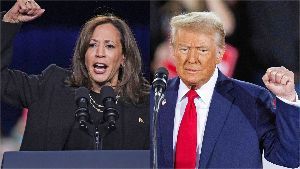
Regardless of who becomes the next president of the United States, the weak won trend due to a strong dollar is expected to continue for a considerable period. The weakened fundamentals of the Korean economy, such as fiscal deficits and a declining position in global trade, are increasing pressure on the won's depreciation, while changes in the dollar trend following the U.S. presidential election results act as a potential risk factor for the won's value decline. There are also predictions that if former President Donald Trump, the Republican candidate, is re-elected, the won-dollar exchange rate could soar to 1,450 won. The Korean government is closely monitoring the impact on the Korean market according to the U.S. election situation while reviewing response measures if necessary.
According to related ministries on the 6th, fiscal and foreign exchange authorities are observing the impact on the Korean market, anticipating that the strong dollar trend will continue after the U.S. presidential election. The Ministry of Economy and Finance plans to hold a meeting on the morning of the 7th, chaired by Deputy Prime Minister and Minister of Economy and Finance Choi Sang-mok, to review the impact of the election results on the domestic and international market economy and prepare response plans. The Bank of Korea is also expected to hold a meeting chaired by the deputy governor sometime this week.
A Ministry of Economy and Finance official said, "It seems clear that the strong dollar trend will intensify if Trump returns to power," adding, "The won-dollar exchange rate rising about 70 won in the past month to around 1,390 won reflects a preemptive reaction to the possibility of Trump's election as a negative factor." Among Trump's pledges, the expansion of fiscal deficits due to tax cuts and inflation intensification caused by tariff increases are raising short-term concerns about a strong dollar. These policies, combined with variables such as the U.S. economy and the pace of interest rate cuts, and ongoing geopolitical risks, are expected to keep the dollar in a strong trend even after the election. Vice President Kamala Harris, the Democratic candidate, also shows little interest in reducing fiscal deficits, so even if she is elected, the increase in fiscal deficits is expected to lead to additional bond issuance and rising interest rates.
As expectations that dollar strength pressure will increase with Trump's re-election gain traction, the won, which had been volatile, rose to around 1,390 won per dollar last month. The market expects that if the Trump second-term scenario materializes, the won-dollar exchange rate could rise to the 1,450 won range, and if Harris is elected, it could reach 1,400 won. Since the won-dollar exchange rate is influenced not only by external factors such as a strong dollar and weakening currencies of neighboring countries but also by weakened Korean economic fundamentals and increased domestic investors' overseas investment demand, it is analyzed that additional depreciation could occur regardless of who wins. The noticeably growing fiscal deficit risk and the declining share of Korea in global export manufacturing are cited as factors limiting won appreciation in the medium to long term.
However, there is also a view that even if former President Trump wins, the short-term market impact will not be as significant as during the 2016 U.S. presidential election. In the past, the expected landslide victory of Democratic candidate Hillary Clinton, who ran against Trump, made Trump's election a surprise, but this time, the possibility of Trump's election has already been actively reflected in the market.
Along with a strong dollar, pressure for rising bond yields is also expected to increase. Since both candidates have pledged to expand fiscal deficits, the supply-demand burden due to fiscal deficit expansion could increase, causing government bond prices to fall. Bond yields move inversely to prices. If the Republican Party achieves a red wave by controlling the White House as well as both the House and Senate in the election, tax cut policies such as lowering the corporate tax rate to 15% as pledged by Trump could be passed. According to the Congressional Budget Office (CBO), a U.S. fiscal and economic think tank, this is expected to result in a federal fiscal deficit of $7.75 trillion (approximately 1,693 trillion won) over the next 10 years.
Vice President Harris's pledges also inevitably lead to deficit expansion, but the scale is projected to be $3.95 trillion (approximately 545 trillion won), which is lower than Trump's. Historically, for every 1 percentage point increase in the U.S. government debt ratio, the 10-year U.S. Treasury yield has risen by 2 to 3 basis points (1 bp = 0.01 percentage points). The Bank of Korea's New York office expects that if the U.S. Republicans control both the House and Senate, it will exert upward pressure on the 10-year U.S. Treasury yield by up to 43 basis points.
On this day, the won-dollar exchange rate fluctuated around the 1,380 won level in the early session amid cautious sentiment as the U.S. presidential election voting began. The exchange rate opened at 1,374.0 won, down 4.6 won from the previous session, then gradually narrowed the decline before reversing to rise. Exchange rate volatility is expected to increase depending on exit poll results from key battleground states in the U.S. election.
© The Asia Business Daily(www.asiae.co.kr). All rights reserved.
![Clutching a Stolen Dior Bag, Saying "I Hate Being Poor but Real"... The Grotesque Con of a "Human Knockoff" [Slate]](https://cwcontent.asiae.co.kr/asiaresize/183/2026021902243444107_1771435474.jpg)
















