Multiple Types of Corruption Including Illegal Subsidy Receipt
209 Cases Referred for Investigation, 140 Cases Prosecuted
The government uncovered a total of 496 cases of corruption related to the operation of the carbon-neutral facility support project for companies subject to the emissions trading scheme. Various types of violations were detected, including the arbitrary preparation and submission of estimates, collusion, and the payment of non-support costs as subsidies. The government has announced plans to improve the system along with investigations and prosecutions to prevent recurrence of such cases.
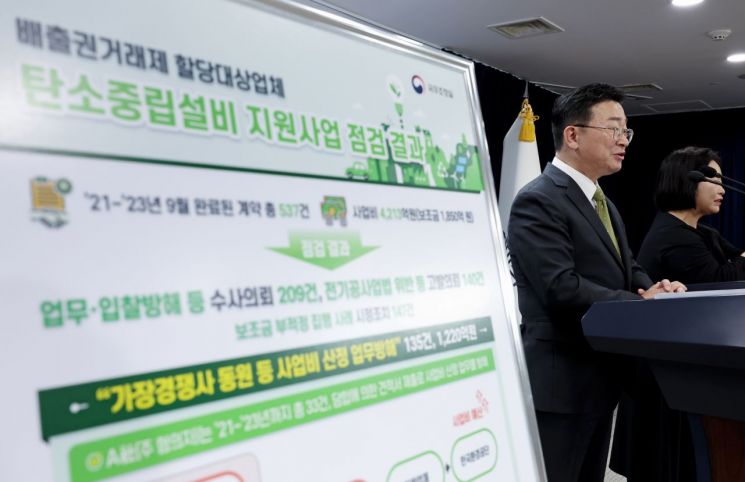 Kim Jong-moon, the First Vice Minister of the Office for Government Policy Coordination and head of the Government Joint Anti-Corruption Promotion Team, is giving a briefing on the inspection results of the carbon neutrality facility support project at the Government Complex Seoul on the afternoon of the 5th.
 [Image source=Yonhap News]
The Government Joint Anti-Corruption Promotion Team of the Office for Government Policy Coordination, in cooperation with the Ministry of Environment, inspected the operation of the 'Carbon-Neutral Facility Support Project for Companies Subject to the Emissions Trading Scheme' from December last year to last month and announced the results on the 5th.
The Promotion Team and the Ministry of Environment reviewed the operation status of 316 carbon-neutral facilities that received national subsidies from 2021 to September last year. They detected a total of 496 improper cases, including suspected obstruction of business and bidding, and violations of the Electrical Construction Business Act. The total number of contracts related to the project was 537, with a project budget of 421.3 billion KRW and subsidies amounting to 185 billion KRW.
First, there were 209 cases involving obstruction of business, bidding interference, and violations of the Monopoly Regulation and Fair Trade Act, involving 139 individuals. Cases included collusion with facility companies to prepare and submit uniform comparative estimates so that the project cost was calculated at the amount desired by the project executors themselves, thereby obstructing the legitimate project cost calculation duties of the Korea Environment Corporation’s president, or interfering with bidding through collusion with related parties.
There were also 140 cases (involving 116 individuals) of violations of the Electrical Construction Business Act and the Framework Act on the Construction Industry. Unregistered contractors performed electrical and construction work, or electrical work subject to separate orders was contracted as a lump sum. Additionally, 147 cases violated the integrated management guidelines for national subsidies and project operation guidelines. Examples include contracting construction projects that should have been procured centrally through self-procurement or paying costs outside the support scope with subsidies.
The Promotion Team plans to improve the system by revising related regulations in consultation with the Ministry of Environment, Korea Environment Corporation, and other relevant agencies to prevent recurrence of the detected illegal and fraudulent cases, and to strengthen post-management. This includes strengthening sanction regulations such as applying the National Contract Act, establishing inspection and sanction regulations, and institutionalizing management and supervision. The appropriateness of project costs will also be verified through specialized institutions. Among the 496 detected cases, 209 will be referred for investigation and 140 will be prosecuted.
The Promotion Team expects that this enforcement will maximize the performance of the carbon-neutral facility support project and reduce budget waste. By reducing the possibility of fraudulent claims and increasing accessibility to carbon-neutral projects, it is expected to activate the projects. It is also anticipated to encourage fair trade between manufacturers and sellers and enable active participation of small and medium-sized enterprises.
The government stated, "To prevent the occurrence of the same illegal and inappropriate cases in projects with similar structures (where subsidy recipients independently carry out the entire project), we will actively disseminate the detected cases to related agencies and continue additional inspections." The Ministry of Environment also announced, "We plan to proceed with the Carbon-Neutral Facility Support Project without disruption to achieve the '2050 Carbon Neutrality' goal."
The Carbon-Neutral Facility Support Project is being promoted to achieve the national carbon neutrality goal (eliminating net carbon dioxide emissions), expand private sector participation, and activate emissions trading. When companies subject to the emissions trading scheme introduce carbon-neutral facilities (facilities that reduce greenhouse gases such as carbon-free equipment), the government supports 30-70% of the facility investment cost depending on the company size within the project budget.
© The Asia Business Daily(www.asiae.co.kr). All rights reserved.

















