One-Year Business Delay Due to Soaring GPU Prices
The procedure for introducing the nation's 6th supercomputer, which has been delayed for over a year due to funding shortages, will resume. This time, there is interest in whether the supercomputer 6 will be introduced on schedule according to the government plan, and which GPU among Nvidia, Intel, and AMD will take charge of Korea's scientific research.
On the 4th, the Ministry of Science and ICT held the National High-Performance Computing Committee (Chair: Minister of Science and ICT) and announced on the 5th that it had revised the "National High-Performance Computer 6th Unit Construction Plan" to reflect external environmental changes such as the rise in market prices of key components.
The main point is that the project cost for the existing Supercomputer 6th unit was increased by 53%, from 292.9 billion KRW to 448.3 billion KRW.
The Supercomputer 6th unit was scheduled to start service next year after selecting a construction contractor through bidding last year, but the project was rejected four times due to the sharp rise in GPU prices caused by the ChatGPT craze. All server companies essentially avoided producing Korea's supercomputer. Since the 6th unit is planned to be configured mainly around GPUs rather than CPUs, it was directly affected by the GPU price surge and shortage.
Ultimately, the Ministry of Science and ICT improved the project cost and project implementation methods through the Ministry of Economy and Finance's "re-examination of project plan appropriateness" to normalize the Supercomputer 6th unit construction project and also expanded the budget. The project period for the Supercomputer 6th unit was extended from December 2028 to February 2031.
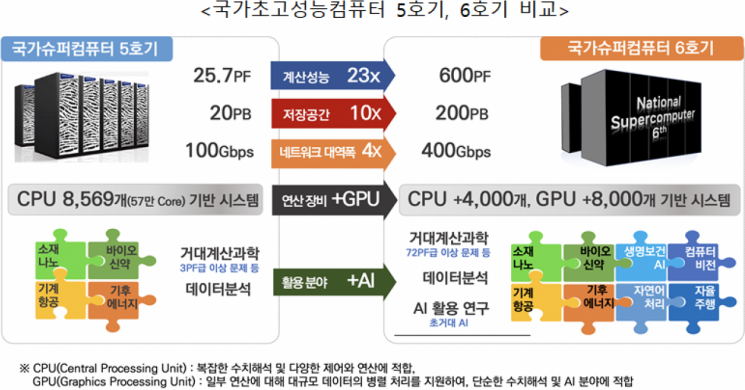
The Ministry of Science and ICT plans to initiate the bidding announcement procedure within this month to build a high-performance computing system with system performance of 600PF, storage capacity of 200PB, and network bandwidth of over 400Gbps, aiming to build a Supercomputer 6th unit ranked within the world's top 10.
Since the Supercomputer 6th unit will operate based on GPUs, it can support research in the era of artificial intelligence (AI). The performance of the Supercomputer 6th unit will be more than 23 times faster in computational resources and have over 10 times larger storage capacity compared to the Supercomputer 5th unit.
This bidding does not specify a particular company's GPU. The evaluation will focus on whether the system performance can be realized rather than which GPU among Nvidia, AMD, or Intel is used. Recently popular Nvidia's 'H100' or the latest 'Blackwell' can be used, but bidders must balance price and performance to participate.
Lee Sik, head of the National Supercomputing Headquarters at the Korea Institute of Science and Technology Information (KISTI), said, "Several major server companies have shown interest," and expressed hope that there would be no no-bid situation like last year. He also emphasized, "Even if it is not Nvidia's GPU, there are many cases using AMD's GPUs as supercomputers, so competition will be attempted."
The government integrated the bidding for system construction and maintenance and improved advance payment and financing methods (bank loans) to incentivize participation of high-performance computer manufacturers and reduce financial costs.
Although the government plans to introduce a supercomputer with world top 10 performance through the Supercomputer 6th unit, considering the operation start time in 2026 and the current pace of GPU development, achieving the goal of securing a top 10 supercomputer may be difficult. The United States plans to operate the world's highest-level exascale supercomputer 'El Capitan' this year. Japan is also working on improving supercomputer performance. Compared to the US and Japan, Korea's investment scale is relatively behind.
The government plans to support the Supercomputer 6th unit not only for basic and fundamental research but also for public social issues and industrial applications. In particular, 30% of resources will be allocated to AI-based core technology development and utilization, and 20% of resources will be preferentially allocated to industrial sectors that have been insufficiently supported.
Excellent research plans will be provided with infrastructure free of charge, and for nationally important or urgent issue-solving projects, a fast-track system will be operated to support resources more quickly.
Minister Yoo Sang-im of the Ministry of Science and ICT stated, "Demand for high-performance computing infrastructure is rapidly increasing to strengthen Korea's global competitiveness in science and technology such as artificial intelligence," and added, "We will promptly introduce the core infrastructure, Supercomputer 6th unit, to contribute to new scientific discoveries, research and development innovation, and industrial competitiveness enhancement."
© The Asia Business Daily(www.asiae.co.kr). All rights reserved.

















