Book Review 'Beauty Crafted in Everyday Language
: The Aesthetics of Blooming, Fading, and Endurance'
Poet Kim Seonhyang’s third poetry diary, That Day, That Flower, has arrived to us along with the autumnal atmosphere.
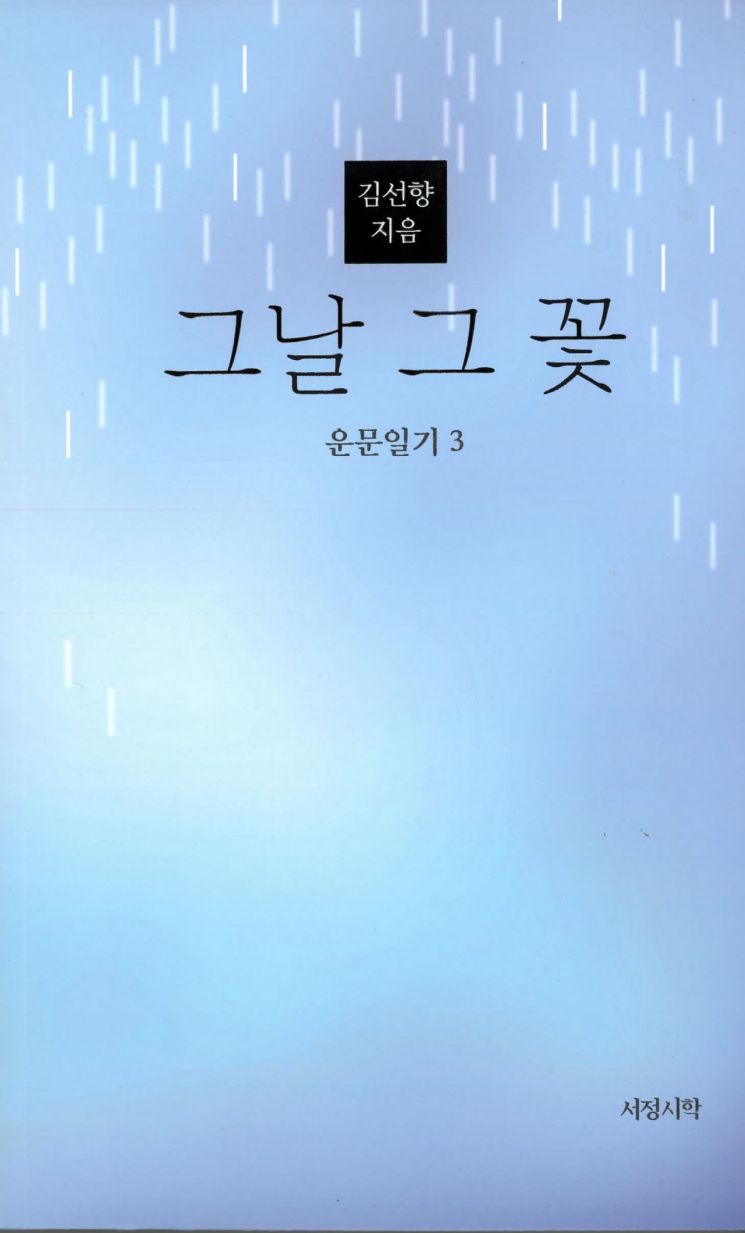 Cover of the poetry collection "That Day, That Flower" by Kim Seonhyang, Chairperson of the Graduate School of North Korean Studies.
Following her previous work The Golden Rose, this collection is another feast of elegant language in full bloom, and a poetry book in which the poet views the world with a deeper gaze.
The virtue of the poetry diary format captivates readers in two ways: one is the clarity of language expressed in verse rather than prose, and the other is the power of the everydayness inherent in a diary. There is nothing quite like a diary as a record of time, where fleeting moments accumulate and flow to become history. Therefore, we enter the poetry collection feeling as if we are having a long conversation with the poet over a cup of tea, or walking along the path where flowers bloom and wither by following the meticulously recorded dates of composition.
That Day, That Flower first beautifully demonstrates the aesthetics of ‘blooming.’ Flowers bloom every season, and the familiar paths walked daily suddenly captivate the poet with beauty?sometimes with verdant leaves, other times with snow-covered whiteness. The joy brought by the melody of beautiful music is also a light that blooms through the poet’s everyday boredom. All these may be trivial traces of time that we easily overlook, but to the poet’s senses, they inevitably approach as the power of life.
Moreover, That Day, That Flower poignantly reveals the aesthetics of ‘disappearance.’ The poet’s diary is “the language of thoughts” that bloom on “sleepless nights.” The lament over loved ones taken away by time, and the indifference of the western sun that swiftly sets “without even a farewell” may be the complicated feelings about disappearance that we all must endure daily alongside the poet. Yet, things that disappear, like the sunset beach or falling flowers, are just as beautiful as those that bloom. The poet’s language, which captures this paradox, poignantly depicts the beauty of things that vanish. Memories fading with time, or the name of someone lingering on the tip of the tongue, barely recalled, represent the earnest push and pull between people and time.
That Day, That Flower also quietly portrays the aesthetics of ‘endurance.’ The pain that seems to have become part of the poet’s body, and the strong wind that disrupts daily walks, make him realize that everyday moments are something to be endured. Like an uninvited guest of time, white hair grows, and the precious present moments will fleetingly pass into an “unseen future.” And aren’t the “things that cannot be expressed” always the ones that block our speech? Yet, in daily life, walking the path against the fierce wind, shaking off pain as if it never existed, and soothing “dry eye syndrome” with artificial tears, the poet’s realization becomes a support to endure another day, no less than any great philosophy or religion.
Underlying the shining aesthetics of blooming, disappearance, and endurance is the poet’s affection for people and the world. The sender’s heart, better than the gift sent; the smiles of children in a photo sent from a distant country; the stories of reunions of separated families to which the poet devoted long hours of service?these all, with their own histories contained within, enrich the poet’s present. We look forward to the poet’s next diary, which sings of the beauty that blooms amid the sorrow of things that disappear. The “That Day, That Flower” blooming in the poet’s “mind’s eye,” written “today / remembered again tomorrow,” will never wither despite the flow of time. ? Lee Sunseon (Associate Professor, Department of English Education, Gyeongnam National University).
© The Asia Business Daily(www.asiae.co.kr). All rights reserved.

















