Launch of High-Speed Internet Service Early Next Year
Government to Proceed with Administrative Procedures Including Regulatory Review
320 Billion Won Large-Scale Project Also Takes First Step Next Year
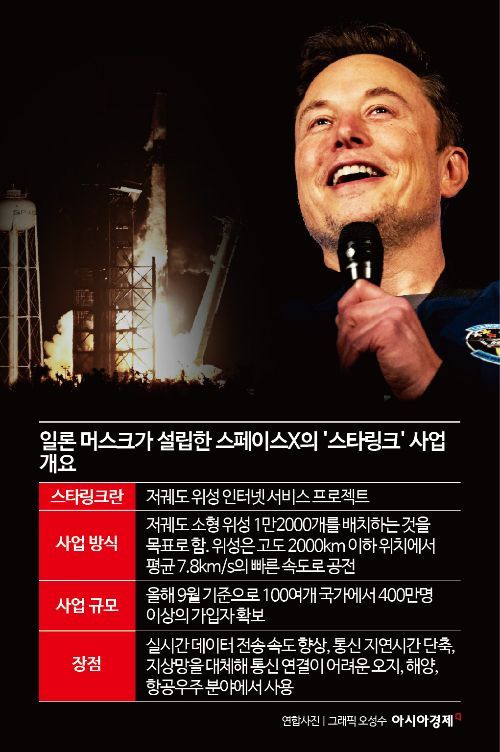
SpaceX's low Earth orbit (LEO) satellite communication service, Starlink, is expected to see its domestic subscriber base increase by more than 10,000 annually on average over the next five years. This projection comes ahead of Starlink's full-scale business launch in South Korea next year, based on a preliminary assessment of the market size.
LEO satellite communication is gaining attention as a core technology for the 6th generation (6G) era. The government is also pushing forward with related research and development (R&D) projects worth 320 billion KRW, signaling that domestic commercialization is rapidly approaching.

According to the cross-border supply agreement approval application business plan submitted by SpaceX to the Ministry of Science and ICT on the 5th, the number of cumulative subscribers in South Korea is expected to be only 2,130 in the first year after launching Starlink services domestically, but it is projected to surge to 9,580 in the second year and 33,540 in the third year. By the fourth year, cumulative subscribers are expected to exceed 40,000, expanding to 67,670 by the fifth year. This is the first time SpaceX has disclosed its domestic subscriber forecast. Currently, Starlink has secured over 4 million subscribers across more than 100 countries.
SpaceX established a subsidiary, Starlink Korea, in March last year to oversee domestic operations. Starlink Korea is registered as a telecommunications service provider. The company plans to introduce LEO satellite communication services that enable ultra-high-speed internet access anytime and anywhere, and has built cooperative frameworks with domestic telecom companies such as SK Telink, KT SAT, and LG Uplus.
The Ministry of Science and ICT is currently preparing new technical standards to ensure that LEO satellite communication services operating at altitudes between 500 and 2,000 km can function stably without radio interference with other wireless equipment. The administrative notice period is ongoing until the 13th of next month.
An official from the National Radio Research Agency explained, "Starlink intends to release three types of terminal models to the market after passing conformity assessments," adding, "Once the administrative notice period ends, the Ministry of Science and ICT will conduct its own regulatory review, followed by an evaluation by the Regulatory Reform Committee." If the administrative procedures proceed smoothly, the business can commence within next year.
With the introduction of LEO satellite communication, seamless connectivity will become possible in areas where building conventional communication networks is difficult, such as islands, mountainous regions, maritime, and aviation sectors.
Next year, domestic companies are also expected to explore opportunities in the LEO satellite communication business. The Ministry of Science and ICT will promote a LEO satellite communication technology development project over six years starting next year. This large-scale project involves launching two LEO satellites and building a communication system by 2030, with a total investment of 320 billion KRW. The budget proposal for next year allocates 20.3 billion KRW from the Ministry of Science and ICT and 11.3 billion KRW from the Space Aviation Administration, totaling 31.6 billion KRW for this project.
The Ministry expects that by linking with the 6G standards to be announced in 2028, South Korea will proactively secure related LEO satellite communication technologies, achieve technological independence in core technologies, and gain a competitive edge in standard-based technology competition. The ministry plans to begin selecting project operators early next year.
In this context, KT signed a memorandum of understanding for cooperation in the LEO satellite business with its satellite-specialized subsidiary KT SAT and Korea Aerospace Industries (KAI). LG Uplus stated in its recently published 6G white paper that "in addition to SpaceX, companies such as OneWeb, Telesat, and Amazon are preparing to build LEO satellite communication networks," and predicted that "by 2030, tens of thousands of communication satellites will be operating in low Earth orbit."
© The Asia Business Daily(www.asiae.co.kr). All rights reserved.


















