Statistics Korea Consumer Price Trends Announcement on the 5th
Petroleum Products Fall the Most in 15 Months
Last month, the consumer price inflation rate recorded 1.3%, marking the lowest level in 3 years and 9 months. Following September, the inflation rate remained in the 1% range for the second consecutive month. This was largely due to the stabilization of international oil prices and the stabilization of previously soaring fruit prices.
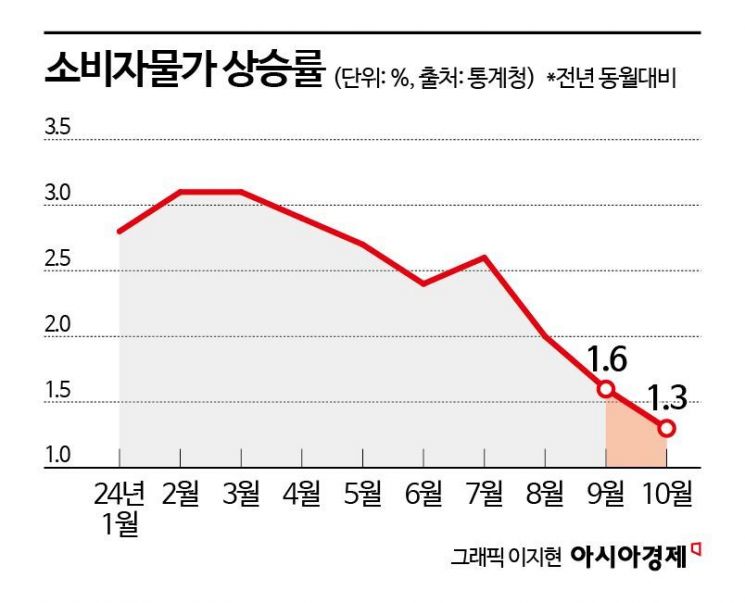
According to the 'October Consumer Price Trends' released by Statistics Korea on the 5th, the consumer price index last month rose by only 1.3% compared to a year earlier. This is the lowest inflation rate in 3 years and 9 months since January 2021 (0.9%). Recording a 1% range for two consecutive months following September (1.6%) is the first time since February (1.4%) and March (1.9%) 2021.
The decline in the inflation rate was largely influenced by the drop in petroleum product prices. Petroleum products fell by 10.9%, marking the largest decline in 15 months since July last year (-25.9%). It was negative for two consecutive months following September (-7.6%). This was due to the base effect from last year's sharp rise in oil prices and the recent stabilization of international oil prices.
Gong Mi-sook, the Economic Trend Statistics Officer at Statistics Korea, explained, "(The decline in inflation rate) was largely due to the drop in petroleum products, which have a high weight in the price index, and the decrease in fruit prices that had risen significantly in the first half of the year." Petroleum products pulled down the overall inflation rate by 0.46 percentage points.
International oil prices, which are usually reflected in consumer prices with a 2-3 week lag, have been on a downward trend since July. Despite instability in the Middle East, the rise in international oil prices was limited. Dubai crude oil, the benchmark for imported crude oil prices, surged to $89.8 per barrel in October last year but remained stable at $73.5 in September and $74.9 in October this year. Accordingly, gasoline prices fell from 1,707 KRW per liter in July to 1,591 KRW in October.
Fruit prices, which had risen sharply due to the heatwave in the first half of the year, also stabilized. Fresh fruit prices fell by 10.7% year-on-year in October, following a 2.9% decline in September. The Ministry of Economy and Finance explained that the price drop was due to an increase in fruit shipments. Apple prices fell by 20%, marking the largest decline in 2 years and 5 months since May 2022 (-22.9%).
However, ahead of the kimchi-making season, vegetable prices rose by 15.6% compared to the same month last year, recording the highest increase since October 2022 (22.1%). Napa cabbage rose by 51.5%, radish by 52.1%, and lettuce by 49.3%. Industrial product prices fell by 0.3% compared to a year ago, turning negative for the first time in 44 months since February 2021 (-0.8%).
A Ministry of Economy and Finance official said, "Last year in September and October, apple and pear prices led the rise in fruit prices. This year, apple harvests were good and shipments increased, leading to a downward trend." However, the official added that vegetable prices remain strong due to poor growth caused by the heatwave continuing until last month.
The core inflation index, which excludes volatile food and energy prices, rose 1.8% year-on-year. This is 0.2 percentage points lower than the previous month and the lowest level in 3 years and 1 month since September 2021 (1.4%). Another core inflation index excluding agricultural products and petroleum products rose 1.7%, with the monthly increase 0.1 percentage points lower. This is the lowest level in 3 years and 4 months since June 2021 (1.5%). The living cost index, which reflects the prices of 144 frequently purchased household items and indicates perceived inflation, rose 1.2% compared to a year ago.
The Ministry of Economy and Finance forecasted that although the decline in petroleum prices will slow this month, putting upward pressure on inflation, the consumer price inflation rate will remain within 2% if there are no special external shocks. They also stated that, with the kimchi-making season approaching and price pressures on vegetables continuing, they will thoroughly implement measures to stabilize the supply of kimchi ingredients. Napa cabbage supply under contract farming will increase by 10% from last year to 24,000 tons, and in addition to the ongoing maximum 40% discount support on napa cabbage and radish, discounts of up to 50% will be provided this month on green onions, garlic, sea salt, and salted seafood to reduce consumer burden.
© The Asia Business Daily(www.asiae.co.kr). All rights reserved.
![Clutching a Stolen Dior Bag, Saying "I Hate Being Poor but Real"... The Grotesque Con of a "Human Knockoff" [Slate]](https://cwcontent.asiae.co.kr/asiaresize/183/2026021902243444107_1771435474.jpg)
















