Proposal for Meeting First on Naver
Discussion on Cooperation Measures for 'AI Safety'
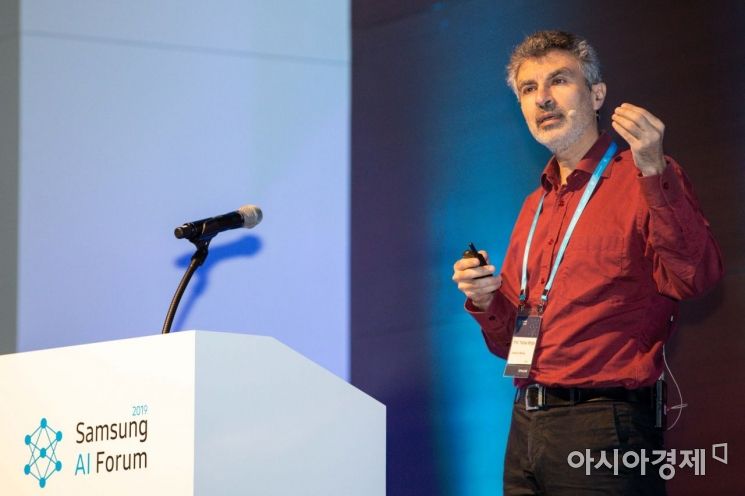 World-renowned AI scholar Yoshua Bengio, a professor at the University of Montreal, is attending the 'Samsung Electronics AI Forum' held on the 4th at Samsung Electronics Seocho Building in Seocho-gu, Seoul, delivering a lecture on 'Deep Learning.' Photo by Jinhyung Kang aymsdream@
Naver met with Yoshua Bengio, a world-renowned scholar from the University of Montreal in Canada, who is considered one of the four great kings of artificial intelligence (AI). They shared domestic and international issues regarding AI safety and discussed future cooperation plans.
According to the IT industry on the 5th, Ha Jung-woo, head of the Naver Cloud AI Innovation Center, and Lee Hwa-ran, leader of the Naver AI Safety Lab, recently met Professor Bengio, who was visiting Korea to attend the Samsung AI Forum. It is known that the meeting was proposed by Professor Bengio himself.
Professor Bengio is a world-renowned scholar who, along with Geoffrey Hinton of the University of Toronto and Yann LeCun of New York University, pioneered deep learning. The three jointly received the Turing Award in 2018, which is considered the Nobel Prize in the field of computing, recognizing their contributions. In the industry, including Andrew Ng of Stanford University, they are called the four great kings of AI. Among them, Professor Bengio is regarded as a cautious scholar who warns about the side effects of AI and believes control is necessary. He is participating in the UK government-led 'AI Safety Project' and is developing AI models to identify AI risks.
Professor Bengio proposed the meeting with Naver because Naver is establishing internal systems related to AI safety and applying them in actual development. It is said that he showed interest in AI safety systems operated in the industry, beyond theoretical research in academia. In June, Naver unveiled the 'ASF (AI Safety Framework),' a practical system for AI safety. It is a response system designed to recognize, evaluate, and manage potential risks of AI at all stages of AI system development and deployment. Naver plans to improve ASF by reflecting the cultural diversity of sovereign AI.
During the meeting, both sides shared domestic and international issues related to AI safety. They exchanged opinions on areas requiring AI safety research, such as the spread of open binary models (models that release only executable files without source code, like Meta's LLaMA) and the emergence of AI agents. They also showed interest in the AI Safety Research Institute, which is launching this month under the leadership of the Korean government. Center head Ha said, "We discussed the preparation status of Korea's AI Safety Research Institute and Naver's perspective on AI safety, and talked about cooperation on a broad scale."
This meeting raised the possibility of future cooperation in AI safety-related research. In July, Professor Bengio jointly established an AI research center with the Korea Advanced Institute of Science and Technology (KAIST). Naver Cloud operates a joint AI research center with Intel and KAIST, maintaining research connections. Naver Cloud is also participating as a domestic partner in the 'National AI Research Hub,' which conducts international joint AI research between the public and private sectors along with the AI Safety Research Institute.
Last July, when Professor Ng visited Korea, Naver also discussed cooperation, aiming to expand its global ecosystem. At that time, Naver executives met Professor Ng at Naver’s second headquarters, 1784, introduced Naver’s technology, and exchanged opinions on cooperation plans.
© The Asia Business Daily(www.asiae.co.kr). All rights reserved.
![Clutching a Stolen Dior Bag, Saying "I Hate Being Poor but Real"... The Grotesque Con of a "Human Knockoff" [Slate]](https://cwcontent.asiae.co.kr/asiaresize/183/2026021902243444107_1771435474.jpg)
















