Major Outbound Travel Agencies Begin Strengthening Local Products
Modetour's Daily Booking Rate for China Products Up 65%
Increased Travel Demand Expected in Major Cities like Beijing and Shanghai
China has decided to implement a visa-free policy for South Korea for the first time since establishing diplomatic relations in 1992, causing a stir in the domestic outbound travel industry (overseas travel by Korean nationals). There is growing anticipation that demand for China travel products, which were popular before COVID-19, will increase again. Along with popular destinations mainly visited by middle-aged and older travelers, younger generations are showing interest in major cities where visa issuance costs and procedures had been obstacles, leading to expectations of soaring reservation rates.
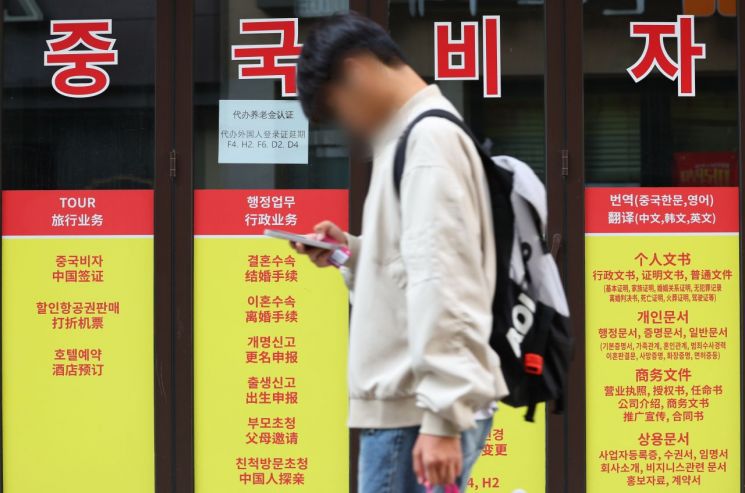
According to industry sources on the 4th, major outbound travel agencies such as Hana Tour, Modetour, Norangpungseon, and Kyowon Tour Travel Easy have confirmed that they have begun internal discussions on expanding China-related products starting from the first business day after the announcement of China’s visa-free policy.
A representative from Hana Tour said, "After the Chinese government suddenly announced the implementation of the visa-free policy, inquiries about future operational plans related to this have flooded in after the weekend," adding, "Currently, the China travel department is formulating detailed plans to expand local product lines, including package tours."
Modetour also gathered opinions from those in charge of China business on the same day regarding sales plans for local products targeting the winter season. Specifically, they plan to expand package products for popular winter destinations in China such as Xiamen, Kunming, and Lijiang, and launch semi-package and independent travel products for major cities (Shanghai, Beijing, Qingdao, Dalian, Tianjin, etc.) targeting the 20-40 age group for light 2-night 3-day trips.
In addition, Norangpungseon and Kyowon Tour Travel Easy are preparing to sell and promote products combining famous local tourist attractions and activities centered around major cities such as Beijing, Shanghai, and Qingdao, targeting the 20-40 age group, alongside popular destinations for middle-aged and older travelers like Zhangjiajie and Baekdu Mountain.
Earlier, on the 1st, the Chinese Ministry of Foreign Affairs announced on its website that it would implement a "unilateral visa-free policy" from the 8th of this month until December 31 of next year for holders of ordinary passports from nine countries including South Korea, Slovakia, Norway, Finland, Denmark, Iceland, Andorra, Monaco, and Liechtenstein. Accordingly, holders of ordinary passports from these nine countries, including South Korea, do not need to obtain a visa when visiting China for business, travel/tourism, visiting relatives or friends, or transit purposes for up to 15 days. This is the first time China has included South Korea in its visa-free policy.
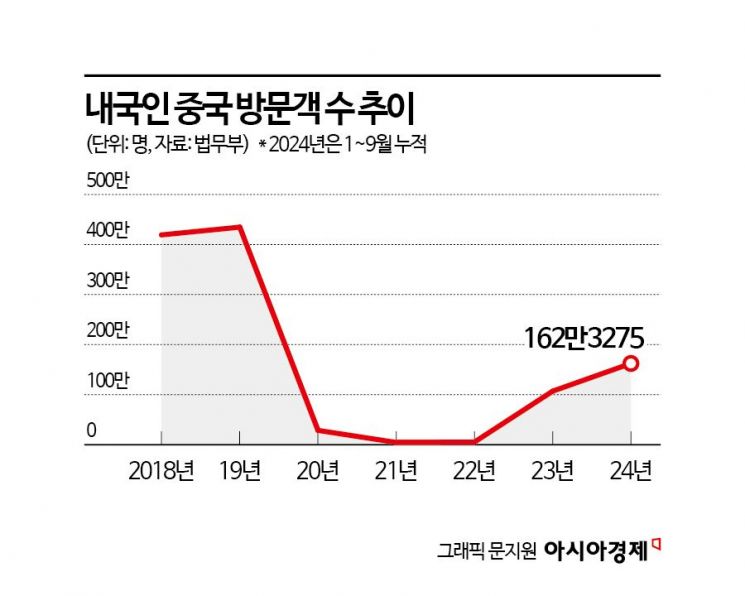
Before the outbreak of COVID-19, China was a popular travel destination with over 4 million Korean visitors annually, competing with Japan for first and second place. However, due to the pandemic, travel restrictions, and overlapping diplomatic issues between the two countries, demand sharply declined. Since 2020, the Chinese government has not published statistics on the number of Koreans visiting China. Instead, the number of Korean visitors can be estimated through the "Monthly Immigration Foreign Policy Statistics" published by the Ministry of Justice, which shows the number of Korean departures by destination. According to this, the number of Koreans traveling to China by air dropped to 44,641 in 2021 but increased to 1,069,687 last year when group tours resumed. This year, up to September, 1,623,275 Koreans have visited China.
An industry insider said, "More than 70% of those using China package tours to see natural attractions like Zhangjiajie or Baekdu Mountain are middle-aged and older travelers, and younger people in their 20s to 40s still hesitate to visit China," adding, "Round-trip airfare to China costs between 100,000 and 200,000 KRW, but an additional 50,000 to 100,000 KRW for visa issuance and the complicated screening process were obstacles." They continued, "With the visa-free policy, it is expected that younger travelers and families will increase, especially in major cities with shopping centers and theme parks. Also, transit products through China to Europe or Southeast Asia, which could not be sold due to visa issues, can now be operated, expanding consumer choices."
Reflecting these expectations, the stock prices of Norangpungseon and Chamjoeun Travel surged to the upper limit on the day. Modetour (16.80%) and Hana Tour (6.04%) also recorded significant gains compared to the previous trading day. A Modetour representative said, "The reservation rate for China products increased by about 65% compared to the average on other business days," adding, "This visa-free issue is having a positive impact on the China travel market."
© The Asia Business Daily(www.asiae.co.kr). All rights reserved.
![Clutching a Stolen Dior Bag, Saying "I Hate Being Poor but Real"... The Grotesque Con of a "Human Knockoff" [Slate]](https://cwcontent.asiae.co.kr/asiaresize/183/2026021902243444107_1771435474.jpg)

















