Corporate Profits Mainly Used for Controlling Shareholders' Benefits
Amendment of Commercial Act and Governance Improvement Needed
Despite Capital Outflow from China, Korea Fails to Gain Reflective Benefits
Overseas institutional investors positively evaluated the policies promoted by the government to resolve the undervaluation issue of the Korean stock market, but pointed out that mid- to long-term amendments to the Commercial Act and improvements in corporate governance must accompany these efforts. They also noted that regulatory uncertainty has increased due to the extension of the short-selling ban, and argued that to encourage long-term investment by foreign investors, the short-selling ban should be lifted in March next year.
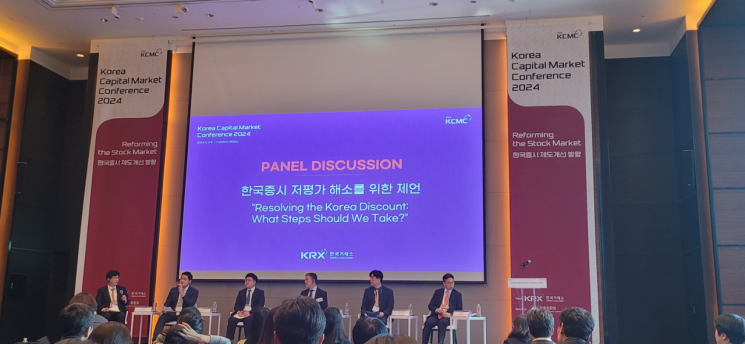 On the 4th, attendees are discussing the topic "Suggestions for Resolving the Undervaluation of the Korean Stock Market" at the 'Korea Capital Market Conference 2024' held at the Conrad Hotel in Yeouido, Seoul.
Jon Jhun, the Korea representative of MY. Alpha in Hong Kong, said at the 'Korea Capital Market Conference 2024' held on the 4th at the Conrad Hotel in Yeouido, Seoul, that the market positively evaluates efforts to reduce friction with institutional investors regarding Korea's value-up program, but added, "Although accessibility to the Korean market is increasing and it is expected to help resolve the Korea discount, it is not sufficient."
During a panel discussion titled 'Suggestions for Resolving the Undervaluation of the Korean Stock Market' held that day, Jon Jhun pointed out that when companies generate profits, they are often used for controlling shareholders rather than being allocated to common or minority shareholders.
Jon Jhun, who believes the link between corporate profits and returns to foreign investors has been broken, said, "If Korean corporate profits are 100, it is unclear whether the entire 100 is reinvested in the company or returned to shareholders. There are many leakages here and there." He added, "If these funds are reinvested in the business, corporate value will increase, and they can also be returned to shareholders." He believes that this accumulated situation has led foreign investors to lose trust in the Korean market.
He also criticized corporate governance, stating, "The independent outside directors are the ones responsible for ensuring that corporate profits are returned to shareholders. In advanced countries, directors do their best to represent all shareholders, but unfortunately, Korean companies have had governance issues until now."
Ultimately, he said that mid- to long-term amendments to the Commercial Act and governance improvements are necessary to resolve these issues. Jon Jhun said, "If the Commercial Act is amended, I will invest more in Korea. If outside directors take an interest and represent shareholders' interests, investor confidence will increase, which can create a virtuous cycle of a strong stock market, increased investment, and increased employment."
Peter Stein, CEO of the Asia Securities Industry & Financial Markets Association (ASIFMA), diagnosed that the Korea discount phenomenon is damaging the Korean capital market. He cited the fact that funds outflowing from China have not flowed into Korea at all as an example of this reality, especially while the Chinese stock market has been sluggish.
Peter Stein said, "The liquidity share of China in the Asia-Pacific market fell from 60% in 2022 to 52% this year, while Korea's share dropped from 19% to 16% during the same period."
This means Korea has not benefited at all from the spillover effects of capital outflows from China. According to him, the funds exiting China flowed into other Asian regions such as India, Taiwan, and Japan. Peter Stein explained, "India's share rose from 11% to 16%, Taiwan's share also increased, and Japan maintained a stable share of 31%."
Peter Stein pointed out that the extension of the short-selling ban in Korea has increased regulatory uncertainty, which deepens the Korea discount. He said, "The short-selling ban issue needs to be resolved for Korea to be considered an advanced market, but instead, it has been expanded. Foreign investors have lost an important tool to reduce risk exposure for long-term investment in the Korean market." He added, "The extension of the short-selling ban has increased policy uncertainty."
Peter Stein also suggested, "While hoping that the short-selling ban will be lifted in March next year, penalties for violations of short-selling regulations are expected to become stricter. I think there should be some consideration for cases where violations occurred in good faith during trading."
In response, Park Jae-young, team leader of the Capital Market Supervision Division at the Financial Supervisory Service, rebutted, "Some argue about 'good-faith negligence' that may occur in overseas investors' transactions, but the short-selling computerized system is designed to prevent large-scale illegal activities from occurring in large-scale short-selling trades from the outset. Punishments are for those who seek unfair gains with malicious intent, not for those who do not."
Regarding the criticism that regulatory uncertainty has increased, Park Jae-young said, "Rather, by introducing this system, it is believed that excessive regulatory risks can be eliminated. The direction is to allow overseas investors to trade comfortably, and we will communicate sufficiently with overseas institutional investors to ensure that policies are market-friendly and positive."
The government's value-up program and related tax benefit measures were positively evaluated. Peter Stein said, "I highly appreciate the government's active efforts, and the improvement of tax issues and the deferral of the financial investment income tax can have a positive impact and are aspects to be valued highly. It is expected that more funds will flow in with the inclusion in the World Government Bond Index (WGBI)."
© The Asia Business Daily(www.asiae.co.kr). All rights reserved.
![Clutching a Stolen Dior Bag, Saying "I Hate Being Poor but Real"... The Grotesque Con of a "Human Knockoff" [Slate]](https://cwcontent.asiae.co.kr/asiaresize/183/2026021902243444107_1771435474.jpg)
















