A technology that can diagnose the aging level of buildings through color changes has been developed domestically.
The research team at the Korea Institute of Machinery and Materials (KIMM), led by Principal Researcher Jaesung Yoon of the Nano Lithography Research Center at the Nano Convergence Research Division (also an adjunct professor at the University of Science and Technology (UST)) and student researcher Hwangmin Nyeon (UST-KIMM School doctoral program), announced on the 4th that they have developed a ‘nano-optical sensor’ technology that can easily measure deformation and stability of structures.
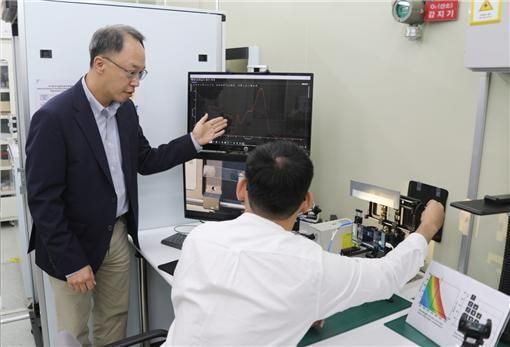 Senior Researcher Jaesung Yoon (left) at the Nano Lithography Research Center, Korea Institute of Machinery and Materials, is explaining the measurement results of the film nano-optical device. Photo by Korea Institute of Machinery and Materials
The research team developed a deformation sensor in the form of a film with nano patterns, inspired by the structural color phenomenon found in peacock feathers and Morpho butterflies. When this sensor film is attached to buildings, the color changes according to whether and how much deformation occurs, enabling the assessment of aging, damage, and safety.
In particular, the film nano-optical sensor developed by the team expresses mechanical deformation as optical coloration caused by nano patterns, allowing the deformation amount to be visually confirmed without pigments, dyes, or separate power sources.
Additionally, by quantifying the color using a smartphone, precise measurements become possible. This simplifies the existing structural measurement and monitoring process to just attaching a patch.
A long-standing technical challenge in the domestic and international research field of nano structural colors was that the color changes depending on the viewing angle. However, the research team corrected this to prevent the color from being affected by the observation angle. They developed a nano pattern that maintains a consistent color and uses it as a reference value to compensate for the effects of angle changes.
The research team has filed more than 10 domestic patents and one international patent (PCT) for the film nano-optical sensor technology. They are currently in the process of filing an additional patent in the United States (one case).
Principal Researcher Yoon said, “Using the film nano-optical sensor technology will revolutionize the ease of diagnosing aging in buildings and facilities,” adding, “By providing a highly accurate monitoring solution at a low cost, we will contribute to enhancing social safety.”
© The Asia Business Daily(www.asiae.co.kr). All rights reserved.

















