Hyundai Transys Union Nearly One Month Full Strike
Employee Wage Loss Due to 'No Work, No Pay' Principle
The Hyundai Transys labor union has been continuing a strike for about a month, causing significant damage to both labor and management. The company, a subsidiary of Hyundai Motor Group, manufactures and supplies transmissions and seats for Hyundai and Kia finished vehicles. The strike has not only disrupted vehicle production but also resulted in employees not receiving their wages.
According to industry sources, the Hyundai Transys labor and management parties have failed to narrow their differences in the recently resumed negotiations. The company’s largest plant, the Seosan plant, entered a full strike on the 11th following a partial strike on the 8th of last month. Although negotiations resumed after about a month and opinions were exchanged, no progress was made. The union plans to strike on the 4th as initially announced, with further decisions to be made and implemented by the dispute countermeasure committee.
The main point of contention between labor and management is the size of the performance bonus. The union is demanding a performance bonus equivalent to 2% (about 234 billion KRW) of last year’s annual sales (approximately 11.7 trillion KRW). The management maintains that such a performance bonus amount is about twice the operating profit (116.9 billion KRW) of the past year and is therefore unacceptable.
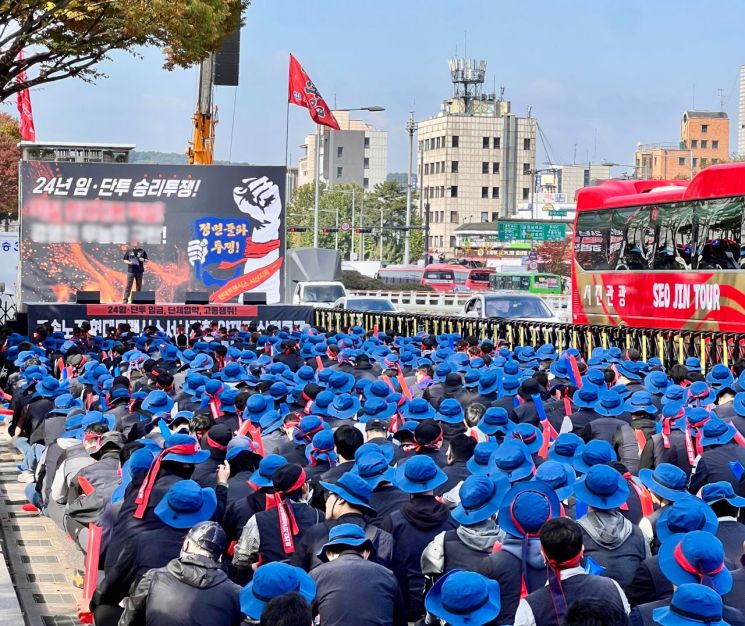 On the 28th of last month, about 1,000 Hyundai Transys union members and others gathered for a rally at Hyundai Motor Group's headquarters in Yangjae-dong.
 [Photo by Reader]
Employees participating in the strike inevitably face wage losses under the principle of no work, no pay. Considering the average monthly wage of production workers at the company, the industry estimates that each employee has incurred a wage loss of about 5 to 6 million KRW.
As the strike prolongs without narrowing the differences, dissatisfaction among employees has reportedly increased. On workplace communities, complaints such as “Who will take responsibility for the wage loss?” “There has never been a case of compensating wage loss due to a strike, it’s tough,” and “Won’t the transmission line be taken away to Hyundai Motor’s Ulsan plant?” have been steadily posted. The disruption in the supply schedule of parts to finished vehicles has also led Hyundai and Kia finished vehicle plants to reduce or cancel overtime work.
In the past, even during strikes, there were cases where labor and management reached side agreements to compensate for wage losses. Recently, however, both the company and the union have heightened their awareness of compliance, making such arrangements difficult. If the company violates principles to compensate wage losses, it could be considered a violation of labor laws and may even be subject to charges of breach of trust for causing damage to the company.
© The Asia Business Daily(www.asiae.co.kr). All rights reserved.
![Clutching a Stolen Dior Bag, Saying "I Hate Being Poor but Real"... The Grotesque Con of a "Human Knockoff" [Slate]](https://cwcontent.asiae.co.kr/asiaresize/183/2026021902243444107_1771435474.jpg)
















