Growth to $475 Billion... SAF 2 to 8 Times More Expensive Than Conventional Jet Fuel
Only Domestic HVO Pretreatment Facility
Supply Contracts Secured Before Completion... Additional Annual Revenue of Hundreds of Billions
US SAF Production to Increase 600-Fold by 2030
Advanced countries such as the United States and the European Union are strengthening regulations to increase the use of Sustainable Aviation Fuel (SAF) to reduce carbon emissions. With forecasts suggesting that SAF will rapidly replace conventional aviation fuel over the coming decades, DS Danseok is attracting attention. Han Seung-wook, chairman of DS Danseok, has a positive outlook on the SAF market and has swiftly invested in SAF raw material plants. The company is set to complete a hydrogenated vegetable oil (HVO) pre-treatment plant capable of producing SAF raw materials next month. By signing a supply contract worth 1.0216 trillion KRW with the U.S. oil and natural gas giant Phillips 66 for pre-treated products intended for SAF, DS Danseok has secured a foothold for overseas market entry.
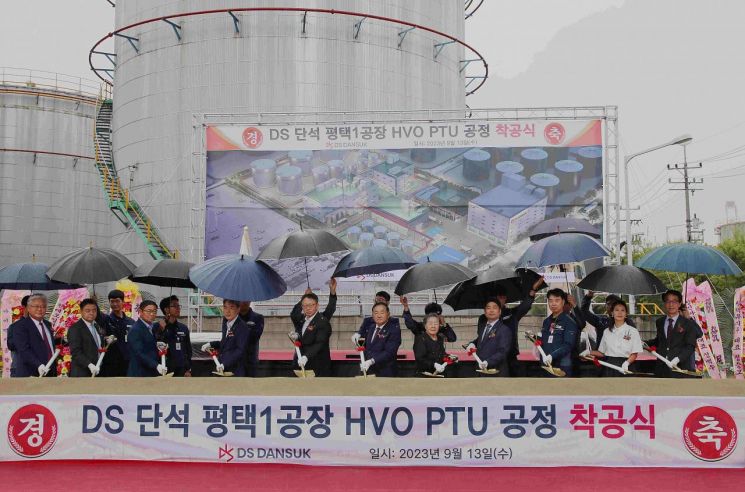
According to industry sources on the 1st, DS Danseok began investing in refining process facilities for HVO raw material supply last year, aiming to complete the plant by next month. The goal is to lead the next-generation HVO market based on advanced production technology. The oil refining plant removes impurities from animal and vegetable raw materials such as waste cooking oil and palm by-products, with an annual production capacity of 300,000 tons. DS Danseok is currently the only company in Korea equipped with HVO pre-treatment facilities.
Starting in December, the company will begin producing raw materials necessary for SAF production and supply them to Phillips 66 International. It is expected to recognize sales and secure new growth momentum by early next year at the latest. The contract period with Phillips 66 runs until November 30, 2027. Simple calculations suggest annual sales could increase by approximately 400 billion KRW.
DS Danseok’s stock price has rebounded rapidly since signing the large-scale supply contract. After hitting a post-listing low on the 25th of last month, DS Danseok’s shares have recently risen by 32.6%, recovering a market capitalization of 513 billion KRW. However, there is still some way to go before regaining the initial public offering price of 100,000 KRW at the time of listing last December. The stock price even rose to 495,000 KRW on the day after listing. Subsequently, shares declined as institutional investors who invested before listing sold their holdings. Most of the overhang (potential large sell-off volume) has been absorbed, raising expectations for a stock price rebound.
Han Seung-wook, chairman of DS Danseok, said at the plant groundbreaking ceremony last year, "Starting with the groundbreaking of the refining plant for HVO raw material supply, which is the second-generation biodiesel, we have laid the foundation for constructing a 500,000-ton plant for HVO production itself by 2026, not just pre-treatment raw materials." He added, "DS Danseok will continue to secure new eco-friendly growth engines based on its first-generation biodiesel export capabilities and strengthen its position as a leading resource circulation company."
Governments worldwide are strongly regulating to replace conventional aviation fuel with SAF. Based on the carbon dioxide (CO2) emissions per passenger per kilometer, airplanes emit 285g, buses 68g, and trains 14g, meaning airplanes emit 20 times more CO2 than trains. With the rapid increase in air passengers, the need to reduce greenhouse gas emissions in the aviation sector is growing daily. While land transportation reduces carbon emissions through electrification, it is practically impossible to equip aircraft with batteries due to weight constraints. Introducing eco-friendly fuels is a realistic solution. SAF can reduce carbon emissions by 80% compared to conventional aviation fuel. SAF acts like a secondary battery. It is an eco-friendly raw material chemically similar to conventional aviation fuel and can be used immediately by refueling existing aircraft. It can also be blended with aviation fuel.
However, since SAF costs 2 to 8 times more than conventional aviation fuel, governments are strengthening regulations to encourage its use. Environmental regulatory agencies in various countries are currently promoting carbon emission reductions in the aviation sector by mandating a certain proportion of aviation fuel to be replaced with SAF.
The United States plans to replace 10% of aviation fuel with SAF by 2030 and 100% by 2050. According to the U.S. Department of Energy, SAF is the only means to achieve carbon neutrality in aviation fuel, with annual SAF production in the U.S. expected to increase from 5 million gallons in 2021 to 3 billion gallons in 2030 and 35 billion gallons in 2050, a 7,000-fold increase. Tax credits are provided for SAF produced and sold domestically to encourage fuel suppliers to expand facility investments.
The EU requires that at least 2% of aviation fuel be SAF starting in 2025, with mandatory blending ratios planned to increase to 6% by 2030 and 70% by 2050. Japan also plans to replace 10% of aircraft refueling fuel at domestic airports with SAF by 2030.
According to the Woori Financial Research Institute, global market research firms expect the cumulative investment in SAF raw material production facilities to reach up to 5 trillion USD by 2050 due to the rapid increase in capacity. Considering that the aviation industry’s expenditure over the past 30 years was about 4.3 trillion USD, the SAF ecosystem is expected to replace the existing jet fuel industry. Morgan Stanley forecasts that if the SAF share, which was only about 0.1% in 2022, expands to 6% (the EU mandatory rate) by 2030, the related industry could reach up to 475 billion USD (655 trillion KRW). The International Air Transport Association expects global SAF demand to exceed 400 billion tons by 2050, similar in scale to the annual aviation fuel demand (350 to 400 billion tons).
Hana Securities explained, "DS Danseok’s bioenergy division is expected to benefit structurally due to its high export ratio to the U.S. Since January this year, it has already signed MOUs for SAF fuel and raw material supply with Japan’s largest refiner ENEOS, HMLP, Nomura Office, and Sapporo Oil." They anticipate external growth of the bioenergy division by 2025.
DS Danseok has secured a solid value chain through long-term bioenergy business operations. It has also prepared measures to stably procure raw materials necessary for the HVO pre-treatment process.
© The Asia Business Daily(www.asiae.co.kr). All rights reserved.
![Clutching a Stolen Dior Bag, Saying "I Hate Being Poor but Real"... The Grotesque Con of a "Human Knockoff" [Slate]](https://cwcontent.asiae.co.kr/asiaresize/183/2026021902243444107_1771435474.jpg)
















