Skin Horn Grown Over Several Years, Currently 10cm in Size
A Skin Condition Caused by Excessive Epidermal Growth
A grandmother over 100 years old living in China has become a topic of interest due to horns growing on her forehead. On the 29th of last month (local time), foreign media including the New York Post reported the story of a 107-year-old grandmother known only as Chen. Recently, a video showing Chen's recent appearance was uploaded on China's TikTok platform 'Douyin,' attracting the attention of netizens. Chen, who is 107 years old this year, began growing horns on her forehead in recent years. She has maintained a healthy diet to slow down aging, and aside from the horns, she has shown no significant health issues.
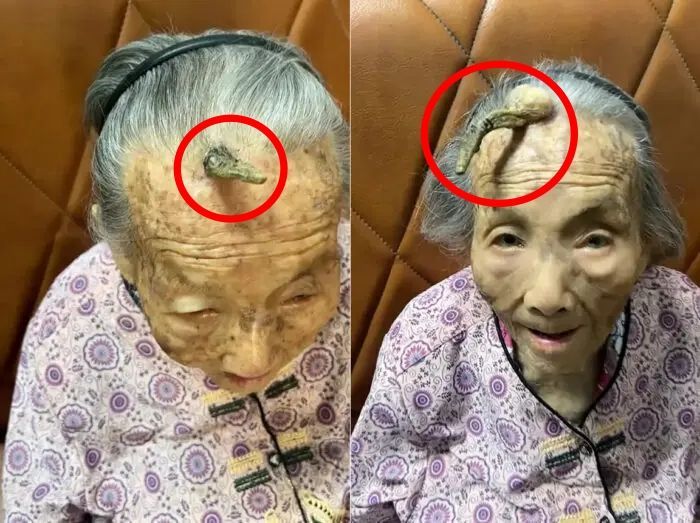 A 107-year-old Chinese grandmother has attracted attention due to a horn growing on her forehead.
 [Photo by New York Post]
Medical professionals have identified the horns on Chen as 'cutaneous horns,' which they estimate were caused by exposure to ultraviolet rays. They also diagnosed that "Chen's health condition is very good, so it is highly unlikely that the cutaneous horns will have an adverse effect on her health." Netizens who watched the video commented, "Since it appeared on a healthy 107-year-old grandmother, it looks like a symbol of longevity." Currently, the horns on Chen's forehead measure 10 cm in length.
Although cutaneous horns (피각) like those on Chen may seem unfamiliar, they are common. Cutaneous horns are a skin condition where excessive growth of the epidermis, the outermost layer of the skin, forms horn-shaped protrusions. The longest cutaneous horn recorded was 25 cm long, found on the forehead of a 76-year-old woman from 19th-century Persia. Cutaneous horns are mostly straight or curved, hard, and yellowish in color. They can appear anywhere on the body.
The areas where they mainly occur are those heavily exposed to ultraviolet rays, such as the face, hands, and arms. They commonly develop in old age, with the highest incidence between ages 60 and 70. Cutaneous horns can appear as complications of seborrheic keratosis (papules on the skin surface) or viral warts. In some patients, they may be caused by skin cancers such as squamous cell carcinoma. The growth rate of cutaneous horns is very fast, and the length of the protrusions varies.
Cutaneous horns are often accompanied by inflammation. Because the protrusions repeatedly appear and disappear, infections occur easily. Usually, there are no symptoms even if the protrusions grow, but if inflammation occurs, pain caused by the inflammation is experienced. Cutaneous horns have been known since the 16th century, and about 60% of patients reported so far have had benign lesions. Treatment may be delayed depending on the progression of the protrusions. However, if skin cancer is suspected, they can be removed through surgery or chemotherapy. Currently, there is no known prevention method for cutaneous horns. If symptoms of cutaneous horns appear anywhere on the body, it may be a sign of skin cancer. Therefore, if there is an unfamiliar protrusion on the skin, it is essential to get it examined at a hospital.
© The Asia Business Daily(www.asiae.co.kr). All rights reserved.

















