KIEP, Economic Impact Analysis of Trade Policies Following the US Presidential Election
An analysis has emerged indicating that if Donald Trump wins the U.S. presidential election next month, South Korea's total exports could decrease by up to $44.8 billion, and its real Gross Domestic Product (GDP) could decline by 0.67%.
There is a need for systematic preparation against the risks inherent in the production structure of South Korea's key export industries, which are highly dependent on global supply chains amid increasing uncertainty in the international trade environment.
The Korea Institute for International Economic Policy (KIEP) stated in its report titled "2024 U.S. Presidential Election: Economic Impact Analysis of U.S. Trade Policy," published on the 31st, that if the U.S. imposes universal tariffs on South Korea following a Trump victory, South Korea's total exports could decrease by approximately $22.2 billion to $44.8 billion. Furthermore, if responses to substitute demand or export shifts are not smooth, real GDP could decline by about 0.29% to 0.67%.
The reduction in exports to the U.S. due to America's global tariff policies was observed in the order of China, Canada and Mexico, the European Union (EU), China, Japan, and South Korea.
Although unlikely, if South Korea is excluded from tariff imposition, increased substitute demand for Korean products and export shifts to third countries could lead to a potential increase in real GDP by 0.10% to 0.24%.
If the U.S. advances its tariff policy further by strengthening supply chain restructuring policies aimed at countering China, leading to supply chain bloc formation, South Korea's welfare is estimated to change by between -1.37% and 0.30%. KIEP forecasted, "If the U.S.-China conflict intensifies global supply chain bloc formation and South Korea participates in this bloc, the welfare of the Korean economy could decrease by up to 1.37%."
According to KIEP, despite a relative decrease in China's exports to the U.S. following the tariff policies of Trump's first term, the value-added exports to the U.S. through indirect exports from third countries have continued to show a strong upward trend, indicating that U.S. efforts to counter China have evolved into a much more complex situation.
In particular, as access to the U.S. market is restricted, Chinese companies are actively seeking entry into other markets, which has increased issues such as oversupply and market disruption. It is important to note that policy responses from major countries exposed to these negative impacts are also accelerating.
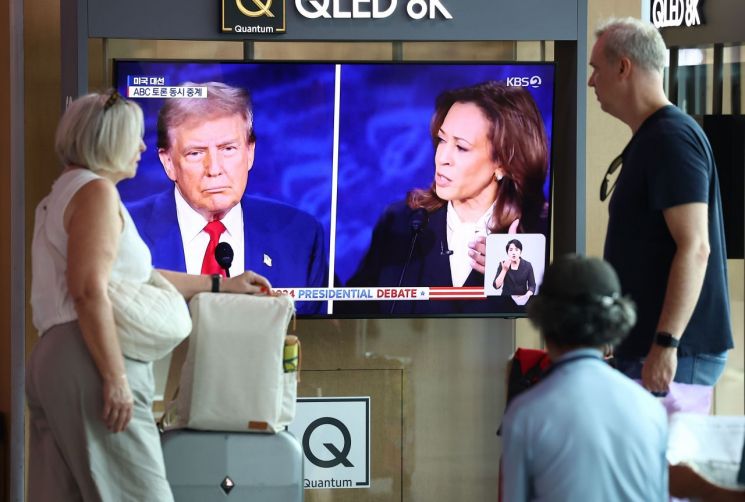
With improved understanding of the economic impacts of U.S. policies to counter China through the Trump first term and the Biden-Harris administration, the report pointed out the need to prepare for the possibility that the next U.S. administration may introduce the next phase of pressure measures against China considering these factors.
The report stated, "While closely monitoring the possibility that additional U.S. tariff measures could be expanded to Free Trade Agreement (FTA) partners including South Korea, it is necessary to renew positive mutual recognition between the two countries regarding the reciprocal achievements of the Korea-U.S. FTA."
Additionally, the report recommended preparing for the expansion of U.S.-centered supply chain restructuring policies beyond tariff measures to include restrictions on foreign direct investment, overseas direct investment, labor mobility, and linking labor rights with corporate responsibility, thereby broadening the scope into complex and micro-level trade policies.
The report noted, "The U.S. Trade Representative (USTR) evaluated in the 'Section 301 Four-Year Review' that tariffs on China were an effective measure, and has shown a proactive stance on tariff policies by maintaining existing tariffs and announcing additional tariff measures, which also requires attention."
It added, "Although there are some differences among presidential candidates, it is important to note that ideological, value, and security issues are being linked with trade policies, expanding policy tools through complex and diverse U.S. trade-related measures such as tax reductions (income tax, corporate tax), subsidies (Infrastructure Law, IRA, CHIPS and Science Act, etc.), investment controls (Defense of National Critical Capabilities Act, etc.), restrictions on skilled labor mobility or import controls related to labor rights (Uyghur Forced Labor Prevention Act, USMCA RRM, etc.)."
Finally, the report emphasized, "It is necessary to strive for international cooperation to prevent supply chain fragmentation from leading to substantial and complete bloc formation, and to prepare mid- to long-term response strategies for supply chain bloc formation resulting from intensified U.S.-China conflicts."
For countries like South Korea with high openness to foreign trade, restoring a multilateral trade order and establishing a stable trade environment are crucial. Therefore, efforts should be made through solidarity and cooperation with middle powers to prevent supply chain bloc formation from spreading across all industries.
The report advised, "If geopolitical bloc formation of global supply chains progresses due to intensified U.S.-China conflicts, it is necessary to analyze the global production networks of Korean companies and devise mid- to long-term response strategies. It is also important to prepare alternatives to replace demand for Chinese products in major U.S.-centered bloc countries, diversify import markets in key industries and items, and expand domestic demand."
© The Asia Business Daily(www.asiae.co.kr). All rights reserved.
![Clutching a Stolen Dior Bag, Saying "I Hate Being Poor but Real"... The Grotesque Con of a "Human Knockoff" [Slate]](https://cwcontent.asiae.co.kr/asiaresize/183/2026021902243444107_1771435474.jpg)











