Enforcement of the Amendment to the Nuclear Safety Act from November 1
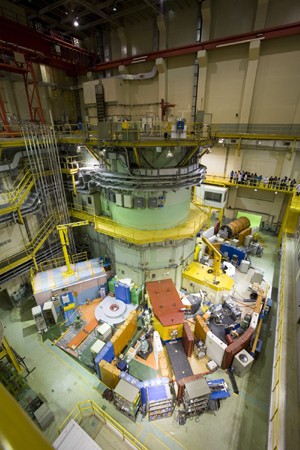 Research Reactor Hanaro
From now on, to obtain or renew a reactor operator license, one must pass a physical examination. Additionally, those who have already obtained a reactor operator license must renew it every six years. If caught lending, borrowing, or mediating the lending of a license, the offender will face imprisonment of up to one year or a fine of up to 10 million KRW.
The Nuclear Safety and Security Commission announced on the 31st that the partial amendment to the Nuclear Safety Act and the subsequently revised subordinate regulations, which include these provisions, will take effect from the 1st of next month.
The reactor operator license is essential for operating reactor facilities such as nuclear power plants and includes the Senior Reactor Operator (SRO) license and the Reactor Operator (RO) license. Those who perform or supervise the direct control of reactor reactivity and output in the main control room of reactor facilities must obtain a reactor operator license from the Nuclear Safety and Security Commission in accordance with the Nuclear Safety Act.
Until now, unlike similar licenses in other fields such as railway vehicle operation licenses, the reactor operator license did not have a renewal system, leading to opinions that institutional improvements were necessary to enhance the safety of reactor operation. Accordingly, the partial amendment to the Nuclear Safety Act was promulgated on October 31 last year and will be enforced from November 1 this year, one year later.
According to the amended law, license holders must meet the requirement of having at least three years of experience in work requiring the license before the license’s validity period (six years) expires, or pass a competency recognition test conducted by the Nuclear Safety and Security Commission within three years of the renewal application date. Previously, maintaining the license’s validity only required attending legally mandated refresher training every three years, but the conditions have now become more stringent.
Furthermore, license renewal requires completing refresher training at least twice and passing the physical examination, among other strengthened requirements. If the license is not renewed within the validity period, it will be suspended, and if not renewed within three years from the suspension date, the license will be canceled.
The physical examination standards for obtaining and renewing reactor operator licenses will also be strengthened. Previously, only submission of health certificates and other documents was required, with no separate physical examination passing criteria. However, from now on, applicants for issuance or renewal must undergo a physical examination within one year of the application date at a hospital or medical institution under the Medical Service Act, meeting the passing criteria specified in the amended Nuclear Safety Act regulations.
Additionally, employers must take necessary measures and record and retain such measures if a reactor operator develops physical defects that could negatively affect reactor operation.
Management of nuclear-related licenses, including reactor operator licenses, will also become stricter. Penalties have been introduced for obtaining licenses through false or other fraudulent means, lending or mediating licenses, with punishments of imprisonment up to one year or fines up to 10 million KRW. The penalty for lending a license has been strengthened from a fine of up to 3 million KRW to imprisonment of up to one year or a fine of up to 10 million KRW.
Yoo Guk-hee, Chairperson of the Nuclear Safety and Security Commission, stated, "By introducing a renewal system for reactor operator licenses and requiring passing physical examinations, we expect that personnel meeting appropriate qualifications will perform reactor operation tasks, thereby significantly enhancing the safety of reactor facilities. We will continue to strive for related policy and institutional improvements so that the public can feel secure."
© The Asia Business Daily(www.asiae.co.kr). All rights reserved.
![Clutching a Stolen Dior Bag, Saying "I Hate Being Poor but Real"... The Grotesque Con of a "Human Knockoff" [Slate]](https://cwcontent.asiae.co.kr/asiaresize/183/2026021902243444107_1771435474.jpg)















