
Commercial banks are tightening household loans on all fronts, not only by raising loan interest rates but also by restricting conditional jeonse loan handling, waiving early repayment fees, shortening mortgage loan maturities, and imposing limits on loan agents' handling capacity. Although the increase in household debt has somewhat stabilized, it is still too early to be complacent given the forecast that the growth in mortgage loans will continue until November.
On the 31st, KB Kookmin Bank decided to extend the restriction on handling conditional jeonse loans. Since September 3, KB Kookmin Bank has been operating a 'restriction on handling conditional jeonse loans based on the transfer of ownership by the lessor,' initially planned as a temporary measure until the end of October. However, to manage household debt and prevent house price increases through gap investments, the bank decided to extend the operation. The lifting date of the restriction is undecided.
As a result, among the four major commercial banks (KB Kookmin, Shinhan, Hana, and Woori), Hana Bank is now the only one handling conditional jeonse loans.
On the same day, NH Nonghyup Bank announced it would reduce the maximum maturity of mortgage loans from 40 years to 30 years starting next month. However, this does not apply to balance loans, Didimdol loans, or policy mortgages.
Following restrictions on jeonse loan handling and mortgage loan maturity reduction, commercial banks are focusing all efforts on household debt management by waiving early repayment fees and imposing loan limits on loan brokerage firms.
Previously, Shinhan Bank, Woori Bank, and IBK Industrial Bank decided to waive early repayment penalties (early repayment fees) on household loans. Shinhan Bank will waive fees from the 25th until the end of November, while Woori Bank and IBK will do so from November 1 to 30. Normally, if repaid within three years of receiving a household loan, fixed-rate loans incur fees of 0.8?1.4%, and variable-rate loans incur fees of 0.7?1.2%, but these fees will be waived until the end of November.
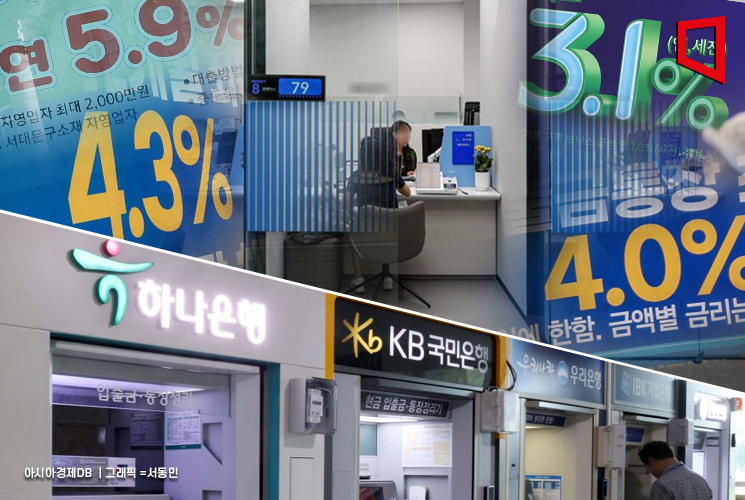
A Shinhan Bank official explained, "To curb the increase in household loans, after reducing loan limits and eligible borrowers, we are encouraging repayment by waiving early repayment fees to reduce the total loan volume."
Additionally, Woori Bank has decided to temporarily suspend the sale of some unsecured loans through non-face-to-face channels such as internet and mobile to manage household loans. The affected products include 12 types: loans for employees of excellent contracted companies (PPL), Woori WON Workplace Loans, Woori Main Workplace Loans, Corporate Employee Group Loans, Woori Dream Car Loans, Woori Special Loans (including refinancing), Woori First Salary Unsecured Loans, Woori WON Plus Workplace Loans, Citi Refinancing Unsecured Loans (refinancing), Veteran Preferential Loans, WON EASY Living Expense Loans, and unsecured loan recommendation services (including refinancing).
A Woori Bank official said, "This is a measure for stable household debt management, and the implementation period may be shortened or extended."
Moreover, since the 25th, Woori Bank has reduced preferential interest rates on refinancing unsecured loan products by 1.0?1.9 percentage points.
In addition, acceptance of mortgage loans through loan agents has also been suspended. Previously, Shinhan, Woori, NH Nonghyup, and IBK Industrial Bank had stopped accepting mortgage loans through loan agents in the metropolitan area or nationwide. Hana Bank has also managed total loan volume by imposing new loan limits per loan brokerage firm.
Secondary financial institutions and internet banks are also strengthening their household debt management policies. This comes amid concerns that as commercial banks strongly drive household loan management, a balloon effect of loan regulations could occur in secondary financial institutions and internet banks.
On this day, the National Credit Union Federation of Korea announced it would implement household loan stabilization measures starting November 6. It will limit mortgage loan amounts for multi-homeowners for living stability funds to 100 million KRW and restrict mortgage credit insurance (MCI) products for current single-homeowners to preemptively block investment-purpose mortgage loans.
On the 25th, the National Federation of Saemaul Geumgo decided to restrict mortgage loans for multi-homeowners and implement a system where the federation pre-reviews all interim payment loans.
The Nonghyup Central Association also plans to send official letters to each local Nonghyup to strengthen loan regulations for multi-homeowners and implement these measures.
Internet bank K-Bank raised apartment mortgage loan interest rates by 0.05?0.1 percentage points and jeonse loan interest rates by 0.15 percentage points on the 25th. K-Bank has raised loan interest rates six times since July.
This trend among banks is expected to continue until the end of the year.
According to the Financial Institution Lending Behavior Survey released by the Bank of Korea on the 23rd, domestic banks plan to continue restraining mortgage and unsecured loans in the fourth quarter of this year.
Financial Services Commission Chairman Kim Byung-hwan expressed caution at a press briefing the day before, saying, "I expect the increase in household loan balances to be greater than in September," signaling no relaxation of vigilance.
© The Asia Business Daily(www.asiae.co.kr). All rights reserved.



















